Wednesday, 8 July 2026

A sharp rise in onion prices contrasts with stable potato markets and easing tomato rates, reflecting distinct supply fundamentals across India’s wholesale markets
India’s wholesale vegetable markets are exhibiting sharply divergent price trends as the monsoon season gathers pace, with onions emerging as the biggest inflationary concern while potatoes continue to offer price stability and tomatoes show signs of cooling after weeks of volatility. The latest wholesale price data from Agmarknet, as of July 6, 2026, highlights the contrasting supply dynamics influencing three of the country’s most essential kitchen staples and provides an early indication of how food inflation may evolve over the coming weeks.
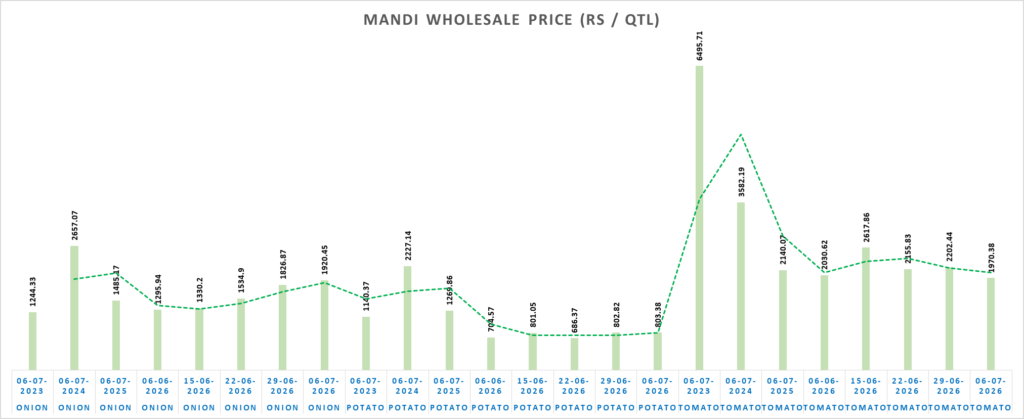
Onions have registered the strongest price appreciation among the three vegetables. Wholesale prices climbed from Rs 1,295.94 per quintal on June 6 to Rs 1,920.45 per quintal on July 6, reflecting a steep 48.2 per cent increase within a month. The rise has been consistent throughout June as prices moved from Rs 1,330.20 per quintal in mid-June to Rs 1,534.90 per quintal a week later before touching Rs 1,826.87 per quintal by the end of the month. Although prices remain below the exceptionally high levels of Rs 2,657.07 per quintal recorded in July 2024, they are now almost 29.3 per cent higher than the Rs 1,485.17 per quintal seen during the corresponding period last year. The rally reflects tightening availability of stored rabi onions at a time when fresh kharif arrivals are still weeks away, gradually tightening market supplies.
Potatoes, in contrast, continue to remain the most stable commodity among India’s major vegetables. Wholesale prices stood at Rs 803.38 per quintal on July 6 compared with Rs 704.57 per quintal a month earlier, representing a relatively modest monthly increase of around 14 per cent. Even after this recovery, potato prices remain substantially below historical levels. Compared with July 2025, prices are nearly 37 per cent lower, while they remain almost 64 per cent below the unusually elevated prices recorded during July 2024. The market has shown little volatility during June, with prices fluctuating within a narrow range despite the onset of the monsoon. Comfortable availability from cold-storage inventories and steady market arrivals continue to prevent any significant upward movement, making potatoes the least inflationary among the three vegetables.
Tomato prices have followed a different trajectory altogether. After witnessing a sharp increase to Rs 2,617.86 per quintal during the middle of June, wholesale prices have steadily moderated to Rs 1,970.38 per quintal by July 6. This represents a decline of nearly 25 per cent from the mid-June peak and around 11 per cent compared with prices prevailing a month earlier. On an annual basis, tomato prices are now about 8 per cent lower than those recorded in July 2025 and remain significantly below the extraordinary spikes experienced during the past two years. Compared with July 2024, wholesale tomato prices have declined by approximately 45 per cent, while they are nearly 70 per cent lower than the unprecedented levels of over Rs 6,495 per quintal witnessed during the supply crisis of 2023. The recent correction suggests that fresh arrivals have begun easing temporary shortages caused by heat-induced production disruptions earlier this season.
The latest market data demonstrates that each vegetable is currently being driven by a distinct supply cycle. Onion prices are strengthening because stored inventories are gradually declining before fresh kharif production enters the market. Potato prices remain subdued due to comfortable stock availability and balanced supplies, while tomato prices are correcting as new arrivals improve market availability after earlier seasonal shortages. These differing market fundamentals explain why household food inflation is increasingly becoming concentrated in specific commodities rather than broad-based across the vegetable basket.
Looking ahead, the progress and distribution of the southwest monsoon will remain the single most important factor influencing vegetable prices over the next several weeks. Any prolonged rainfall deficit or uneven precipitation could delay kharif planting and adversely affect future onion and tomato supplies, potentially reversing the recent easing in tomato prices while extending the upward trend in onions. Conversely, favourable rainfall, healthy crop conditions and uninterrupted transportation could stabilise market arrivals and moderate price volatility. For now, the latest wholesale data clearly indicates that onions are once again emerging as the primary contributor to vegetable inflation, potatoes continue to anchor affordability, and tomatoes appear to be transitioning into a more balanced price environment after a period of heightened volatility.
— Suchetana Choudhury (suchetana.choudhuri@agrospectrumindia.com)