Thursday, 2 July 2026

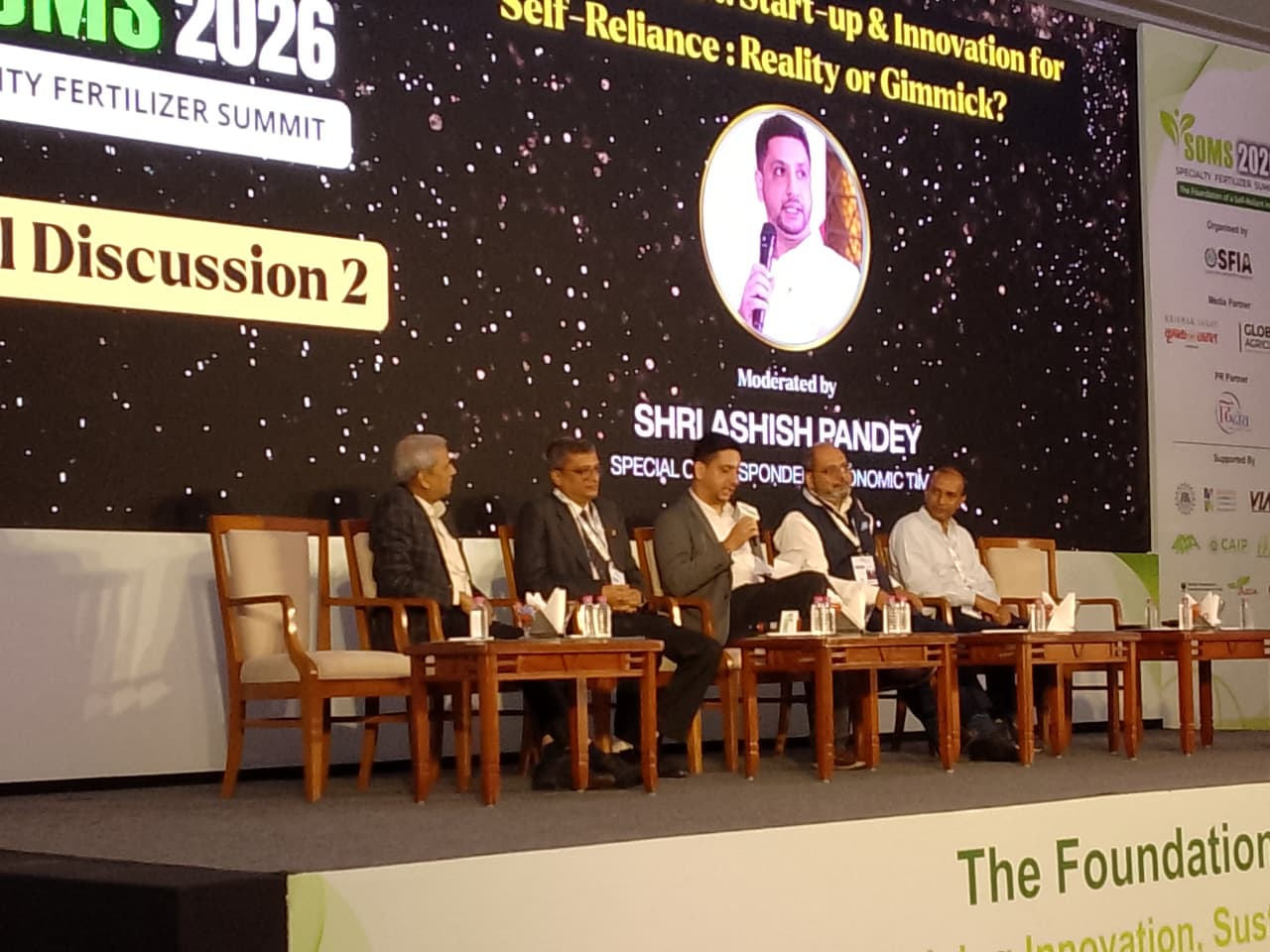
Despite championing Startup India and Atmanirbhar Bharat, India’s fertiliser innovation ecosystem remains trapped in a maze of licensing hurdles, inspector raj and policy contradictions that favour imports over indigenous technologies, industry leaders warn
India’s aspiration to become a global agricultural powerhouse rests increasingly on a difficult contradiction.
On the one hand, the country has emerged as one of the world’s largest startup ecosystems, boasting over 1.8 lakh recognised startups and positioning itself as a hub of technological innovation. Agriculture, too, has witnessed a proliferation of entrepreneurs developing solutions in precision farming, nanotechnology, microbial inputs, biostimulants and specialty fertilisers. On the other hand, the very sector that urgently requires innovation—the fertiliser and plant nutrition industry—continues to operate under a policy and regulatory framework that many entrepreneurs describe as antiquated, fragmented and deeply inhospitable to innovation.
The paradox is particularly striking because India today faces unprecedented vulnerabilities in nutrient security. The Russia-Ukraine war, disruptions in the Red Sea and increasing geopolitical tensions have exposed the country’s heavy dependence on imported fertilisers and intermediates. More than ever before, India requires indigenous technologies, domestic manufacturing capabilities and a vibrant innovation ecosystem.
Yet industry leaders warn that the existing policy framework may be doing precisely the opposite.
At a recent industry deliberation on fertiliser innovation and startup ecosystems, entrepreneurs, policymakers and industry executives painted a sobering picture of the challenges confronting India’s agri-startups. Their message was clear: unless India fundamentally reforms its regulatory architecture, it risks remaining a large market for imported technologies rather than becoming a global centre for agricultural innovation.
The Missing Government-Startup Compact
Rajib Chakraborty, President, SFIA, one of the most vocal advocates for startup reforms in the fertiliser sector, believes the relationship between government institutions and startups remains largely superficial. “The government-startup linkage has only just begun,” he said. For a country that frequently celebrates entrepreneurship and innovation, he argues, the ecosystem remains structurally skewed against young companies.
Government fertiliser companies, according to him, rarely procure products from startups. Procurement mechanisms, tender conditions and eligibility requirements are often designed in ways that effectively exclude emerging enterprises. “Government fertiliser companies do not buy from startups. The tenders are designed that way,” he said. The criticism goes beyond bureaucratic inefficiency. It points to a larger structural problem.
Innovation ecosystems thrive when governments act as early adopters and create markets for emerging technologies. In countries such as Israel, the United States and Brazil, public procurement has played a critical role in helping young companies achieve scale. In India, entrepreneurs argue that the opposite often happens. Stringent experience requirements, high turnover thresholds and lengthy validation procedures effectively shut startups out of government procurement opportunities. The result is a classic policy contradiction: the state calls for innovation while simultaneously denying innovators access to markets.
Rajib’s strongest criticism was directed at the Fertiliser Control Order (FCO), the principal regulatory framework governing the sector. “The FCO was designed to finish startups,” he remarked. While the statement may sound provocative, it reflects deep frustration within the industry. The licensing architecture under the FCO is widely regarded as one of the biggest obstacles confronting innovators. Obtaining approvals, registrations and licences often requires navigating multiple layers of bureaucracy. “Half your life gets consumed in obtaining licences,” Rajib said.
For startups, time is capital.
Every delay in obtaining approvals increases costs, discourages investment and delays market entry. Young companies with limited financial resources often struggle to survive prolonged regulatory processes. The problem becomes even more severe because many agricultural technologies require extensive field trials and validation before commercialisation. The consequence is that many promising technologies fail not because they lack scientific merit but because they are unable to survive the regulatory journey.
According to Rajib, nearly 60 per cent of the difficulties confronting fertiliser startups arise because of policy restrictions rather than technological challenges. This is perhaps the most telling indictment of the system. In other words, the principal barrier to innovation in India’s fertiliser sector is not science or entrepreneurship but regulation itself.
The Persistence of Inspector Raj
Another recurring concern among entrepreneurs is what they describe as the persistence of “inspector raj.” Inspections, discretionary powers and regulatory ambiguities create uncertainty and increase compliance burdens. The issue is particularly problematic for startups that lack dedicated compliance teams and legal resources.
For large corporations, regulatory complexity is an inconvenience. For startups, it can be existential. Entrepreneurs argue that the fertiliser industry continues to operate under a command-and-control regulatory philosophy that is increasingly incompatible with a modern innovation ecosystem. Rajib therefore called for a fundamental rethinking of the regulatory architecture, including the removal of fertilisers from the ambit of the Essential Commodities Act.
The logic is straightforward. A sector seeking innovation and entrepreneurship cannot continue to be governed by regulations originally designed for scarcity management and state control.
The Case for “One Nation, One Licence”
Among the most significant policy proposals to emerge from the discussions was the demand for a “One Nation, One Licence” regime. At present, companies often require multiple state-level approvals and registrations, creating duplication, increasing costs and slowing market access. A unified licensing framework, entrepreneurs argue, would significantly reduce transaction costs and accelerate innovation.
The proposal has broader implications. A single national licence could create a unified market for agricultural technologies, enabling startups to scale more rapidly and attract investment. It would also align with the broader objectives of ease of doing business and the creation of a national agricultural market. Rajib further argued that every state should have a dedicated mandate and budget allocation for startup creation and agricultural innovation. “Mandatory state mandates and budget allocations are needed for startup creation,” he said. The demand reflects a growing recognition that innovation ecosystems require active state support rather than passive policy declarations.
The Manufacturing Deficit
The debate repeatedly returned to an uncomfortable question. Why does India continue to import products and technologies that could potentially be manufactured domestically?
Dr Suhas Buddhe , Founder & CEO, NaturExchange believes the answer lies in the absence of supportive industrial policies. He called for subsidy support specifically targeted at startups and stronger incentives for indigenous manufacturing. “There is no incentivisation for manufacturing in India,” he said. The issue assumes particular significance because agriculture and fertilisers are increasingly becoming strategic sectors.
The disruptions caused by the Russia-Ukraine conflict demonstrated that overdependence on global supply chains can create serious vulnerabilities. Dr. Buddhe pointed to China as an example. China’s transition towards coal gasification technologies insulated it from many of the shocks that affected global fertiliser markets. “China shifted to coal gasification and therefore was not affected in the same way by the war,” he observed.
The lesson for India is significant. Countries that invest in technological self-reliance are better positioned to withstand global disruptions. India’s vulnerabilities are particularly acute in phosphatic fertilisers. “There are no mines to produce phosphorus. What is the alternative?” Buddhe asked. The question strikes at the heart of India’s nutrient security challenge. The answer, according to many experts, lies in innovation—developing alternative nutrient technologies, biological solutions and resource-efficient production systems.
The Financing Challenge
Even where technologies exist, financing remains a major obstacle. “Risk capital is not coming to agri-startups,” Buddhe said. Agricultural technologies differ fundamentally from digital startups. They require longer development cycles, extensive field trials and greater scientific validation. Returns are often delayed and risks are perceived to be higher. As result, many investors remain reluctant to commit capital.
The consequence is a severe financing gap. Many promising agricultural startups struggle to move from pilot projects to commercial scale. Without targeted financial support and dedicated funding mechanisms, India risks losing an entire generation of agricultural entrepreneurs.
The Valley of Death
Manohar Malani, Founder , Mitrasena, highlighted another structural problem. “The government wants proven innovation,” he said. This seemingly reasonable requirement often becomes an impediment to scaling. Innovations cannot become “proven” without being adopted at scale. But they cannot achieve scale unless governments and markets are willing to take calculated risks.
The result is what entrepreneurs call the “valley of death”—the stage between innovation and commercial adoption where many startups fail. This problem is particularly severe in agriculture because farmers and institutions are naturally risk-averse. Consequently, many potentially transformative technologies remain confined to laboratories and pilot projects.
The Distribution Monopoly
Mahesh Damodare, Director, Dhanashree Crop Solutions Pvt. Ltd, identified another major challenge—the dominance of large companies over distribution channels. “Large companies have a huge hold on distribution channels,” he said. In agriculture, market access is often more important than technological capability. Even the most innovative products struggle if they cannot reach farmers.
Established companies enjoy extensive dealer networks, marketing resources and brand recognition. Startups, by contrast, often lack access to distribution infrastructure. This creates a structural disadvantage that makes scaling exceptionally difficult. According to Damodare, dedicated startup policies in the fertiliser sector remain largely absent. The prevailing mindset, he argues, continues to favour imports over domestic manufacturing. “There is a mentality that if importing is easy, why manufacture in India?” he said.
The China Dependence
Nowhere is this dependence more visible than in water-soluble fertilisers. “Sixty-five per cent of water-soluble fertilisers are imported from China. It is a sorry state of affairs,” Damodare remarked. The figure is particularly striking because water-soluble fertilisers are among the fastest-growing segments of Indian agriculture and are increasingly critical for precision farming and horticulture. The dependence on imports exposes India to exchange-rate risks, supply disruptions and geopolitical uncertainties. It also represents a lost opportunity for domestic manufacturing and employment generation. For a country advocating Atmanirbhar Bharat, such dependence raises fundamental questions about industrial strategy.
Innovation as National Security
Damodare believes the future of agriculture lies in technologies that improve resource efficiency. “Nanotechnology can help achieve more crop per drop,” he said. The phrase captures the central challenge facing Indian agriculture. The future will depend not on consuming more inputs but on producing more output from fewer resources. Technologies that improve nutrient-use efficiency and water-use efficiency will become increasingly valuable as climate stress intensifies. However, innovation requires incentives. “If the government can provide incentives for innovation, Indian companies can create world-class technologies,” Damodare said.
A Strategic Imperative
The debate around fertiliser startups is ultimately about far more than entrepreneurship. It concerns the future of India’s food security.
Can the country continue to rely on imported technologies and specialty nutrients?
Can it build resilient domestic manufacturing capabilities?
Can it create an ecosystem in which innovation can move rapidly from laboratory to market?
Can it reduce external vulnerabilities while improving agricultural productivity?
The answers to these questions will determine whether India becomes a global leader in agricultural innovation or remains a large consumer market for technologies developed elsewhere.
As geopolitical disruptions become more frequent and climate uncertainty intensifies, innovation itself may become one of India’s most important strategic assets. Yet innovation cannot thrive in an ecosystem characterised by fragmented licensing, inspector raj, limited market access and policy uncertainty. The message from industry leaders is therefore unambiguous.
If India genuinely seeks self-reliance in agriculture, it must move beyond slogans and fundamentally redesign its fertiliser innovation ecosystem. In the coming decades, the real competition in agriculture may not be over who consumes the most fertiliser. It may be over who develops the technologies that enable farmers to produce more with less. Unless India creates space for its startups to survive and scale, the country risks remaining not an innovation superpower, but a permanent importer of agricultural technologies conceived and manufactured elsewhere.
— Suchetana Choudhury (suchetana.choudhuri@agrospectrumindia.com)