Saturday, 11 July 2026

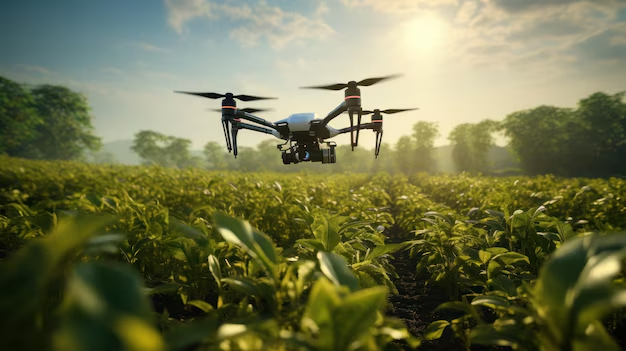
In an exclusive AgroSpectrum interview, Simon Henry outlines how aerial intelligence is cutting inputs, boosting yields, and driving ESG outcomes

Simon Henry, Vice President of Business Development – EMEA / Ireland at ZenaTech, outlines how precision agriculture is rapidly shifting from a niche innovation to a necessity across EMEA, driven by regulatory pressure, rising costs, and climate volatility. He emphasizes that ZenaTech’s Drone-as-a-Service model is breaking down cost and complexity barriers, making advanced aerial intelligence accessible to farms of all sizes. The company is tackling one of the sector’s biggest challenges—turning complex data into actionable insights—by embedding AI-driven analytics that deliver real-time, field-level decisions.
Henry highlights how drone-led automation can significantly cut input waste, improve water efficiency, and boost profitability while aligning with sustainability and ESG goals. Looking ahead, he envisions a digitally integrated farming ecosystem powered by AI, predictive analytics, and emerging technologies, positioning drones as a critical support system rather than a replacement for farmers.
Precision Agriculture at Scale
ZenaTech’s drone solutions enable plant health monitoring, crop mapping, and early stress detection using multispectral imaging. How do you see precision agriculture evolving from a niche technology to a mainstream farming necessity across EMEA markets?
In the EMEA region, precision agriculture is already considered a structural necessity, rather than a luxury, in many regions. This has been driven by increasingly rigorous EU mandates, rising input costs, and fluctuating supply markets. The reason this may not be illustrated in practice is because mainstream adoption has been hindered by the high cost of entry and technical complexity required by many solutions currently on the market.
ZenaTech is bridging this gap through our Drone as a Service (DaaS) model. By building precision agriculture as a scalable utility, we enable farmers to meet strict targets and maximise their inputs without the burden of hardware ownership. As climate volatility increases, our real-time multispectral insights will provide the essential resilience needed to transform localized data into a universal standard for sustainable, high-yield farming. Harnessing this resilience will become crucial to safeguarding yields throughout the coming decades, as farms of all sizes and specialisms worldwide grapple with intensifying climate volatility.
From Data to Decisions
Your platforms generate high-resolution, real-time agricultural data. What are the biggest barriers farmers face in translating this data into actionable decisions, and how is ZenaTech addressing this gap?
For most farmers, the primary barrier is the challenge of translating complex multispectral maps into practical field-level actions. Most platforms provide data that requires manual interpretation, creating a technical gap that stalls decision-making and in doing so, lessens impact. ZenaTech is focused on addressing this by integrating AI-powered analytics directly into our ZenaDrone ecosystem.
Our software processes raw data into prescription maps that identify specific issues like nitrogen deficiency or pest outbreaks in real-time, cutting out the middleman entirely. By providing actionable insights and ensuring our software platform integrates with existing farm management systems, we turn aerial intelligence into a practical tool for increasing crop yields and operational efficiency. This allows farmers to make better, faster decisions with confidence, based on our data-based insights.
Drone-as-a-Service (DaaS) vs Ownership Models
ZenaTech’s DaaS model removes the need for upfront drone investment. How disruptive is this model for traditional agri-tech adoption, especially among small and mid-sized farms?
DaaS model is cutting-edge in innovating legacy and low-tech processes. Historically, precision agriculture required six-figure investments in hardware, specialized pilot training, and complex regulatory compliance. As a result, the largest industrial farms could avail of this technology. By removing the capital expenditure wall and supporting users with a skilled DaaS consultant who provides in-person setup and ongoing customer support tailored to clients’ needs, we have democratized access through our drone technology.
Small and mid-sized farmers can now access advanced multispectral imaging and precision spraying through a manageable, predictable operational expense. We also manage the technical overhead, including AI data processing and flight certifications, to ensure farmers are provided with actionable insights without the need for deep technical knowledge on their end. This pay-per-use flexibility ensures that cutting-edge aerial intelligence is no longer a luxury but an accessible tool for increasing profit and enhancing sustainability across the entire agricultural spectrum.
AI, Automation & Farm Economics
With AI-driven plant counting, disease detection, and yield optimization, how significantly can drone-led automation reduce input costs and improve farm profitability in real terms?
Crucially, our drone technology has the capacity to eliminate the need to “blanket spray” fertilizer, which is a traditional approach that wastes a substantial amount of chemical input for the average farmer annually, while also stifling their ability to meet key sustainable targets. Instead, our multispectral drone imaging enables precise, variable-rate application, reducing fertilizer and pesticide costs. By moving operations to the air, we also have the capacity to eliminate soil compaction caused by heavy machinery, which can improve yields significantly.
Meanwhile, our disease and pest detection software helps to mitigate unforeseen risks, ensuring farmers can maximise yield from their inputs. Ultimately, Zenatech’s Drone as a Service model replaces high-risk investments with a “pay-per-use” service that slashes labour, input waste, and mitigates profit lost through avoidable risks, ensuring precision agriculture is the most profitable path for any modern farm.
Water & Climate Intelligence
Given increasing climate stress and water scarcity, how can drone-based 3D mapping and irrigation analytics reshape water-use efficiency in agriculture?
We tackle this in a similar way to how we effectively manage fertilizer use; through the insights provided by our drone-based 3D mapping, we replace broad irrigation tactics with 3D-driven precision irrigation. Through our ZenaDrone technology, we create high-resolution topographic maps that reveal exactly how water moves across a field, identifying drainage issues and high-risk drought zones.
Complementing this, our multispectral and thermal sensors detect crop water stress in real time, allowing for localized, variable-rate irrigation. By targeting only the areas in need, farmers can significantly reduce water (and energy waste) while maintaining optimal plant hydration. Through our DaaS model, this high-level irrigation intelligence becomes an affordable necessity for every kind of farm navigating the challenges of global water scarcity.
Integration with Broader Agri-Tech Ecosystems
How does ZenaTech envision integrating drone data with farm management systems, satellite analytics, and IoT platforms to create a unified “digital farm” ecosystem?
In ZenaTech’s vision for a unified “digital farm” ecosystem, ZenaDrone serves as the primary engine for real-time intelligence. We integrate aerial data with IoT ground sensors and satellite analytics via our Enterprise SaaS platform, creating a single source of truth for farmers to refer to.
By using open APIs, our AI-driven insights flow directly into existing farm management systems and smart machinery, enabling automated, variable-rate applications. This seamless integration (supported by our upcoming quantum-enhanced processing) transforms fragmented data points into a cohesive, predictive toolset, allowing farmers to optimize every acre with unprecedented speed and precision.
Regulatory & Airspace Challenges in EMEA
Drone deployment in agriculture is often constrained by regulatory frameworks. What are the key policy bottlenecks across Europe, the Middle East, and Africa, and how can they be streamlined to unlock scale?
As with any set of tech-focused regulatory frameworks, this is an ongoing conversation across many jurisdictions. Specifically, governments around the world have placed a focus on developing regulatory frameworks for the new world of drones for a number of years already, with the aim of opening airspace to enable businesses to use this technology.
The good news is that ZenaTech’s DaaS model is specifically designed to manage these considerations on behalf of the end-user. Rather than forcing farmers to carry the regulatory burden, we can offer Drone as a Service as an end-to-end solution, controlling all aspects of the drone analytics process from hardware, software, and AI-driven analytics to operational flight services. This gives farmers peace of mind that the regulatory aspect of our operation is compliant within the areas we service.
Sustainability & ESG Alignment
With increasing focus on carbon footprint and sustainable farming, how can drone-enabled agriculture contribute to measurable ESG outcomes for farmers, agribusinesses, and investors?
On the environmental side, our ZenaDrone technology enables a significant reduction in chemical inputs through precision variable-rate spraying, which directly lowers nitrous oxide emissions and prevents nitrogen run-off. By replacing heavy, diesel-burning tractors with autonomous aerial systems, we also eliminate soil compaction, which restores soil health and improves carbon sequestration, while reducing the farm’s overall footprint.
From a monitoring and governance perspective, our integrated Enterprise SaaS platform provides an automated, immutable audit trail for every field action. This high-level transparency provides the comprehensive proof required for agribusinesses to validate sustainable practices, comply with the EU Green Deal, and secure green financing from ESG-focused investors.
The Future: Autonomous Farming Systems
Looking ahead to 2030, do you see agriculture moving toward fully autonomous, drone-led farm management systems? What role will AI, predictive analytics, and possibly quantum computing play in that transition?
Our Drone-as-a-Service model is not engineered to realize a fully autonomous, drone-led farm management system but to permanently alleviate the time, environmental, and safety burdens associated with traditional management systems from farmers, while boosting their confidence to make more informed strategic decisions. We recognize the many plates that the modern farmer has to spin, from business strategy to supply chain management to everyday risk management and execution.
We want to position ourselves as supporting staff, easing the day-to-day burden for farmers by providing them with detailed, actionable insights, specific to their operation, thereby enhancing their decision-making, without requiring extra elbow work. By 2030, we want to be facilitating as many farmers as possible to leverage the benefits of AI, predictive analytics, and quantum computing in their everyday practice to enhance sustainability, mitigate risk, reduce costs, and increase yield, while lessening their workload.
— Suchetana Choudhury (suchetana.choudhuri@agrospectrumindia.com)