Thursday, 2 July 2026

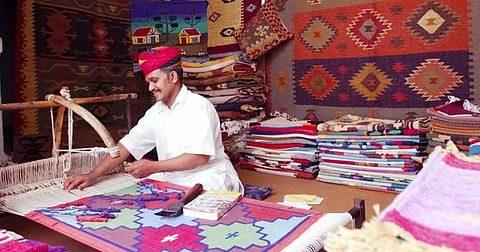
Expands the scope of agricultural growth beyond the farm gate with the launch of the Mahatma Gandhi Gram Swaraj Initiative, a comprehensive programme aimed at strengthening khadi, handloom and handicraft sectors through improved market access, branding, skill development and production quality
Positioned at the intersection of agriculture, rural livelihoods and cultural industries, the initiative recognises that a significant share of non-farm rural income is closely tied to agricultural cycles, raw material supply chains and seasonal employment patterns. By upgrading village industries, the Budget seeks to stabilise rural incomes and reduce pressure on agricultural land while enhancing overall productivity.
Linking Agriculture and Rural Value Chains
Khadi, handloom and handicraft sectors are deeply interwoven with agriculture through cotton, wool, silk, jute and other natural fibres. The Gram Swaraj Initiative aims to strengthen these linkages by improving quality standards, design capabilities and supply-chain integration, allowing farmers and artisans to capture greater value from primary production.
By expanding global market access and creating a coherent branding framework, the initiative seeks to move village industries away from fragmented, low-margin sales toward organised domestic and export markets. This shift is expected to improve price realisation for both cultivators and artisans, particularly in ODOP clusters where agricultural produce and traditional crafts are closely aligned.
Skills, Youth and Quality Upgradation
A central pillar of the initiative is investment in training and skilling, with a focus on rural youth. By upgrading production techniques, quality control and design capabilities, the programme aims to make farm-linked rural industries more competitive while creating alternative employment opportunities beyond agriculture.
This approach supports a broader Budget 2026 objective: enhancing rural purchasing power without relying solely on farm income growth. Diversified livelihoods reduce income volatility caused by weather shocks and price fluctuations, contributing to more resilient rural economies.
ODOP and Cluster-Based Growth
The initiative complements the One District One Product (ODOP) framework by strengthening cluster-based development. By aligning branding, skilling and market access within ODOP districts, the Budget seeks to deepen local specialisation while avoiding duplication of efforts across schemes.
For agriculture, this reinforces a value-chain perspective—where primary produce, processing and artisanal activity coexist within the same regional ecosystem.
A Broader Rural Growth Strategy
The Mahatma Gandhi Gram Swaraj Initiative reflects Budget 2026’s broader strategy of integrating agriculture with allied and non-farm rural sectors. Rather than treating crafts and village industries as welfare activities, the Budget positions them as productivity-enhancing complements to agriculture—capable of generating employment, preserving traditional skills and expanding India’s cultural exports.
In doing so, Budget 2026 underscores a key policy shift: sustainable agricultural growth increasingly depends on the strength of the rural economy around it. Strengthening village industries is thus not an adjunct to farm policy, but a necessary extension of it.
— Suchetana Choudhury (suchetana.choudhuri@agrospectrumindia.com)