Wednesday, 1 July 2026

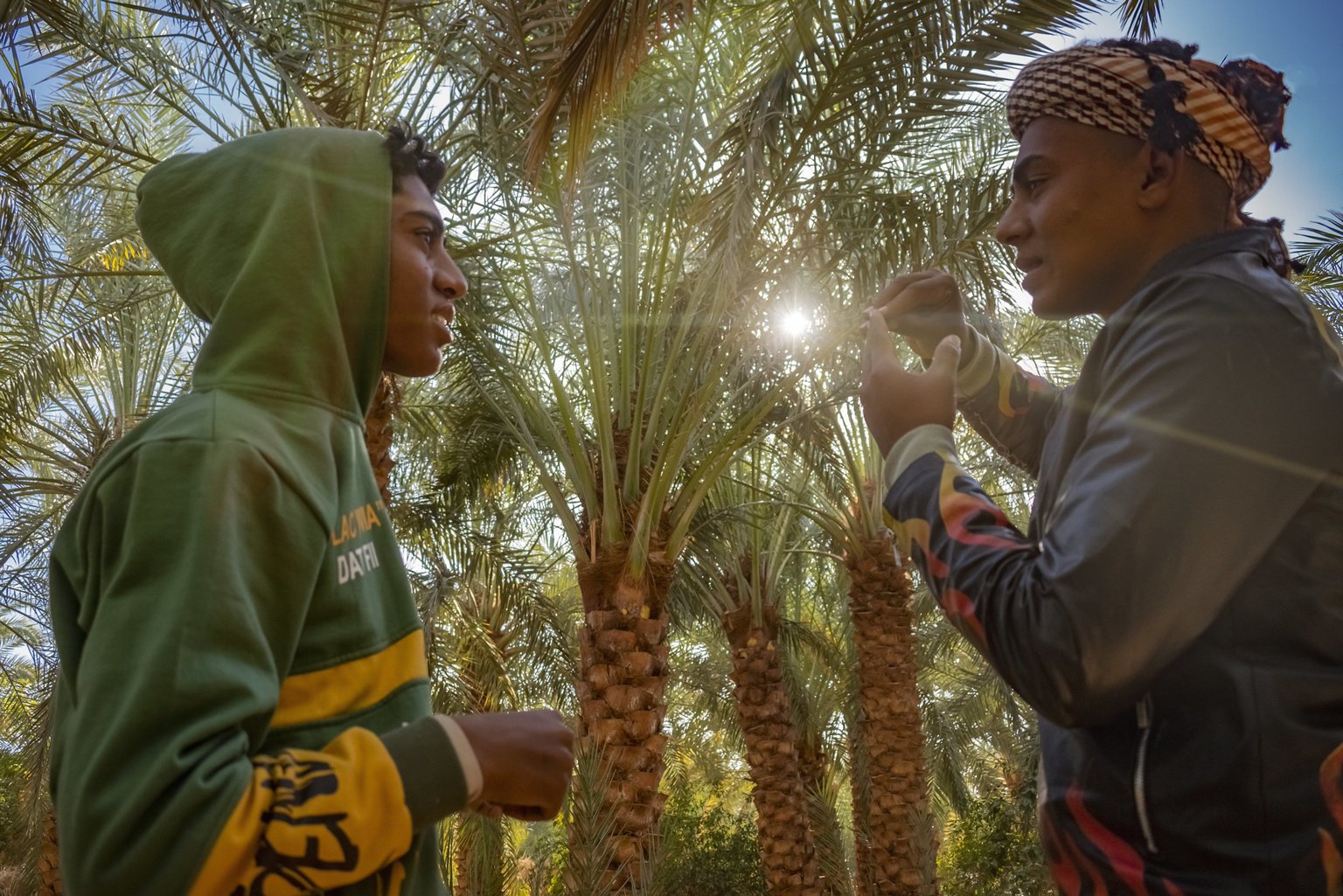
Image Source: FAO/Ahmed Elshemy
Adapted Farmer Field Schools in Egypt help deaf farmers access agricultural knowledge and improve yields
In the Kharga Oasis, a crescent of green carved into Egypt’s western desert, the afternoon heat settles over rows of date palms like a blanket. Fifteen farmers gather in the shade, but there are no shouted greetings or casual banter. Hands move through the air in quick, precise gestures—a conversation unfolding in complete silence.
This is the “Sound of Silence” Farmer Field School, funded by the Global Environment Facility (GEF), where deaf and speech-impaired farmers have transformed what was once a barrier into a source of collective strength, becoming some of the most skilled date growers in Egypt’s New Valley Governorate.
Date palm cultivation is the backbone of life in Kharga. In recent years, however, cultivation has been mired by water scarcity, rising numbers of pests and the spread of the red palm weevil. For farmers with hearing and speech impairments, the challenges were compounded. Conventional agricultural trainings relied on spoken instruction, leaving them largely excluded from technical knowledge, early-warning systems and pest-management guidance.
Khaled Mohamed has worked this land for decades, reading soil and seasons with practiced ease. But for years, the most critical information, such as how to identify early signs of infestation, how to improve soil health and how to seal pruning wounds to prevent pest colonization, remained out of reach.
“For the first time,” Mohamed signed, with interpretation support from his wife, Nehmedo Riad AbdelHamied, “I felt truly seen and heard, even without speaking.”
The idea for the school began in 2021, when Mohamed attended a conventional Farmer Field School session by the Food and Agriculture Organization of the United Nations (FAO) and sat quietly at the back, studying photographs and videos with visible intensity. He owned a date palm grove. He needed solutions but lacked access to this knowledge.
With Nehmedo’s support and encouragement, he approached FAO with a simple proposal: adapt the Farmer Field School model so that deaf farmers could participate fully. FAO agribusiness and programme development specialist, Ahmed Diab, immediately recognized the significance of the request.
“Real inclusion means rethinking how we teach, not who we teach,” he states. Working alongside the community, FAO adapted its discovery-based Farmer Field School approach—already built around peer learning and experimentation—into a format accessible to producers with hearing and speech impairments.
The resulting “Sound of Silence” Farmer Field School brought together 15 deaf farmers in a learning environment shaped by their needs. Nehmedo served as a central communication bridge, translating technical concepts into sign language and facilitating dialogue between farmers and facilitators. Lectures were replaced with visual tools: illustrated guides, diagrams drawn collectively on the ground and silent video demonstrations showing compost application, systematic pest monitoring and early detection of red palm weevil infestation. Learning unfolded through observation, repetition and shared experimentation rather than spoken instruction.
Over the course of the full Farmer Field School cycle, participants tested improved agronomic and integrated pest-management practices directly in their groves. They introduced compost to enhance soil health and nutrient availability, adopted routine monitoring to identify infestations early and applied protective sealing materials to pruning wounds to block insect entry points.
The results were measurable. Farmers reported an average 20 percent increase in date yields, alongside noticeable improvements in fruit quality, including size uniformity and sweetness—gains that translated into higher market prices and increased household income.
Equally significant has been the shift in social perception. Once regarded primarily as beneficiaries of assistance, the deaf farmers are now recognized as knowledgeable practitioners. Mohamed Abdel Aziz, one of the participants, has begun teaching deaf neighbours how to identify pest damage and protect their trees. “The pictures and signs helped me understand everything clearly,” he explained. “Now I teach my neighbours too.”
The model’s simplicity is part of its power. The estimated cost of running an inclusive Farmer Field School group in Egypt is approximately $ 1 000—covering facilitation, learning materials and logistics. That low-cost, high-impact design has drawn attention beyond Kharga.
During FAO’s 2024 Science and Innovation Forum, the initiative was selected as a laureate of the first ever FAO Innovation Award for Farmer Field Schools. FAO’s office in Egypt has already supported replication in the Minya Governorate, with further scaling under review through ongoing and pipeline projects.
Beyond its impact on individual farmers, the “Sound of Silence” initiative is part of FAO’s commitment to “Leave No One Behind.” By ensuring that people with disabilities are not only included but actively contributing to local value chains, the programme demonstrates how inclusive approaches can unlock untapped potential and strengthen rural economies. Its replication across the country shows that the model is scalable, sustainable and relevant across different contexts. What began as a localized response has become a national example of how innovation, dignity and opportunity can grow together.
As dusk falls over the oasis, the farmers disperse, hands still moving in conversation. In Kharga, silence no longer signals exclusion. It marks a different kind of dialogue: one rooted in trust, shared knowledge and a landscape where voices, though unspoken, are now heard.
To read more, click: https://www.fao.org/newsroom/story/silent-lessons-speak-the-loudest/en