Sunday, 12 July 2026

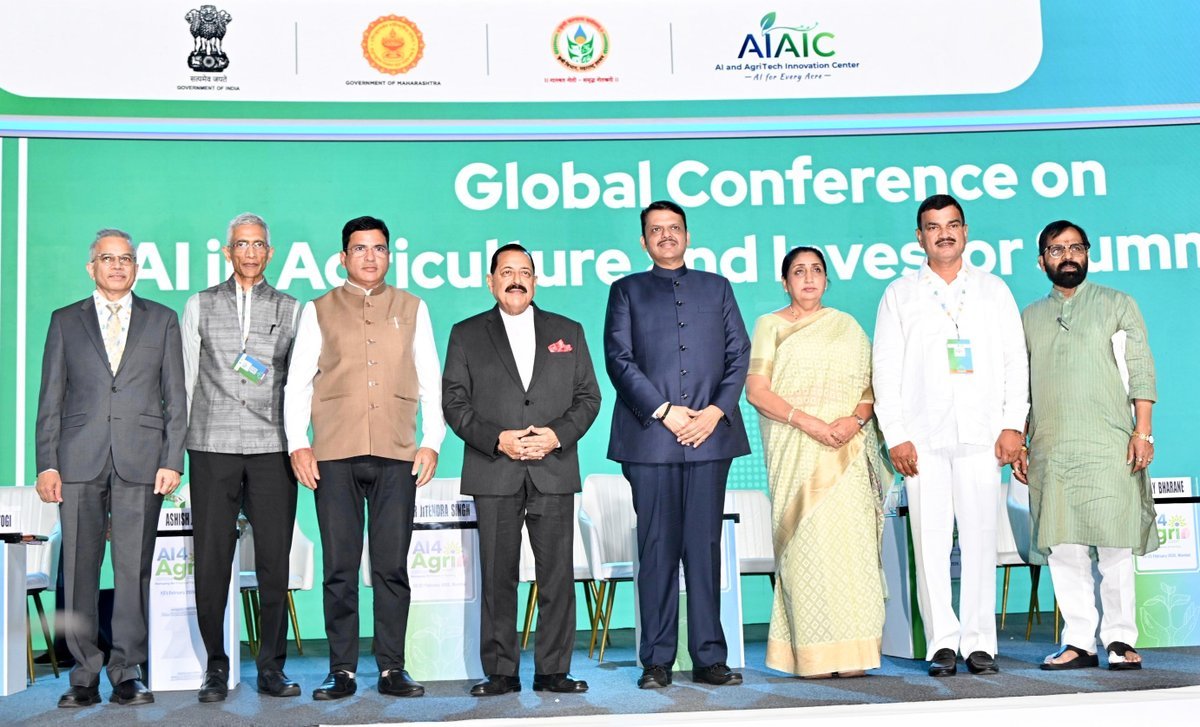
Maharashtra advances integrated AI platforms serving millions of farmers
A defining question echoed across AI4Agri2026: How many pilots will become platforms, and how many MoUs will be visible in the market?
The insight, articulated by Dr. Jitendra Singh – Union Minister of State (Independent Charge) for Science & Technology, Government of India, captured the spirit of the summit — moving from experimentation to execution, from announcements to adoption, and from innovation to income impact.
AI4Agri2026 brought together national and state leaders to position Maharashtra at the forefront of scalable Artificial Intelligence in agriculture, grounded in measurable outcomes for farmers and the economy.
Technology Rooted in MANAV: Tradition Meets Innovation
Dr. Jitendra Singh highlighted that India’s technological advancement is guided by the philosophy of “MANAV,” articulated by Prime Minister Narendra Modi — integrating modern science with traditional knowledge systems.
He noted that the global food industry stands at a critical juncture, requiring optimized resource use, improved disaster preparedness, enhanced meteorological forecasting and predictive crop performance systems. Initiatives such as Agri Param, launched on 19 February, and Mission Mausam are designed to build a climate-resilient agricultural economy supported by early-warning intelligence and weather analytics.
He emphasized that drone technology, genetically engineered drought-tolerant crops, early disease detection in rapeseed mustard and smart irrigation systems are redefining the agricultural landscape. With Bharat Vistaar (Virtually Integrated System to Access Agri Resources) introduced in Budget 2026–27 and a Rs 10,000 crore deep-tech startup fund announced by the Prime Minister, India is laying the foundation for scalable agri-tech innovation.
“If AI can save Rs 5,000 per farmer per year, it could generate Rs 17,000 crore annually for the economy,” he observed, underlining that economic impact — not announcements — will define success.
Traditional Knowledge and AI: The Maharashtra Model
Dattatreya Bharne – Agriculture Minister, Government of Maharashtra stressed that the convergence of farmers’ traditional knowledge with AI will shape the future of Maharashtra’s agricultural ecosystem.
He noted that the MahaVISTAAR app, which answers farmer queries in local languages, has already reached 2.5 million farmers across the state. AI, he said, must strengthen food security and combat climate stress while being designed for grassroots accessibility. Technologies that consume less internet bandwidth and deliver reliable outputs will ensure penetration into remote and low-connectivity regions.
The emphasis is clear: innovation must reach the smallest farmer in the remotest village.
Scaling MahaVISTAAR and the Bhil Language AI Model
Vikas Rastogi – Principal Secretary, Agriculture, Government of Maharashtra highlighted that MahaVISTAAR has expanded to serve over 3 million farmers, demonstrating Maharashtra’s capacity to scale AI-based advisory systems statewide.
During AI4Agri2026, the state unveiled a specialized Bhil language AI model, reinforcing its commitment to linguistic inclusion and tribal outreach. Maharashtra aims to identify seven to eight high-impact AI use cases and build a structured, scalable deployment model around them, ensuring coherence rather than fragmentation.
A Blueprint for Systemic Transformation
Suraj Mandhare – Agriculture Commissioner, Government of Maharashtra described AI4Agri2026 as the beginning of a comprehensive restructuring of Maharashtra’s agricultural ecosystem. Under the leadership of Chief Minister Devendra Fadnavis, he stated, the state has found its compass toward sustainable productivity.
The blueprint includes predictive crop intelligence, climate resilience systems, data-driven governance and inclusive digital advisory platforms — designed not as isolated initiatives but as an integrated transformation strategy.
From MoUs to Market Impact
AI4Agri2026 reinforced a shared understanding among leaders: the future of agricultural AI will not be measured by the number of pilots launched, but by the number of platforms scaled and the visibility of outcomes in farmers’ fields and markets.
By aligning traditional knowledge with advanced analytics, strengthening climate resilience, and ensuring last-mile accessibility, Maharashtra is positioning itself as a living laboratory for agricultural AI — where innovation translates into income, resilience and food security.
The challenge ahead is clear — to convert intent into infrastructure, pilots into platforms, and technology into tangible prosperity for millions of farmers.
— Suchetana Choudhury (suchetana.choudhuri@agrospectrumindia.com)