Friday, 17 July 2026

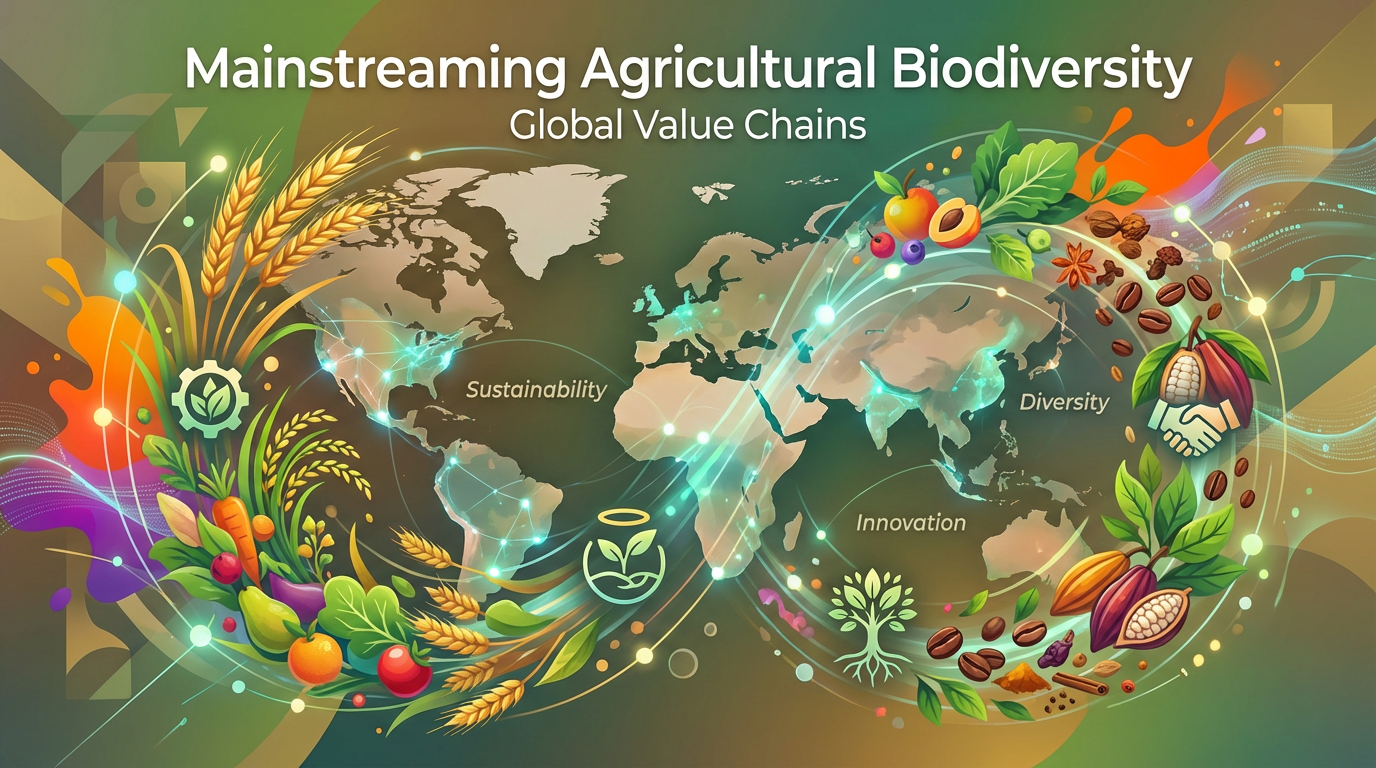
Why landraces, orphan crops, and genetic diversity must become the core of climate adaptation and next-gen food markets
For decades, the global food system has been built on a narrow band of crops—an efficiency-driven architecture that made sense in the era of cheap inputs, stable seasons, and predictable trade flows. Today, that system is cracking. Climate volatility, water constraints, yield plateaus, soil degradation, and rising fertilizer and energy prices are exposing the fragility of monoculture-dominated value chains. Yet, even as policymakers and corporations talk about resilience, a central variable often remains absent from the conversation: agricultural biodiversity.
The urgency is unmistakable. The FAO estimates that over 75 per cent of global crop diversity has vanished since the early 1900s, replaced by high-yield uniform varieties that dominate global acreage. Three crops—rice, wheat, and maize—account for nearly 60 per cent of global caloric intake. This hyper-concentration may have unlocked scale, but it has also left farmers, supply chains, and consumers extraordinarily vulnerable. With each degree of warming, climate models show that global yields for rice, wheat, and maize could fall by 6–10 per cent , hitting both food security and economic stability.
Against this backdrop, landraces, wild relatives, and so-called “orphan crops” are experiencing a quiet revival. These genetically diverse species—millets, teff, yam, taro, pigeon pea, cowpea, indigenous rice varieties, and dozens more—offer biological attributes modern hybrids often lack: heat tolerance, drought resilience, pest resistance, nutrient density, and lower input requirements. They represent not the past of agriculture, but its future.
Yet they remain undervalued in global markets, underfunded in research, and underutilized in supply chains. The challenge now is not merely to recognize biodiversity’s strategic importance, but to mainstream it into global value chains through pricing incentives, procurement pathways, traceability tools, and corporate sustainability frameworks that reward—rather than penalize—crop diversity.
Landraces and Orphan Crops: A Climate Strategy Hidden in Plain Sight
Across geographies—from the Sahel and the Mekong Basin to the Deccan Plateau and the Andean highlands—scientific evidence is converging on one point: agricultural diversity is no longer a conservation ideal; it is an economic and climate-risk hedge. In a decade marked by extreme weather volatility, input price shocks, and widening micronutrient deficiencies, landraces and orphan crops are emerging not as niche alternatives but as strategic assets. Yet they remain systematically undervalued in both research pipelines and global commodity markets.
Consider millets. Once dismissed as “poor man’s food,” they have re-entered the global discourse because the data is irrefutable. Most millet varieties are up to 50 per cent more drought-resilient than major cereals, capable of yielding under 300–400 mm rainfall where rice and wheat would collapse. Nutritionally, finger millet contains three times more iron and nearly twice the calcium of polished rice—precisely the minerals at the heart of India’s and Africa’s persistent anaemia crises. Little surprise, then, that global millet-based foods—from granola and gluten-free flours to energy bars—are growing at a 12–14 per cent CAGR, driven by wellness-oriented consumers in the U.S., EU, Japan, and South Korea.
Teff, Ethiopia’s ancient grain, mirrors this trajectory. High in lysine—a limiting amino acid absent in wheat and maize—teff’s unique profile has unlocked demand from athletes, keto consumers, and specialty bakers worldwide. Over the past decade, Ethiopia’s teff exports have increased nearly fivefold, despite strict domestic controls designed to prevent food security risks. Its climatic profile is equally compelling: teff thrives in altitudes from 1,800–3,000 metres, tolerates waterlogging as well as drought, and remains stable across temperature swings that destabilise wheat. As global supply chains search for climate-proof raw materials, teff is rapidly repositioning itself as a premium ancient grain with modern utility.
Legume landraces offer another layer of strategic value—this time through ecosystem services. Pigeon pea and cowpea, cultivated for centuries in semi-arid regions of Africa and South Asia, fix atmospheric nitrogen through symbiotic rhizobia. Field studies show they can replace between 30–80 kg of synthetic nitrogen per hectare, reducing fertiliser dependency by up to 25–40 per cent—an invaluable buffer when global fertiliser markets remain vulnerable to geopolitical volatility, Russia-Ukraine tensions, and phosphate export restrictions. Beyond nutrient fixation, these crops improve soil organic carbon, breaking monoculture fatigue while providing protein-dense food for rural households.
Sorghum—perhaps the most under-leveraged climate crop—demonstrates why landraces are crucial for the climate of 2050. Capable of withstanding temperatures above 40–45°C, sorghum remains productive where maize and soybean yields crash. Its C4 photosynthetic efficiency gives it an edge under high heat and water stress, making it a rare cereal naturally aligned with the IPCC’s projected climate scenarios. For beverage makers, sorghum is already a gluten-free alternative; for sustainable packaging innovators, its cellulose-rich stalks are a feedstock for bioplastics. The economic case is growing far beyond food.
Yet, despite this biological and economic promise, less than 1 per cent of global public and private crop R&D budgets go to orphan crops. CGIAR data suggests that over 80 per cent of breeding investment is still concentrated in five major staples—rice, wheat, maize, soy, and potato—even though these species are increasingly vulnerable to climate stress, pests, and market concentration. The funding imbalance reflects a market failure, not agronomic logic. Orphan crops are under-researched not because they lack potential, but because they lack visibility in global trade structures and corporate supply chains.
This asymmetry comes at a cost. Countries lose genetic diversity that could buffer climate shocks. Corporates lose access to resilient, low-input raw materials that could stabilise margins. Consumers lose affordable, nutrient-dense foods that could reduce dependence on supplements. And farmers lose crops adapted to their terrain, replaced by input-heavy seeds that expose them to price volatility and climate risks.
Correcting this course requires more than romanticising ancient grains—it requires rewiring incentives. That means targeted R&D funding, climate-linked procurement models, guaranteed buy-backs for landrace cultivation, and premiumisation pathways that reward nutrient density and resilience. Simply put: a future-proof food system demands redistributing scientific attention toward the species most equipped to survive climate chaos, rather than doubling down on the fragile giants of the Green Revolution.
Why Global Value Chains Fail Biodiversity
If biodiversity is so central to climate resilience, nutrition security, and input reduction, why is it almost entirely absent from global value chains? The answer lies not in the biology of crops, but in the architecture of markets. The modern food system was engineered for scale, uniformity, and efficiency—values that directly conflict with the inherent heterogeneity of landraces and indigenous species. As a result, biodiversity remains locked in subsistence or niche systems instead of moving into mainstream agri-trade.
The first constraint is procurement design. Over decades, global agribusiness procurement evolved to prize predictability: the same grain size, the same starch profile, the same moisture level, the same colour uniformity. These narrow specification sheets allow processors to automate operations, reduce losses, and manage logistics with industrial precision. The unintended consequence is that landraces—which express natural genetic variability—fall outside these technical standards. A single field of traditional sorghum or millet often contains dozens of micro-adapted lines, each varying slightly in grain characteristics. This diversity is an ecological asset but a commercial liability. Processors therefore over-invest in a handful of hyper-standardised hybrids, while farmers cultivating diverse varieties risk rejection, lower prices, or complete exclusion from formal procurement channels. In effect, the system rewards sameness, even though sameness is exactly what makes global agriculture vulnerable to pests, droughts, and geopolitical shocks.
A second structural failure stems from weak price discovery. Climate-resilient crops like fonio, Bambara groundnut, landrace sorghums, and traditional millets often lack liquid markets, formal exchanges, quality grades, or MSP-like price floors. Without institutional visibility, farmers opt for wheat, rice, and maize—crops with assured buyers, predictable support systems, and longstanding procurement architectures. Banks prefer lending for input packages tied to major commodities, not biodiverse crops whose pricing is opaque and whose demand remains fragmented. This mismatch persists even when indigenous crops generate higher margins per unit of water or fertilizer. In Ethiopia, for instance, teff landraces can outperform wheat during drought years, yet wheat still attracts more than ten times the credit, subsidy, and state procurement attention. In such markets, the superior agronomy of orphan crops is overshadowed by the inferior economics of their trading systems.
The third bottleneck arises from certification frameworks that were never designed to reward diversity. Today’s dominant labels—organic, Fairtrade, Rainforest Alliance—focus on chemical reduction, labour welfare, deforestation avoidance, or carbon footprints. They do not explicitly incentivise the cultivation of multiple varieties, nor do they recognise the ecological value of growing landraces or underutilised species. As a result, a farmer cultivating twelve millet landraces using low-input regenerative methods receives no market premium over one cultivating a single high-yield hybrid organically. Food companies cannot easily signal biodiversity-positive sourcing to their buyers, and retailers have no credible labels to help consumers choose more diverse foods. The system is trapped in a paradox: the practices that rebuild ecological resilience lack commercial rewards, making them difficult to scale.
Perhaps the most fundamental failure is informational. In most global supply chains, genetic diversity is invisible. Food companies cannot trace varietal origin beyond broad crop categories; “millet” is treated as millet, and “sorghum” as sorghum, even though each category contains hundreds of genetically distinct lines with dramatically different nutritional and climate-resilience traits. Without traceability, biodiversity gains cannot be demonstrated in ESG reporting, consumer brands cannot build climate- or nutrition-backed product narratives, and farmers cannot be compensated for conserving traditional varieties.
Yet momentum is shifting. Advances in digital traceability—from AI-enabled phenotyping to QR-linked batch segregation and blockchain provenance—make varietal identity trackable in real time, offering a path to reward farmers for growing diverse species. Simultaneously, corporate climate commitments are creating demand for low-input, high-resilience raw materials as food companies scramble to reduce Scope 3 emissions by 30 to 50 percent by 2030.
Landraces and orphan crops, with their lower fertilizer needs, drought tolerance, and soil-carbon benefits, provide a cost-effective route to hit these targets. Finally, global consumers are increasingly gravitating toward ancient grains, climate-positive foods, and gut-health-oriented nutrition, all fast-growing categories with double-digit CAGR. Biodiverse crops naturally align with these trends due to their micronutrient density, lower water footprint, cultural authenticity, and functional food characteristics.
As these forces converge—traceability technologies, corporate ESG pressure, and shifting consumer tastes—the economic logic for biodiversity is beginning to align with the ecological logic that farmers have understood for generations.
Seed Systems: The First Mile That Shapes the Last Mile
Seed systems are the foundation on which agricultural biodiversity either flourishes or fades. In today’s global market, four multinational companies control more than 70 per cent of global seed sales, concentrating their R&D pipelines on a small handful of commercially dominant crops. This structural consolidation narrows farmers’ choices and sidelines the diverse germplasm that underpins climate adaptation. Biodiversity cannot scale if the first mile of agriculture—the seed—begins with uniformity.
Yet the landscape is beginning to shift through three transformative developments. Across Asia, Africa, and Latin America, community seed banks are moving from pilot-scale experiments to robust institutional models. Nepal and India together host thousands of preserved landrace varieties that are now being reintroduced into climate-stressed districts. Evidence from Nepal shows that farmers using landrace seeds record 25–40 per cent lower crop failure during droughts or heatwaves, a statistic impossible to ignore in an era when extreme-weather events cost the global food system over $100 billion annually.
In parallel, global breeding consortia are tapping into the genetic goldmine of wild relatives—species that survived millennia of climatic volatility. Pre-breeding programmes are unlocking traits such as heat tolerance, salinity resistance, and pest resilience. Early-generation wheat lines derived from wild species, for instance, deliver yield gains of nearly 20 per cent under 38–40°C conditions, conditions that are becoming the new normal across South Asia and Africa. These advances challenge the long-held assumption that high productivity must come at the cost of genetic diversity.
Equally significant is the entry of private-sector actors into the orphan-crop domain. Companies that once focused exclusively on maize, soybean, and rice are now investing in millets, grain legumes, and other climate-resilient species—driven partly by rising consumer demand for ancient grains, and partly by the recognition that narrow crop portfolios amplify climate risk. ESG-linked incentives and supply-chain resilience metrics are pushing corporates to diversify upstream seed systems in ways that were inconceivable a decade ago.
The logic is clear: Without diversified seed systems, biodiversity remains trapped in scattered pockets—celebrated at conferences but absent from mainstream acreage. Strengthening seeds is the precondition for scaling biodiversity across entire value chains.
The Coming Decade: Biodiversity as the Operating System of Climate-Smart Agriculture
Agriculture is at a historic turning point. The system built for the 20th century—with standardized inputs, uniform seeds, and centralized value chains—is ill-equipped for the climate realities of the 21st.
Biodiversity is no longer an ecological ideal; it is an economic necessity.
Landraces, wild relatives, and orphan crops offer a biological buffer against climate extremes, a nutritional upgrade for consumers, and a strategic advantage for companies navigating ESG and supply-chain volatility. But mainstreaming them requires more than rhetoric—it requires a redesign of the incentives, technologies, certifications, and procurement models that shape global agriculture.
The next decade will determine whether biodiversity remains a peripheral narrative or becomes the foundation of a new food system—one that rewards resilience, not just uniformity; one that values diversity, not just yield; one that sees biodiversity not as a relic of tradition, but as a strategic asset for a hotter, hungrier, more uncertain world.
— Suchetana Choudhury (suchetana.choudhuri@agrospectrumindia.com)