Tuesday, 14 July 2026

Breakthrough in climate-resilient ecosystem restoration earns national recognition
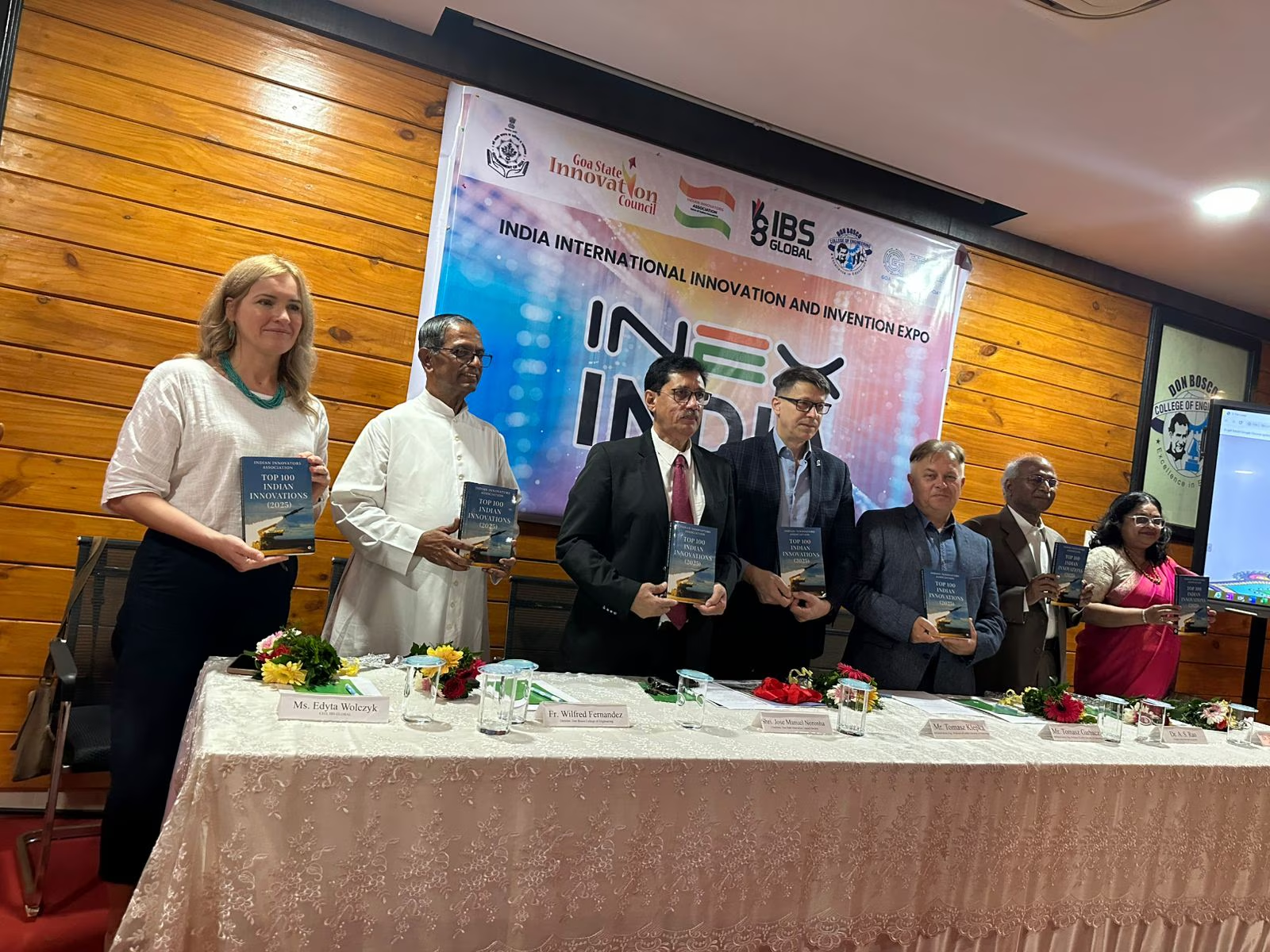
At a moment when India is accelerating its transition toward climate-resilient, circular economies, ICRISAT has secured a major innovation milestone. The institute’s solar-powered water hyacinth harvester has been named one of the Top 100 Indian Innovations of 2025, an annual list curated by the India Innovators Association and launched at the India International Innovation and Invention Expo (INEX India) in Goa on 13 November.
The recognition places ICRISAT at the forefront of ecosystem restoration technologies at a time when freshwater bodies across Asia, Africa, and Latin America are choking under invasive water hyacinth—a weed whose explosive biomass growth can reach over 400 tonnes per hectare, suffocating aquatic life, degrading water quality, and undermining community livelihoods.
ICRISAT’s solution reframes the problem not just as an ecological challenge but as a climate-smart economic opportunity. Designed entirely in-house and powered by solar energy, the harvester offers rural communities a low-cost, low-maintenance alternative to traditional mechanical weed-removal systems, which often remain unaffordable for local agencies. The innovation also enables value creation: harvested biomass can be transformed into compost, biogas, biofertilizers, and other rural enterprise products.
“This recognition reinforces what science-driven innovation can achieve when designed with communities at the center,” said Dr Himanshu Pathak, Director General of ICRISAT. “Water hyacinth’s rapid spread devastates biodiversity and starves wetlands of oxygen. Our solar-powered harvester is proving to be a scalable, sustainable way to restore stressed ecosystems while supporting the people who rely on them.”
The harvester’s journey from concept to national spotlight is notable for its deliberate integration of intellectual property, industry partnerships, and field-level training. ICRISAT secured its first industrial design registration in 2024, followed by an IP licensing agreement with Eco-Paryavaran in 2025. The technology has since been deployed under a Government of Odisha-supported initiative focused on converting water hyacinth biomass into high-quality compost and other value-added products—a “waste-to-wealth” model gaining traction across rural economies.
“This is a standout example of lab-to-field translation,” said Dr Stanford Blade, Deputy Director General – Research and Innovation at ICRISAT. “By collaborating with the Government of Odisha, Eco-Paryavaran, and our multidisciplinary teams, we have delivered an option that cuts time, labor, and operating costs by 50–60 per cent. That makes ecological restoration both achievable and affordable for communities.”
The initiative does more than clear invasive weeds. ICRISAT scientists work directly with rural groups to train them in biomass valorization—turning a dominant environmental nuisance into an income-generating resource. This strengthens circular economies, enhances climate resilience, and brings sustainable ecosystem management into the mainstream of rural development.
“As we scale deployments, our focus is not only on removing the weed but on building rural enterprises around it,” said Dr Aviraj Datta, Scientist – Wastewater Management at ICRISAT. “From compost to biofertilizers, we are ensuring that communities can extract real economic value from ecosystem restoration.”
Accessible through several government rural development schemes, the solar-powered harvester is now positioned for broader adoption across states and potentially across other geographies facing similar ecological pressures. Its selection among India’s Top 100 Innovations underscores a pivotal shift in how climate-smart technologies are assessed—not just by their environmental impact, but by their ability to deliver inclusive growth.
With this recognition, ICRISAT cements its leadership in merging agricultural research, climate innovation, and community-led restoration. The harvester represents the institute’s commitment to designing solutions that are practical, scalable, and inherently aligned with the needs of the Global South—where the future of climate resilience will be tested most.