Sunday, 12 July 2026

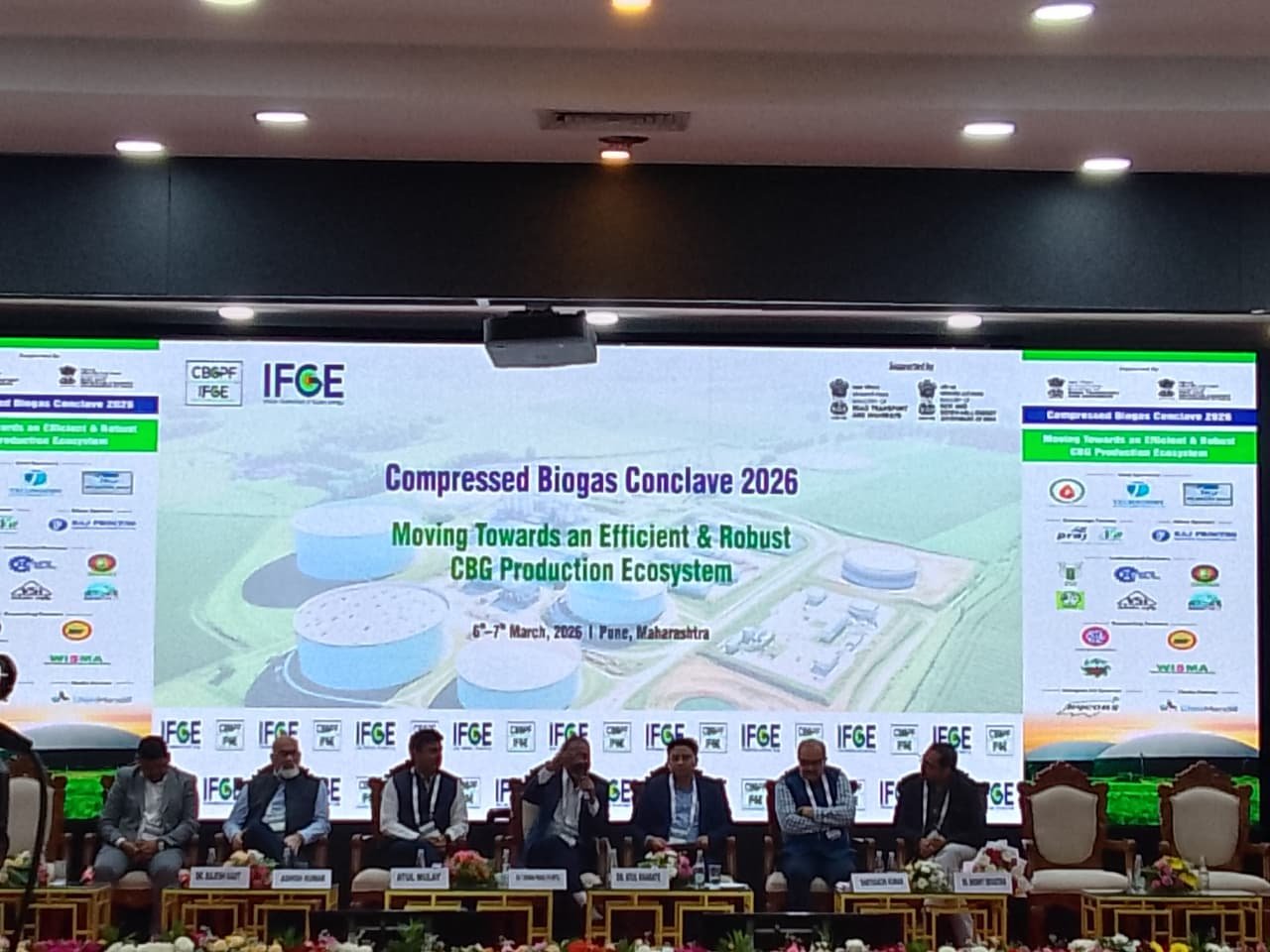
Experts highlight feedstock supply, investment risks, and market development as key hurdles to scaling the compressed biogas ecosystem
As India accelerates efforts to strengthen its energy security and transition toward cleaner fuels, industry leaders and policymakers are emphasizing the urgent need to scale up the country’s compressed biogas (CBG) sector through clearer policies, improved pricing structures, and stronger farmer participation.
Speaking at a recent industry forum, T. Krishna Prasad, IPS (Retd.), Member of Parliament and Lok Sabha Panel Speaker, highlighted the strategic importance of bioenergy in reducing India’s heavy dependence on imported fuels. According to him, nearly 86 percent of India’s energy requirements are currently met through imports, making domestic renewable fuel development critical for the country’s long-term energy security.
He noted that bioenergy represents one of the most important sectors that must be strengthened to reduce this dependence. In recent years, several Indian states have introduced competitive bioenergy policies aimed at encouraging private investment and accelerating project development. Oil marketing companies have also stepped in to support the sector through long-term offtake arrangements for compressed biogas, helping to create a stable market for producers. International collaborations are also beginning to emerge, with governments such as that of Japan exploring partnerships in the bioenergy space. However, Prasad emphasized that the industry must now take the initiative to expand operations and fully capitalize on these policy and market opportunities.
From the industry perspective, stakeholders say economic viability remains one of the biggest challenges facing the sector. Ashish Kumar, Vice President of the Indian Federation of Green Energy, Vice Chairman of the IFGE CBG Producer Forum, and Managing Director of Verbio India, pointed to a persistent viability gap that continues to affect CBG project development.
According to Kumar, the currently notified price for compressed biogas stands at approximately Rs 1,648 per MMBTU, while the effective market rate for CBG is around Rs 2,446 per MMBTU. He suggested that the sector could take cues from the ethanol industry, where pricing support mechanisms have played a major role in enabling rapid expansion. Ethanol currently commands a price of about Rs 3,220 per MMBTU, demonstrating how strong policy support can help scale alternative fuel markets.
Kumar argued that the CBG sector needs similar policy backing to unlock its full potential. Among the key measures he recommended are an increase in the Market Development Assistance (MDA) allocation, expansion of compressed biogas purchase obligations for city gas distribution networks, and a revision of CBG pricing to improve project economics. Increasing MDA support to around Rs 2,958 per tonne and raising CBG pricing by roughly Rs 1,000 per MMBTU, he said, could significantly improve the financial viability of projects.
At the state level, several regions are already witnessing steady progress in compressed biogas development. Rajesh Raut, Managing Consultant at EAC Euro Asia Consulting Pvt Ltd, highlighted the emerging bioenergy landscape in Maharashtra. According to him, the state currently has 22 operational CBG plants with a combined capacity of about 230 tonnes per day, while additional plants with 372 tonnes per day capacity are under construction.
The sector in Maharashtra is largely supported by agricultural feedstocks such as cotton residues, soybean waste, maize residues, and paddy straw, with an estimated 4.2 to 6.2 million tonnes of biomass available annually for CBG production. Raut explained that several operational models are emerging in the industry, including fully integrated in-house value chain models commonly seen in northern India, aggregator-based feedstock collection models, and end-to-end aggregator systems that manage feedstock sourcing and logistics for plant operators.
From the policy perspective, the Ministry of New and Renewable Energy (MNRE) continues to expand support for the sector through targeted programs. Gaurav Mishra, Senior Director and Scientist F at MNRE, explained that the government’s National Bioenergy Programme currently includes three major sub-components designed to promote various bioenergy technologies, including compressed biogas. Under this program, 36 CBG projects have already received government support, demonstrating the ministry’s commitment to building a robust bioenergy ecosystem.
Despite these initiatives, industry leaders say significant operational and financial challenges remain. Sabyasachi Kumar, Revenue and Channel Head for the CBG Business at Reliance Industries Limited, pointed to the gap between national ambitions and actual project development on the ground.
India has set an ambitious goal of establishing 5,000 compressed biogas plants, yet the number of operational facilities currently stands at roughly 150. According to Kumar, one of the primary reasons for the slow pace of expansion is the scale of investment required for CBG projects. A typical 20 tonnes per day plant requires an investment of around Rs 140 crore, making investors cautious about entering the sector.
Feedstock management remains another major challenge. Biomass procurement costs can reach Rs 3,000 per tonne, and maintaining consistent feedstock supply is often difficult due to fragmented agricultural systems and seasonal variations. Kumar noted that while government policies supporting bioenergy are strong on paper, the sector also requires greater ease of operations to attract large-scale investment.
He outlined three key priorities that could help accelerate the industry’s growth. First, there is an urgent need to raise awareness among farmers about the economic value of agricultural residues. Second, the sector requires a robust ecosystem to collect crop stubble directly from farmers while ensuring that farmers receive fair remuneration for the biomass they supply. Finally, locating CBG plants closer to agricultural fields could significantly reduce transportation costs and improve supply chain efficiency.
As India works to expand its renewable energy portfolio and reduce dependence on fossil fuel imports, industry experts believe compressed biogas could become a key pillar of the country’s clean energy strategy. However, unlocking the full potential of the sector will require coordinated action across policy frameworks, pricing mechanisms, technology deployment, and farmer engagement to build a sustainable and scalable bioenergy ecosystem.
— Suchetana Choudhury (suchetana.choudhuri@agrospectrumindia.com)