Thursday, 9 July 2026

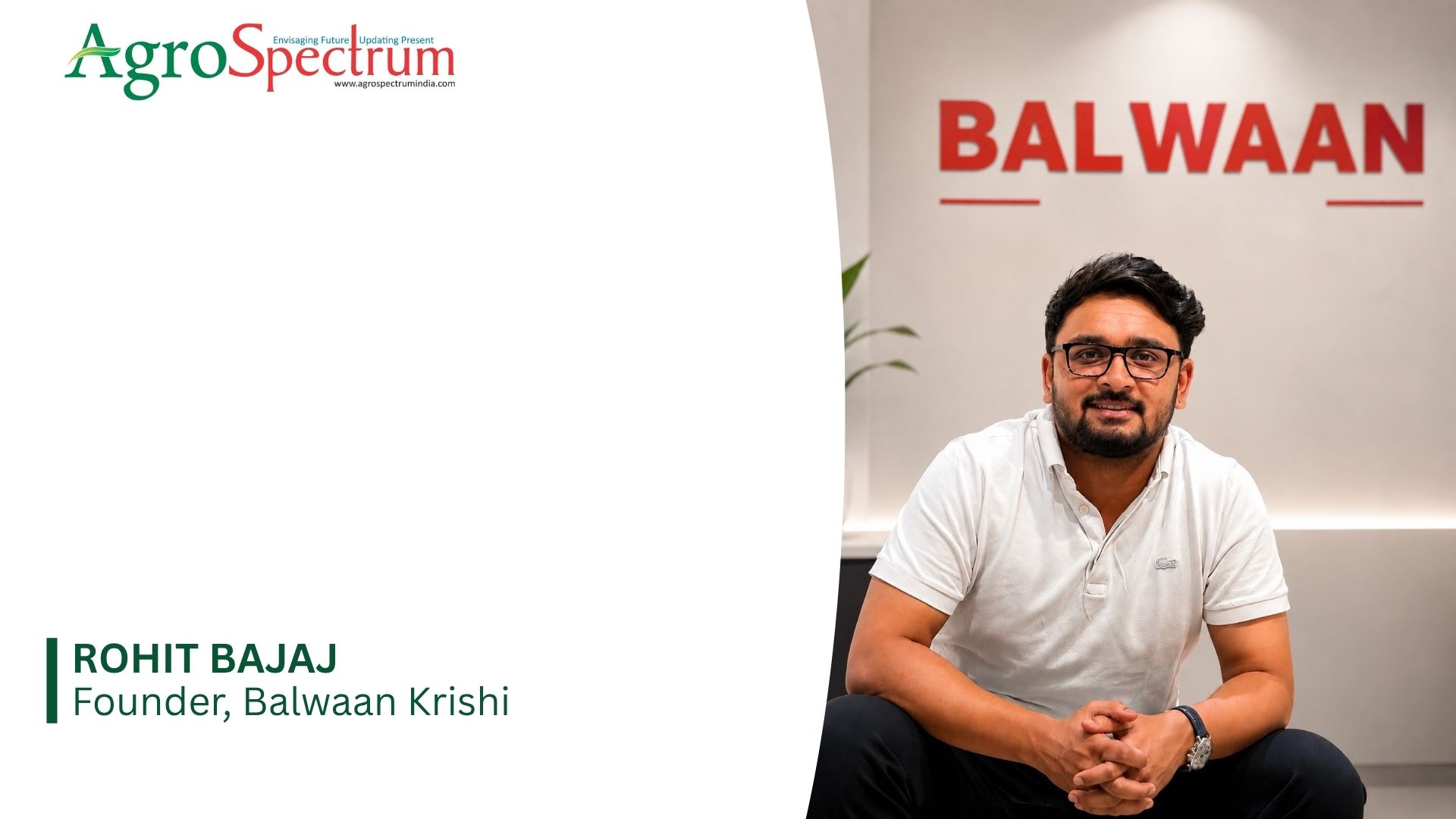
In an exclusive interaction with AgroSpectrum, Rohit Bajaj, Founder, Balwaan Krishi unfolds the various aspects of the supply chain of farm mechanisation equipment. Recently the company launched a new logistics and distribution hub of farm equipment in Chennai and Vishakhapattanam in a strategic move to accelerate its South India expansion and bring farm mechanisation closer to millions of small and marginal farmers across Tamil Nadu, Andhra Pradesh, Telangana, Karnataka and Kerala.
Balwaan Krishi has built a network of over 2,000 dealers nationwide. What role do local dealers play in driving mechanisation adoption among small and marginal farmers?
Our dealers are much more than sales partners—they are our strongest connection with farmers. Most farmers prefer to buy equipment from someone they know and trust. Local dealers understand regional farming practices, speak the local language and are able to demonstrate products in real farming conditions. They also provide service support, maintenance guidance and access to spare parts, which builds confidence among first-time buyers.
For small and marginal farmers, this relationship often makes the difference between considering mechanisation and actually adopting it. That is why we continue to invest in dealer capability, product training and service readiness across our network.
How will the new logistics infrastructure improve delivery timelines, inventory management and after-sales service for dealers and farmers?
A strong supply chain is as important as having a good product. The new logistics infrastructure allows us to keep inventory closer to the market, which significantly improves responsiveness. With the Chennai hub in place, we expect delivery timelines to improve by approximately 30 per cent and ensure quicker availability of products and spare parts across the region. Better inventory planning will also help us minimise stock shortages during peak agricultural seasons.
Equally important is after-sales service. Faster access to spare parts and technical support means dealers can resolve customer issues more quickly, resulting in better uptime for farmers and a more reliable ownership experience.
FPOs and cooperatives are expected to play a key role in your South India strategy. How do you plan to strengthen partnerships with these institutions?
Farmer Producer Organisations and cooperatives are becoming increasingly important in expanding access to farm mechanisation, particularly for smallholders. Our approach is to work closely with these institutions through product demonstrations, awareness programmes, field trials and training sessions that help farmers understand the practical benefits of mechanisation. We also see opportunities to develop customised engagement programmes that make equipment more accessible for group-based farming models.
Over the coming years, we aim to partner with around 500 FPOs and cooperatives across South India to improve awareness and encourage wider adoption of modern farm equipment.
Andhra Pradesh has been identified as another priority market. Which farm mechanisation segments do you expect to witness the strongest demand there, and why?
Andhra Pradesh has a diverse agricultural landscape, with cultivation ranging from paddy and chilli to horticulture and aquaculture-linked farming. We see strong demand for mechanisation solutions that reduce labour dependency and improve operational efficiency.
We expect categories such as power weeders, power tillers, brush cutters, sprayers and harvesting support equipment to witness healthy growth. Labour shortages, rising wage costs and the increasing need to complete farm operations within shorter windows are encouraging farmers to adopt mechanised solutions. Government initiatives promoting farm mechanisation are also creating greater awareness, making Andhra Pradesh an important growth market for us.
The Chennai hub is expected to serve all 38 districts of Tamil Nadu through 34 dealer partners. What are your dealer expansion targets over the next two to three years?
The Chennai hub gives us a strong foundation to scale our presence across Tamil Nadu in a structured manner. While we have already established a network of 34 dealer partners, our focus over the next two to three years will be on expanding our reach into underserved agricultural belts and strengthening our presence in high-potential districts.
Our target is to increase the dealer network in the region to around 1,000 dealer partners across South India over the next 5 years. However, our priority is not just adding more dealers but onboarding the right partners who understand the local farming ecosystem and can provide strong after-sales service. We also intend to invest in dealer training, product demonstrations and technical support so that farmers receive consistent guidance before and after purchasing our equipment.
South India accounts for a significant share of India’s agricultural production but has diverse cropping patterns. How has Balwaan Krishi customised its product portfolio for different states and farming systems across the region?
South India is not a single market, every state has its own cropping patterns, landholding sizes and farming practices. That is why we don’t believe in a one-size-fits-all approach. Our product portfolio has been aligned to the needs of farmers growing crops such as paddy, sugarcane, cotton, banana, coconut, horticulture crops and plantations across the region. Depending on the local requirement, we are focusing on equipment such as power weeders, brush cutters, sprayers, chaff cutters and other farm mechanisation solutions that improve productivity while remaining affordable for small and marginal farmers.
Before entering a market, we work closely with our dealer partners to understand local farming challenges and customer preferences. That feedback helps us decide which products to prioritise and what kind of support farmers need after the purchase. This localised approach has helped us build stronger acceptance across different states.
How do you assess the current farm mechanisation potential in South India compared with northern and western markets?
South India offers tremendous long-term potential for farm mechanisation. While some regions have already seen good adoption, many farming communities are still at the early stages of transitioning from manual operations to mechanised farming. Compared to northern and western markets, South India presents unique opportunities because of its crop diversity, growing horticulture sector and increasing focus on high-value agriculture. Rising labour shortages and changing economics are further accelerating the need for efficient farm equipment. We believe the next phase of growth will come from creating solutions that are affordable, easy to operate and suited to smaller landholdings, rather than simply introducing larger machines.
Precision agriculture, battery-powered equipment and smart farming technologies are gaining traction. How is Balwaan Krishi preparing its product pipeline for these emerging trends?
The future of agriculture will be driven by technologies that improve productivity while reducing operating costs and environmental impact. At Balwaan Krishi, we are continuously evaluating new technologies, including battery-powered equipment, precision farming solutions and smarter, more efficient machines. Our focus is on introducing innovations that solve real problems for farmers rather than adopting technology for its own sake.We are making significant ongoing investments in product development and expect to launch 10 new products over the next 24 months that reflect these evolving market needs.
Looking ahead, what is your long-term vision for Balwaan Krishi in India’s farm mechanisation industry, and what role will South India play in achieving that vision?
Our vision is to make quality farm mechanisation accessible to every farmer, irrespective of the size of their landholding. We want to be recognised not just as an equipment manufacturer but as a trusted partner in improving farm productivity and rural livelihoods. South India will play a pivotal role in that journey. The region has a strong agricultural base, progressive farming communities and significant untapped potential for mechanisation. Our investments in dealer expansion, supply chain infrastructure and local partnerships are all aimed at building a sustainable presence here. Over the next 5 years, we aim to strengthen our footprint across South India, expand our customer base by 300 per cent, and continue introducing solutions that help farmers improve efficiency, reduce labour dependence and increase profitability.
—- Dipti Barve
dipti.barve@mmactiv.com