Saturday, 20 June 2026

Syngenta Group, Asian Development Bank, Wageningen University & Research and Reliance Foundation outline roadmap for trust-based data systems, blended financing and field-level impact
Mumbai, Maharashtra | 2026 — AI4Agri2026 brought together global industry leaders, multilateral institutions, research experts and grassroots practitioners to chart a clear path for scaling Artificial Intelligence in agriculture. The central message emerging from the session was unequivocal: AI must transition from research pilots to real-world deployment that directly improves farmer incomes, resilience and productivity.
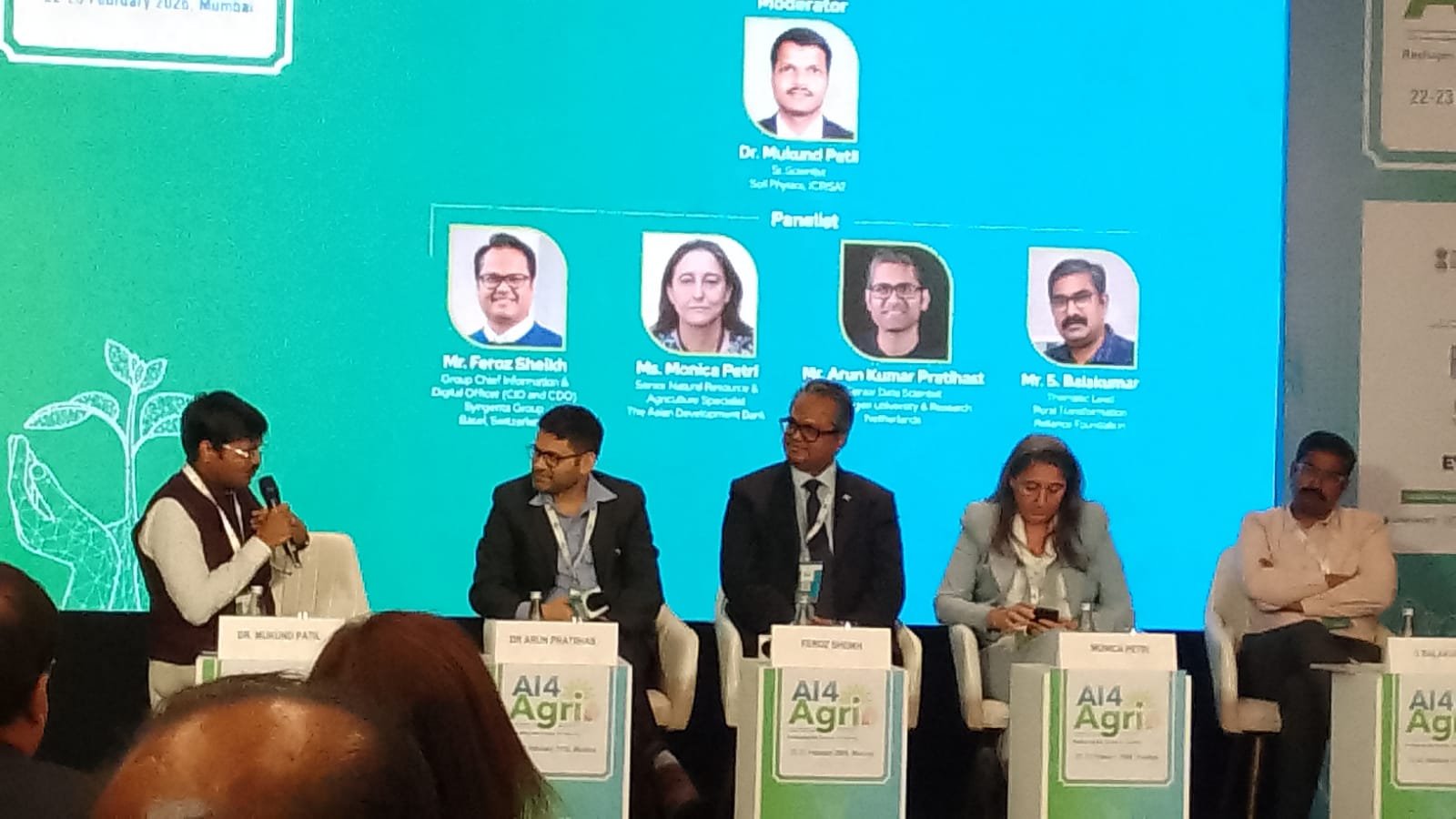
The session featured Feroz Sheikh, Group Chief Information & Digital Officer (CIO and CDO), Syngenta Group; Monica Petri, Senior Natural Resource and Agriculture Specialist, Asian Development Bank; Arun Kumar Pratihast, Senior Data Scientist, Wageningen University & Research; and S. Balakumar, Thematic Lead – Rural Transformation, Reliance Foundation.
Clarity of Mandate: AI Must Be Built for Farmers
Arun Kumar Pratihast emphasized that research institutions and innovation networks must operate with a clear mandate: AI should be developed for farmers, not merely for academic advancement. Governments are increasingly mandating that agricultural data and AI networks serve farmer welfare, and this clarity of purpose must shape research design, technology development and deployment strategies.
He highlighted the importance of defining short-term and long-term goals for agricultural AI, ensuring measurable outcomes while building sustainable digital ecosystems. Data governance, he stressed, is vital — not only from a regulatory standpoint but also in ensuring that agricultural data systems remain simple, agile and usable. In a sector marked by climatic uncertainty and variability, overly complex data frameworks can hinder timely decision-making.
Bridging Research and Field Deployment
Feroz Sheikh of Syngenta Group reinforced the need to move AI beyond laboratory environments. Agriculture operates in cycles, and impact materializes over time. Therefore, bridging the gap between research and field-level deployment is essential for sustainable transformation.
From a private sector perspective, he noted that access to growers can significantly accelerate adoption. By creating structured pathways that connect research institutions with farmers, the private sector can help translate innovation into practice. AI solutions must be tested, validated and refined in real farming conditions to ensure scalability.
Sheikh further underscored that funding mechanisms must reflect agriculture’s long-term nature. Multilateral financing, supported by government participation, can create a balanced ecosystem. If farmers are prosperous, the agricultural model succeeds — making farmer-centricity not just a moral imperative but an economic necessity.
Financing Innovation for Scale
In May 2025, the Asian Development Bank (ADB) announced an expansion of its support for food and nutrition security in Asia and the Pacific by $26 billion, bringing its total planned funding for food security initiatives to $40 billion over the 2022–2030 period. This investment focuses on sustainable agriculture, food production, processing and distribution to address climate-related impacts on agriculture.
Monica Petri explained that innovation must be embedded within agricultural development agendas and integrated into loan and grant portfolios. ADB’s blended financing approach combines sovereign loans, grants and non-sovereign operations to support innovation while managing risk and catalyzing private sector participation.
Research initiatives, she emphasized, must be designed with scalability in mind from inception. Pilots are valuable, but only scalable solutions integrated into broader development frameworks can create systemic impact. Embedding AI-driven tools into development financing ensures that technological progress aligns with resilience, productivity and inclusive growth goals.
Trust, Advisory Councils and Closing the Technology Divide
S. Balakumar of Reliance Foundation brought attention to the human dimension of AI adoption. Through rural transformation programs, he observed that farmers are time-oriented decision-makers who prioritize solutions that deliver immediate, practical value.
Trust, he stated, is a foundational component of AI in agriculture. Without trust in data systems, advisories and institutions, technology adoption remains limited. He proposed the formation of Farmer Advisory Councils to institutionalize feedback loops between innovators and end-users.
Balakumar also emphasized addressing the technology divide to ensure inclusive growth. Farmers generate substantial real-time data through daily operations, and responsibly harnessing this data can strengthen predictive systems and advisory platforms. However, consent, transparency and equitable benefit-sharing must guide these processes.
A Roadmap for Responsible Agricultural AI
AI4Agri2026 reinforced that successful agricultural AI ecosystems require five pillars: clarity of purpose, farmer-centric governance, simplified and agile data systems, blended financing models and trust-based deployment.
The convergence of global research institutions, multilateral financing agencies, private industry leaders and grassroots organizations signals a new phase in agricultural transformation — one focused on scaling impact, strengthening resilience and ensuring that innovation directly benefits farmers.
As discussions concluded, leaders agreed that the future of agriculture will be shaped not only by algorithms and models but by how effectively institutions collaborate to ensure that AI serves those who cultivate the land.
— Suchetana Choudhury (suchetana.choudhuri@agrospectrumindia.com)