Friday, 29 May 2026

Experts from Switzerland, the United States and India outline a roadmap for blockchain-backed trust, metadata intelligence and domain-adapted AI to power scalable agriculture
AI4Agri2026 brought together global thought leaders to address one of the most critical enablers of agricultural transformation: data. While artificial intelligence is rapidly advancing, experts emphasized that its success in agriculture will depend on reducing the cost of reliable information, strengthening trust-based data governance and converting raw datasets into structured knowledge.
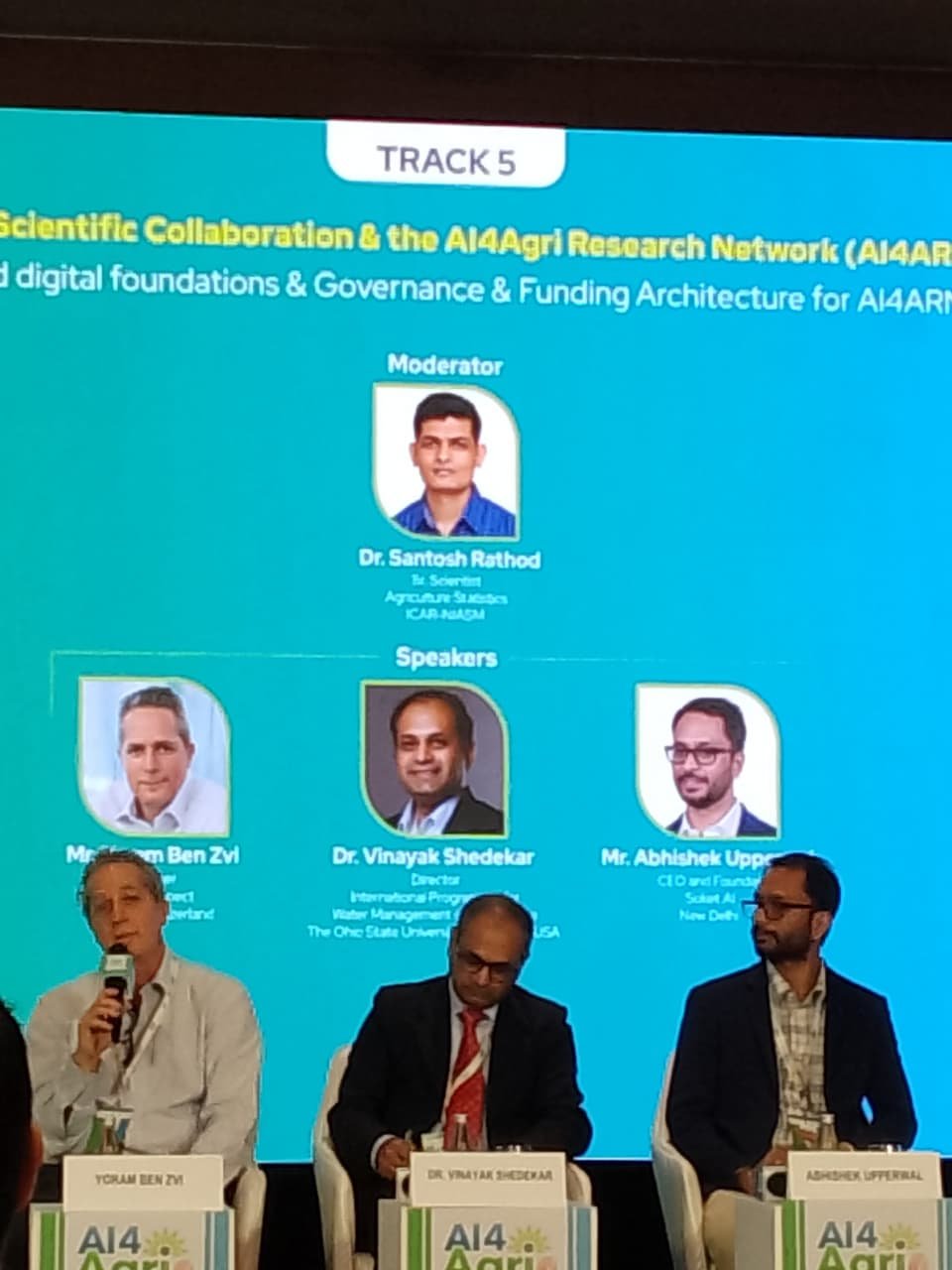
The session featured insights from Yoram Ben Zvi, Partner, ELK Connect, Geneva, Switzerland; Dr. Vinayak Shedekar, Director, International Programme for Water Management on Agriculture, The Ohio State University, Columbus, USA; and Dr. Abhishek Upperwal, CEO and Founder, Soket.AI, New Delhi.
Reducing the Cost of Information Through Trust and Technology
Yoram Ben Zvi, Partner at ELK Connect, underscored that the cost of credible agricultural information remains high, particularly for smallholder farmers. He highlighted the transformative potential of digital data sources, blockchain-enabled verification mechanisms and satellite intelligence in lowering information asymmetry across agricultural markets.
Referring to collaborations with the Syngenta Foundation in India, he explained how satellite imagery can provide real-time crop insights, risk assessments and yield forecasting. Crucially, such systems must operate on farmer consent, ensuring that agricultural data is shared with external stakeholders only with explicit permission.
He also noted India’s expanding international agricultural collaborations, including partnerships with Europe and Brazil, as a pathway to accelerate knowledge exchange and scale trusted agri-data frameworks globally.
Metadata, Human Sensing and the Science of Agricultural Ranges
Dr. Vinayak Shedekar, Director of the International Programme for Water Management on Agriculture at The Ohio State University, emphasized that agriculture operates within ranges rather than absolutes. Instead of relying solely on raw data streams, he advocated for the development of rich metadata frameworks that help decision-makers determine which datasets are contextually relevant and which should be excluded.
He stressed that real-time information is essential, yet collecting reliable and validated agricultural data requires time, scientific rigor and structured monitoring systems. Integrating human sensing — farmers’ experiential knowledge and field-level judgment — with AI models can significantly enhance predictive accuracy.
Drawing comparisons with the United States, he noted that farmer data is treated as private property and accessed primarily through trust-based mechanisms. India, however, is rapidly building one of the world’s most comprehensive soil information systems. With the growth of agri-mechanization and geospatial mapping — including data generated through advanced farm equipment platforms — the opportunity now lies in building public-private partnership models that create secure pipelines for responsible data exchange.
From Data to Knowledge: The Challenge of Domain Adaptation
Dr. Abhishek Upperwal, CEO and Founder of Soket.AI, emphasized that while “data is king,” knowledge is the true differentiator in AI systems.
He pointed to domain adaptation as a major challenge in deploying foundation models within agriculture. AI systems must not only process statistical datasets but also capture the thought processes of agronomists, researchers and farmers. Embedding human reasoning into AI architectures ensures contextual relevance and real-world applicability.
India’s efforts to establish clear data standards were highlighted as a critical enabler of interoperability. Defining protocols for how data should be shared and consumed creates clarity across ecosystems. However, Dr. Upperwal cautioned that many agricultural datasets remain primarily statistical in nature. The core challenge is improving availability, quality and domain-specific richness of data so that AI systems can move from analytics to actionable intelligence.
Building the Foundations of Scalable Agricultural AI
The session concluded with a shared understanding that agricultural AI will only scale if built upon trusted, standardized and interoperable data ecosystems. Reducing the cost of information, strengthening consent-driven governance, creating metadata-rich frameworks and integrating human expertise with machine intelligence were identified as foundational pillars.
AI4Agri2026 positioned Maharashtra as a potential global reference model — one that can combine satellite intelligence, soil databases, blockchain-enabled trust and AI-driven analytics into a cohesive digital public infrastructure.
The consensus was clear: the next agricultural revolution will not be defined by algorithms alone. It will be defined by how responsibly and intelligently nations build their data foundations.
— Suchetana Choudhury (suchetana.choudhuri@agrospectrumindia.com)