Friday, 29 May 2026

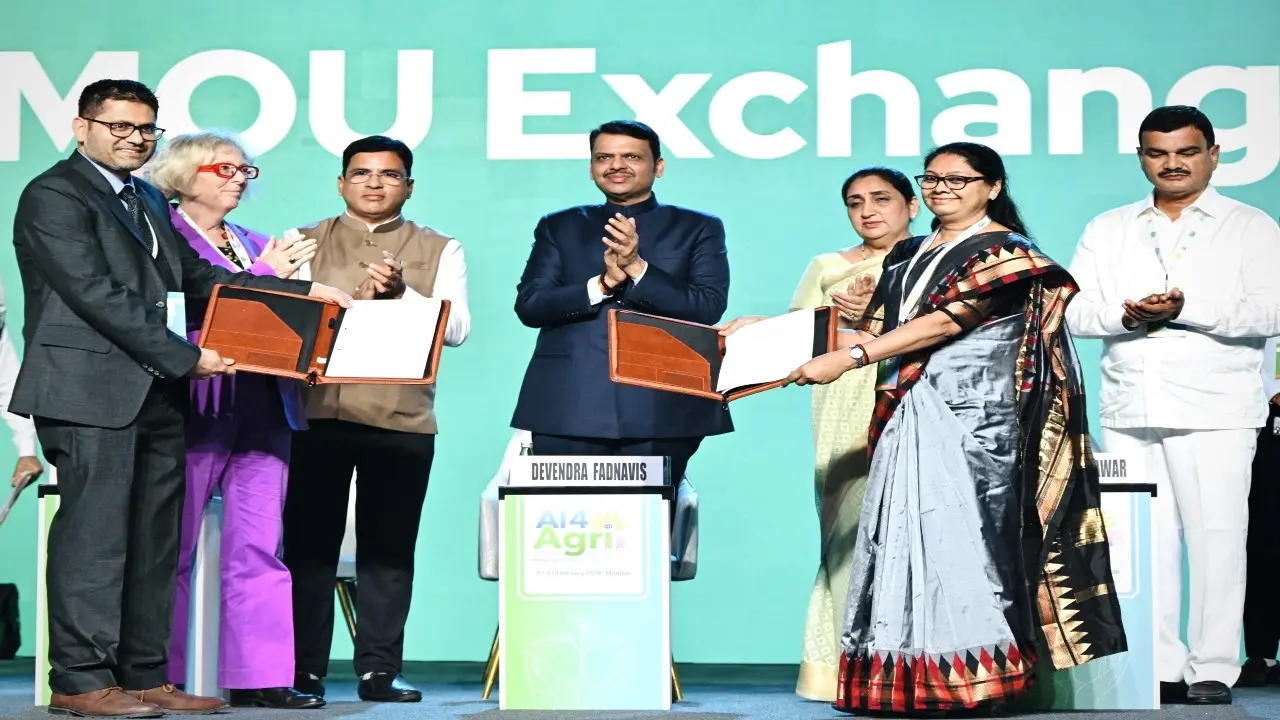
Chief Minister Devendra Fadnavis positions Maharashtra as the world’s foremost “use capital” for agricultural AI; MoUs with World Bank and Wageningen University mark global partnerships
In a landmark moment for India’s agricultural and digital transformation journey, Maharashtra announced a comprehensive suite of Artificial Intelligence-powered public digital infrastructure initiatives at AI4Agri2026, signaling a decisive shift from pilot-based experimentation to institutionalized, scalable AI deployment.
Devendra Fadnavis – Chief Minister of Maharashtra formally launched MahaAgX (MahaAgri Exchange), India’s first Bhili Tribal Language Large Language Model (LLM), MahaVISTAAR Voice Telephony services, and an advanced AI-powered Plant Pest & Disease Detection system under the state’s Rs 500 crore MahaAgri AI policy framework. Together, these initiatives form an integrated architecture designed to drive predictive agriculture, inclusive governance, climate resilience and global competitiveness.
The Chief Minister described the moment as transformative, stating that Maharashtra is not merely adopting AI but redefining its application in agriculture by embedding equity, accountability and data sovereignty into its core design.
MahaAgX: A Unified, Consent-Driven Agricultural Data Backbone
At the centre of the new ecosystem is MahaAgX, developed under the Nanaji Deshmukh Krishi Sanjeevani Prakalp to resolve one of agriculture’s most persistent structural challenges — fragmented and siloed data systems.
MahaAgX functions as a consent-driven Digital Public Infrastructure aligned with Agristack principles, ensuring that farmers retain ownership and control over their data. By integrating more than 200 diverse datasets spanning crop patterns, soil health, irrigation cycles, pest surveillance, market trends and weather intelligence, MahaAgX establishes a unified, interoperable data exchange capable of supporting real-time predictive analytics.
This architecture enables forecasting of weather variability, early pest outbreak detection, crop cycle optimization and precision irrigation advisories tailored to micro-regions. For policymakers, it provides a robust evidence base for targeted interventions, efficient subsidy allocation and data-driven governance. Blue Books outlining governance standards and operational safeguards for MahaAgX were unveiled at the summit, reinforcing Maharashtra’s commitment to responsible AI deployment.
India’s First Tribal Large Language Model in Bhili
In a historic milestone for digital inclusion, Maharashtra launched India’s first Tribal Large Language Model in the Bhili language.
Built specifically for tribal farming communities, the Bhili LLM enables natural-language interaction in a culturally rooted linguistic ecosystem. Rather than merely translating existing advisory systems, the model incorporates local dialect nuances and indigenous agricultural knowledge to ensure contextual accuracy. Tribal farmers can now access crop advisories, weather alerts and market information in their native language, strengthening trust and usability.
This initiative demonstrates Maharashtra’s conviction that technological advancement must adapt to communities — not the other way around — and that inclusion is foundational to scale.
MahaVISTAAR Voice Telephony and AI-Based Crop Protection
Expanding its flagship farmer advisory platform, which already supports more than 3 million farmers, the state introduced MahaVISTAAR Voice Telephony — a multilingual conversational AI interface delivering crop guidance through simple voice calls.
Designed to overcome barriers of literacy, device access and digital familiarity, the system allows farmers to interact with AI seamlessly in their preferred language. The integration of image-based Plant Pest & Disease Detection further enhances field-level responsiveness. Farmers can upload crop photographs for rapid AI analysis and receive precise treatment recommendations, enabling early intervention and reducing yield losses caused by climate variability and pest outbreaks.
Together, these tools shift agriculture from reactive response to predictive protection.
Women at the Centre of Maharashtra’s Agri-AI Transformation
Beyond infrastructure and analytics, Maharashtra’s AI strategy places women farmers at the centre of transformation.
Recognizing that women contribute substantially to agricultural labour yet often lack land ownership, formal recognition and direct access to advisory systems, the MahaAgri AI framework embeds gender-responsive design principles across platforms. MahaVISTAAR and its Voice Telephony services are being structured to ensure ease of access for women farmers, including intuitive interfaces and multilingual support.
Dedicated financial allocations are being aligned to support women’s participation in digital agriculture through targeted training programs, blended learning models and digital literacy initiatives. The objective is not merely to extend advisories to women, but to enable them to confidently use AI tools for crop planning, market decisions, irrigation management and financial management.
By strengthening outreach to women farmer groups, self-help collectives and tribal women cultivators, Maharashtra is integrating women into advisory feedback systems and data governance processes. The state’s approach acknowledges that when women lead agricultural operations, productivity rises, household nutrition improves and community resilience strengthens.
Through this inclusive architecture, AI is positioned not as a neutral tool but as an instrument for correcting structural inequities within the agricultural ecosystem.
Data Sovereignty, Traceability and Global Leadership
The Chief Minister reiterated that Maharashtra’s AI ecosystem is anchored in data sovereignty and aligned with national Agristack principles. Public research generated by the state will be shared openly with other states, reinforcing Maharashtra’s role as a collaborative knowledge hub.
In parallel, the state is developing digital traceability infrastructure to strengthen its competitiveness in global agricultural markets. Standardized digital supply chain records will enhance export readiness, transparency and compliance with international standards.
With a population of 120 million, Maharashtra represents one of the world’s largest living laboratories for applied agricultural AI. The state has invited innovators, researchers and investors to collaborate in building AI infrastructure that can serve India and the broader Global South.
Redefining AI for Agriculture
AI4Agri2026 concluded with a powerful declaration: Maharashtra has redefined AI for India in agriculture.
From consent-driven data exchanges and multilingual tribal AI models to voice-enabled advisories, image-based diagnostics and gender-responsive platforms, the MahaAgri AI ecosystem integrates technology, governance and farmer welfare into a unified framework.
Maharashtra is not piloting artificial intelligence in agriculture — it is institutionalizing it at scale, ensuring that predictive intelligence translates into inclusive growth and sustainable prosperity.
— Suchetana Choudhury (suchetana.choudhuri@agrospectrumindia.com)