Wednesday, 10 June 2026

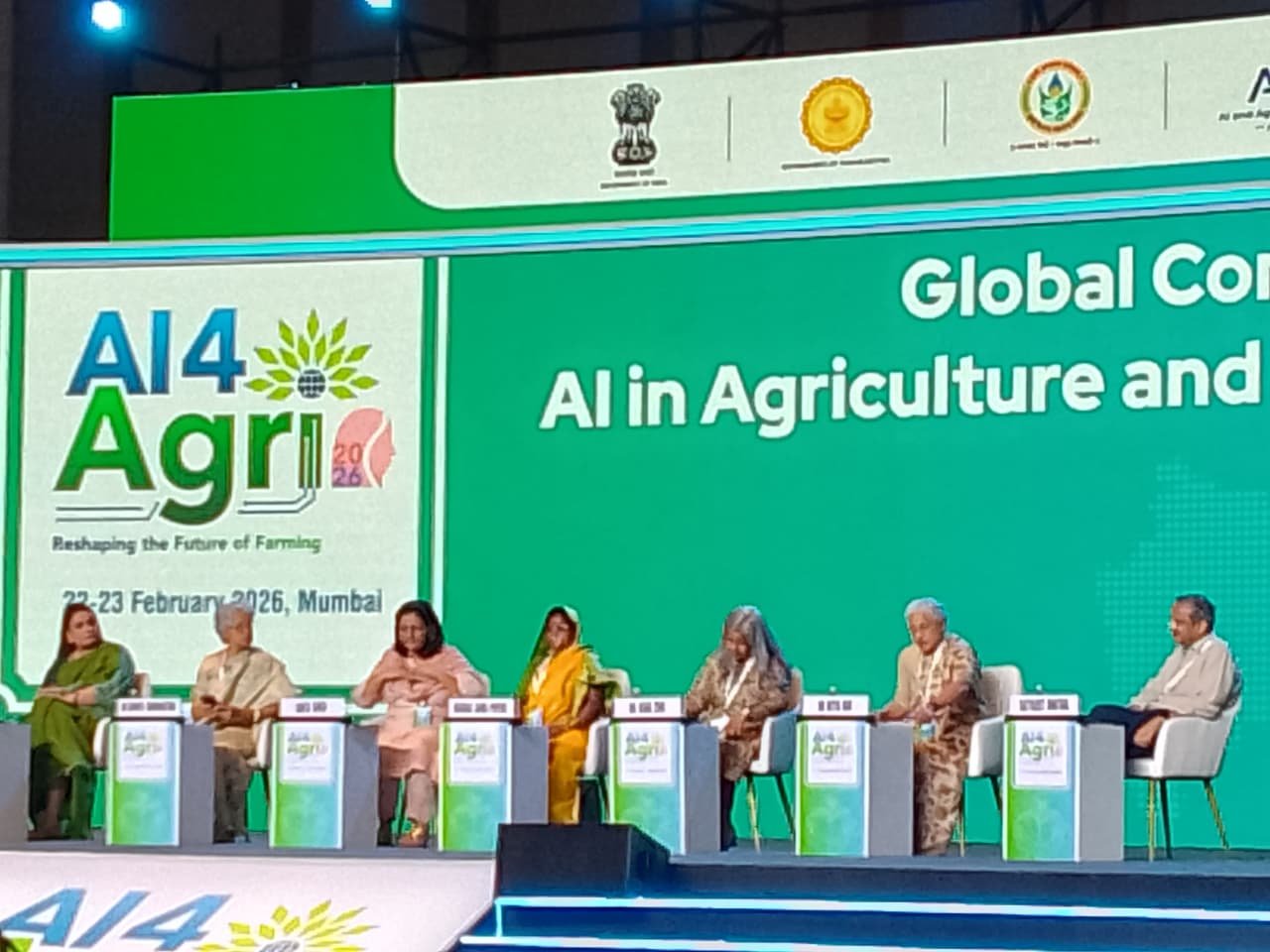
The Government of Maharashtra convened global leaders, scientists, grassroots innovators, multilateral agencies and farmer collectives at AI4Agri2026 in Mumbai, positioning 2026 as the Year of the Woman Farmer and calling for an action-oriented, gender-responsive AI ecosystem in agriculture.
The high-level conference underscored a clear message: women must move from being viewed as “beneficiaries” to recognized leaders, co-designers and rights-holders in the agri-tech transformation.
Women at the Center of India’s Agricultural Future
In Maharashtra, more than 80 percent of rural women are engaged in agriculture and allied sectors. Yet systemic gaps persist — from land ownership and water access to market decision-making and technology design.
Speakers emphasized that farm machinery is rarely designed with women in mind, leading to disproportionate drudgery. Limited land titles exclude women from water entitlements and formal credit systems. Access to smartphones, connectivity and data remains uneven, reinforcing a digital gender divide.
The proposed Woman Farmer Empowerment Bill was highlighted as a critical structural reform to address land record inclusion, decision-making rights, and equitable access to resources.
AI: Operational Reality, Not a Futuristic Promise
Dr. Soumya Swaminathan, Chairperson, M. S. Swaminathan Research Foundation (MSSRF); Former Chief Scientist, World Health Organization, emphasized that AI has transformative potential to improve the lives of millions — but only if it is demand-driven and grounded in equity. She introduced the concept of “biohappiness”, embraced by the Government of Maharashtra, underscoring that modern food systems may be adding calories without nourishment due to ecological imbalance and technological gaps. AI, she noted, must strengthen nutrition, sustainability and farmer well-being — not merely productivity.
Dr. Purvi Mehta, Board Member at M. S. Swaminathan Research Foundation (MSSRF), announced that Maharashtra has emerged as the 18th state globally to implement a clear-cut AI policy in agriculture. She highlighted how AI has compressed crop development timelines — where High Yielding Varieties once took eight years, gene editing supported by algorithms can now accelerate development to months. AI is already delivering real-time insights on harvest timing, weather forecasting, meteorology, commodity trading and livestock valuation.
Yet, she cautioned that global AI datasets disproportionately cover six major crops largely cultivated by men, while women-dominated crops such as pulses and millets remain underrepresented. “Equity in algorithms is a must,” she stressed.
Bridging the Gender Data Gap
Kanta Singh, Country Representative (India), UN Women congratulated Maharashtra for convening a high-level conference dedicated to Women in AI. She identified three structural challenges:
Missing land ownership for women
Feminization of agricultural labor without corresponding financial control
Limited access to information and decision-making platforms
She noted that technologists rarely engage women during AI solution design, resulting in systemic exclusion. Inclusive co-creation must become standard practice.
Usha Zehr, Chief Technology Officer, Mahyco; Director, Grow Indigo, highlighted industry efforts, including AI-driven sustainability initiatives such as carbon farming. She emphasized the urgent need for better gender-disaggregated data. Initiatives are underway to train women farmers in analyzing soil nitrogen data using sensors — empowering them to make informed fertilizer decisions.
Grassroots Innovation and AI in Practice
Satyajit Bhatkal, Founder & CEO, Paani Foundation reported that 65 percent of the foundation’s trainees are women, reflecting the feminization of agriculture. However, ownership and financial authority remain male-dominated. AI-supported communication tools are already being used to generate training modules and advisory content, reducing production costs and expanding outreach. Platforms such as MAHAvistaar are delivering AI-powered crop advisory directly to farmers.
Dr. Nitya Rao, Professor of Gender and Development, University of East Anglia; Visiting Faculty, MSSRF, cited examples of AI applications in plant disease detection — including remote sensing to identify coconut root wilt in Kerala and the Plantex app developed in collaboration with MSSRF, ICRISAT and CABI. She noted that while countries like the UK are investing heavily in AI for rice, wheat, soybean and maize, insufficient data exists for crops predominantly managed by women. AI must bridge this knowledge divide.
Access, Affordability and Algorithmic Equity
Participants repeatedly emphasized that:
79 percent of livestock-related agricultural work in India is performed by women
Women often make cultivation decisions but lack authority over marketing and financial transactions
Many rural women lack smartphones and reliable internet connectivity
AI must therefore prioritize access, affordability and algorithmic fairness. Performance parity with human intelligence is insufficient if systemic barriers prevent women from accessing AI tools.
A Call to Action
AI4Agri2026 concluded with a collective commitment to:
Embed gender equity into Maharashtra’s AI Agriculture Policy
Accelerate inclusion of women in land records and resource governance
Develop women-centric farm machinery and agri-tech design
Expand datasets for women-managed crops
Promote digital literacy and smartphone access for rural women
Ensure demand-driven AI solutions co-created with women farmers
The conference affirmed that AI is not merely a technological intervention — it is a governance, equity and design challenge. Maharashtra’s leadership in declaring 2026 the Year of the Woman Farmer signals a paradigm shift: from productivity-centric agriculture to a biohappiness-centered, women-led agri-tech future.
AI4Agri2026 marks the beginning of a new agricultural compact — where technology advances alongside rights, inclusion and dignity for every woman farmer.
— Suchetana Choudhury (suchetana.choudhuri@agrospectrumindia.com)