Monday, 6 July 2026

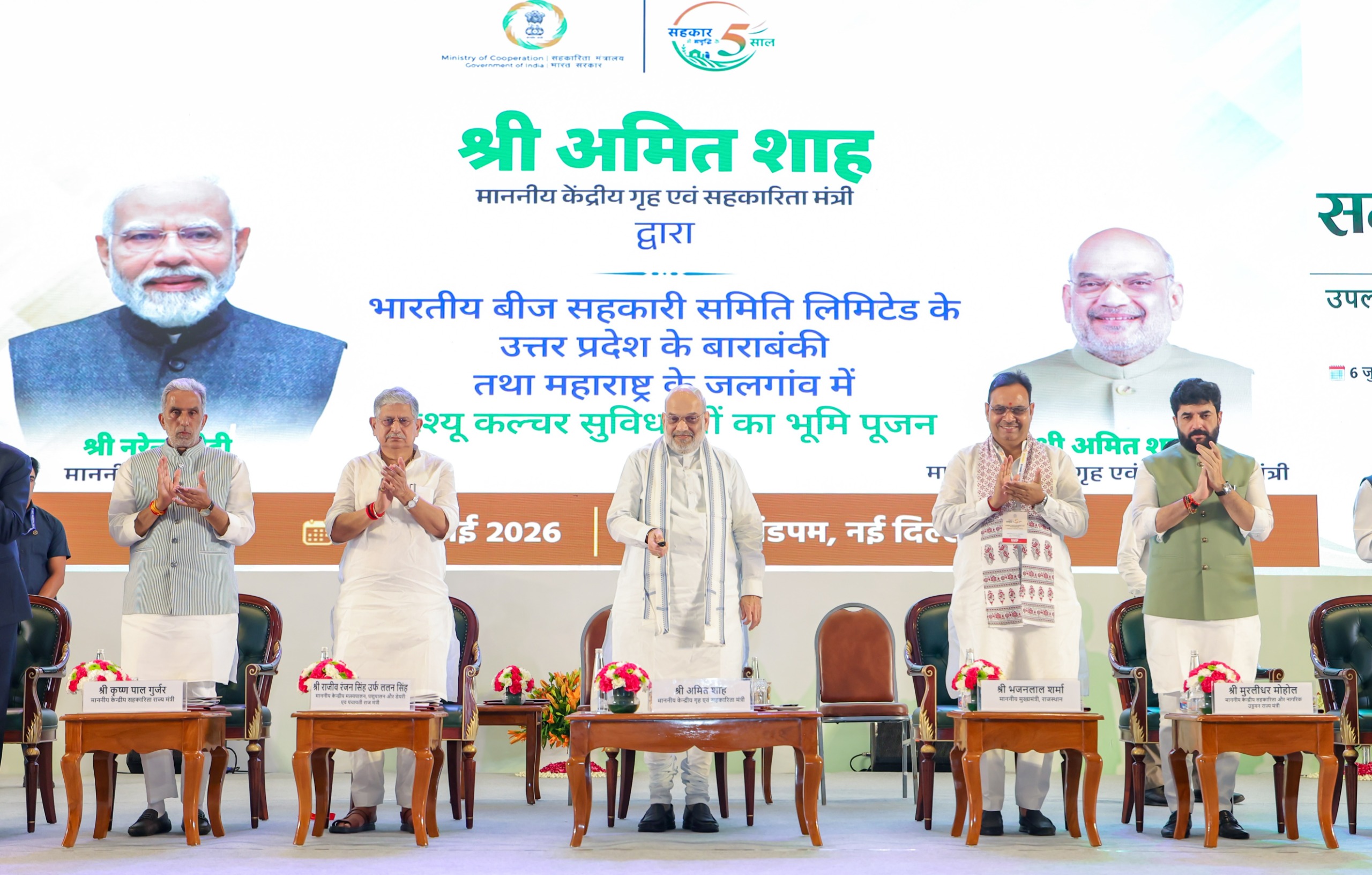
Amit Shah says cooperative reforms are bringing digital governance, market linkages, seed systems, organic farming and circular economy models closer to farmers
Union Home Minister and Minister of Cooperation Amit Shah addressed the 5th Foundation Day celebrations of the Ministry of Cooperation in New Delhi, highlighting the ministry’s progress in modernising India’s cooperative ecosystem and expanding its role in agriculture, dairy, rural services, banking, logistics, mobility, organic production and renewable energy.
Shah said the creation of a dedicated Ministry of Cooperation under the leadership of Prime Minister Narendra Modi has given fresh momentum to India’s cooperative movement, which directly touches more than 30 crore people and over 8.5 lakh cooperative institutions across the country. He said the ministry has spent the past five years identifying structural challenges, building policy solutions and preparing a long-term roadmap to make cooperatives modern, transparent, technology-enabled and competitive.
According to Shah, cooperation will form one of the strongest foundations of a prosperous India when the country celebrates 100 years of Independence in 2047. He said the ministry has worked with states and cooperative institutions from the PACS level to the apex level, ensuring that the central ministry supports policy-making and sectoral development without interfering in state responsibilities.
A major emphasis of the ministry has been the creation of a unified national cooperative database. Shah said the database now brings together 8.58 lakh cooperative societies across 30 sectors and more than 32 crore members. It includes details such as audit status, turnover and grading, enabling state registrars and institutions to identify gaps, upgrade societies and expand cooperative services at the village level.
The ministry has also created a network of nine national-level cooperative societies to connect village-level producers with broader value chains. Shah said these organisations will help link agriculture, dairy, production, exports, organic products, traditional seeds, high-yielding seeds, digital services, banking, mobility, logistics and green energy. He expressed confidence that, over the next decade, these new national cooperatives would grow into some of the world’s largest cooperative institutions.
On seed systems, Shah said the Bharat Beej Sahakari Samiti is expected to become India’s largest non-government seed production company within the next three years. The cooperative model will support the availability of pure and improved seeds to farmers, including tissue culture plants and high-yielding seed varieties for crops such as banana, papaya and potato. New units are planned across states to improve farmer access to quality planting material and strengthen India’s position in seed production.
The minister also underlined the government’s push to link organic farming, cow dung management, biofertilisers, renewable energy and circular economy models through cooperatives. He said the newly launched Gomay Cooperative Society will promote animal feed, animal health, artificial insemination, dung management, organic fertiliser and renewable energy generation, supporting a full circular economy in the dairy sector.
Shah said the government has taken major steps to strengthen Primary Agricultural Credit Societies. Model bylaws have been accepted across the country, while Rs 3,000 crore has been allocated for PACS computerisation. About 50,000 PACS have now been converted into e-PACS, 55,000 PACS are delivering more than 300 services through Common Service Centres, 39,000 PACS are functioning as Kisan Samriddhi Kendras and more than 600 PACS are operating Jan Aushadhi Kendras.
The cooperative banking sector has also expanded through digital banking, cyber security, e-KYC and digital loan systems. Shah said the total business of district cooperative banks has increased from Rs 19.6 lakh crore to more than Rs 25 lakh crore. He added that urban cooperative banks have nearly doubled their net profit, while gross NPAs have reduced from 12.8 per cent to 6.2 per cent and net NPAs from 5.1 per cent to 0.7 per cent over the past five years.
The National Cooperative Development Corporation has invested Rs 70,000 crore in the cooperative sector, giving further momentum to the expansion and modernisation of cooperative institutions. Shah said these efforts demonstrate that small producers, when organised through cooperatives, can build large and sustainable economic models.
The minister also highlighted the importance of professional management in the cooperative sector through the Tribhuvan Cooperative University. He said the university will develop trained professionals for banking, dairy, marketing, agriculture, fertilisers and other cooperative segments, bringing transparency, efficiency and accountability from primary societies to apex institutions.
The event also saw the launch and inauguration of several initiatives, including the handover, inauguration and foundation laying of grain storage warehouses, the launch of NCD 3.0 and a geo-tag mobile application, the launch of NDDB’s milk supply review dashboard, the inauguration of the Cooperative Milk Producers Organisation Multi-State Limited and Gomay Cooperative Society Multi-State Limited, and the unveiling of NUCFDC’s Sahakar CBS and Sahakar Sahayogi platforms. An MoU was also signed between BBSSL and ICAR to strengthen seed systems.
Shah said the ministry’s goal is to ensure that the benefits and profits generated through cooperatives reach their rightful stakeholders — farmers, livestock owners and rural producers — with dignity and transparency.
Key Highlights
| Area | Announcement / Progress |
| Cooperative database | 8.58 lakh cooperative societies across 30 sectors and more than 32 crore members integrated into one database. |
| PACS digitalisation | Rs 3,000 crore PACS computerisation programme; 50,000 PACS converted into e-PACS. |
| Village services | 55,000 PACS delivering 300+ CSC services; 39,000 Kisan Samriddhi Kendras; 600+ Jan Aushadhi Kendras. |
| Seed production | Bharat Beej Sahakari Samiti expected to become India’s largest non-government seed production company within three years. |
| Cooperative banking | District cooperative bank business rose from Rs 19.6 lakh crore to over Rs 25 lakh crore. |
| Sector investment | NCDC invested Rs 70,000 crore to support cooperative sector expansion and modernisation. |
| Circular economy | Organic farming, biofertilisers, dung management and renewable energy being linked through cooperative models. |