Friday, 17 July 2026

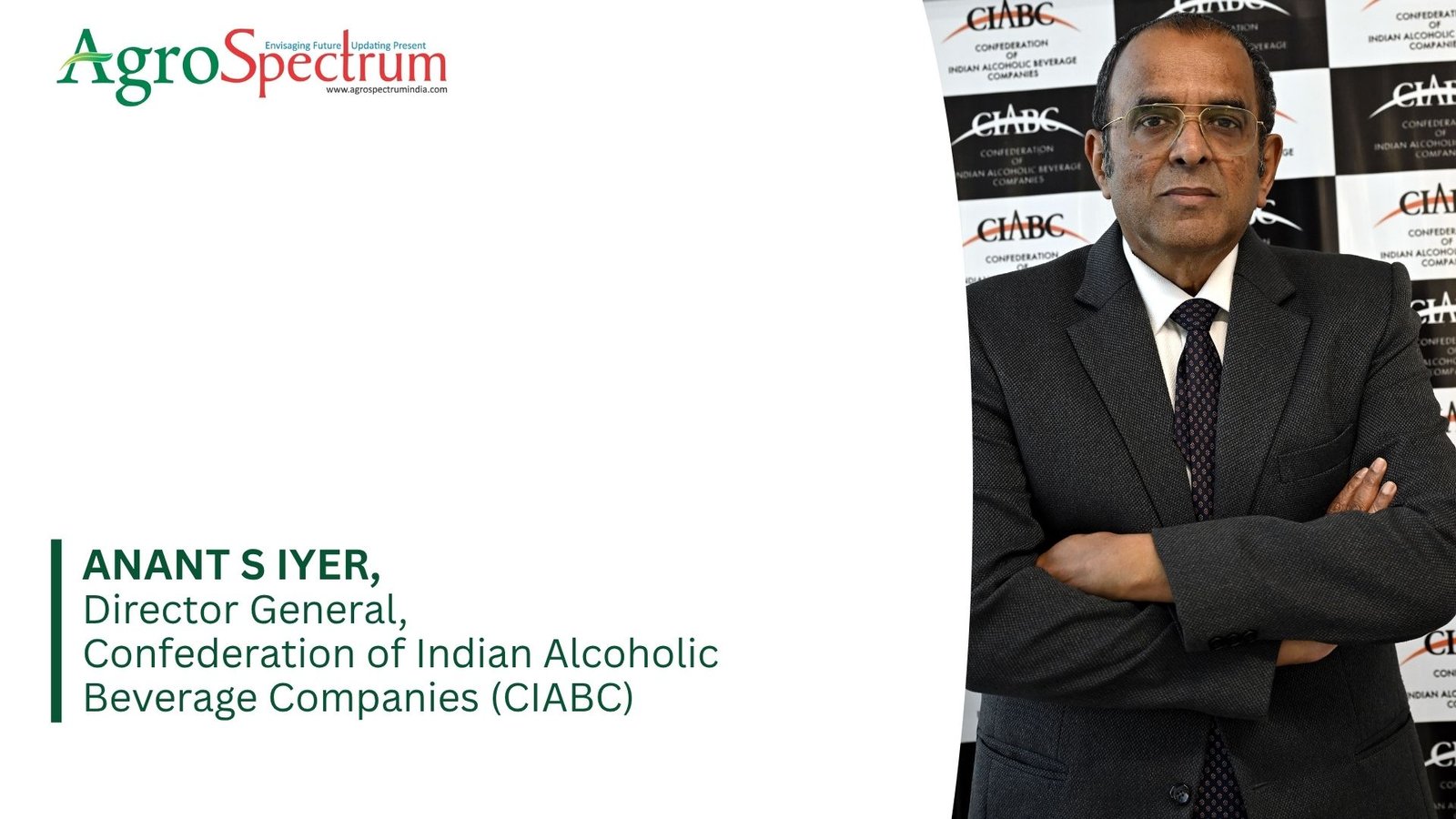
CIABC calls for category-neutral taxation and warns against policy distortions driven by simplistic alcohol-strength narratives
In an exclusive interview with AgroSpectrum, Anant S Iyer, Director General of Confederation of Indian Alcoholic Beverage Companies (CIABC), argues that Karnataka’s alcohol taxation debate is increasingly trapped between fiscal compulsions and simplistic public-health assumptions that fail to account for actual consumption behaviour. He challenges the perception that lower-ABV beverages such as beer are inherently safer, asserting that alcohol harm must be evaluated through total consumption volume rather than category labels alone, while warning that disproportionate taxation on lower IMFL slabs risks destabilising the regulated legal market.
Iyer further contends that excise policy must recognise the industry’s deep economic linkages with agriculture, rural livelihoods, manufacturing and state revenues instead of treating it as an isolated vice sector. As states intensify duty-led revenue extraction amid inflationary and geopolitical pressures, he cautions that excessive taxation could eventually trigger structural market distortions, including downtrading, illicit trade expansion and long-term erosion of fiscal sustainability.
If IMFL generates 4–6 times higher excise revenue per case than beer, does promoting beer through policy incentives amount to a deliberate trade-off of fiscal efficiency for public health objectives, and is that trade-off explicitly acknowledged in state excise design?
If policy design makes beer relatively cheaper or more favourably treated compared to IMFL, it does amount to a trade-off in fiscal efficiency. The concern is that such a framework may be built on the assumption that lower-strength alcohol categories are inherently safer, while higher-strength categories are automatically more harmful.
That is an incomplete way of looking at alcohol consumption. Alcohol-related harm is not determined only by the strength printed on the label. It depends on how much alcohol is consumed, the serving size, frequency of consumption and broader behavioural patterns. In other words, it is not only what one drinks, but how much one drinks that becomes relevant.
For example, a 650 ml bottle of strong beer at 8 per cent ABV contains around 52 ml of pure alcohol, which is broadly comparable to two standard servings of IMFL at 42.8 per cent ABV. Therefore, to suggest that one alcohol type is better or safer purely because its strength per ml is lower is a fallacy.
From a revenue perspective, IMFL contributes significantly higher excise revenue per case. If policy incentives lead consumers to shift from IMFL to beer, the State may lose revenue without necessarily achieving proportionate public health gains. Such a trade-off, if intended, should be explicitly modelled and transparently acknowledged in excise design.
When CIABC argues that category-neutral policy is essential, how should regulators reconcile structural differences in alcohol content, consumption volume and tax yield without implicitly favouring one category over another?
Category-neutral policy does not mean ignoring structural differences between alcohol categories. It means that those differences should be assessed through comparable and objective parameters such as alcohol content, serving size, actual consumption volume, tax yield, route-to-market structure and market impact.
Across states, excise policies have generally been designed to enhance revenue year-on-year without overt discrimination between alcohol categories in so far as excise duty is concerned. Differences, if any, are usually seen in distribution and route-to-market structures. For example, in some states, departmental stores or standalone vends may be permitted to buy and sell wine, beer or RTDs under differential licence fee structures.
The key point is that excise duty should not implicitly favour one category merely because it is perceived as milder. A lower alcohol percentage does not automatically translate into lower alcohol impact if the product is consumed in larger volumes. A 650 ml strong beer can deliver alcohol comparable to two standard servings of spirits.
A level playing field would require all categories to be assessed on comparable principles. If the design makes one category significantly more attractive merely because of lower ABV, without considering actual volume of consumption and revenue contribution, it can unintentionally favour that category.
The risk is that revenue extraction may follow a simple but problematic pattern: higher taxes on spirits to drive revenue and lower taxes on low-alcohol beverages to drive consumption shifts. Such an approach can distort the market unless carefully calibrated.
At what precise threshold does excise-led premiumisation shift from being a revenue optimisation strategy to becoming demand suppression in lower IMFL slabs, particularly given the reported 6 per cent volume decline post-duty hikes?
There is no precise universal threshold because the impact varies by state, income level, consumer behaviour, pack size, category mix and price elasticity. However, there is enough anecdotal evidence as well as actual experience in the past to show that price increases in lower slabs can lead to revenue depletion on a like-to-like basis.
In such cases, excise revenue enhancement happens only because duties are increased year-on-year, not because of genuine volume growth. The lower slabs are highly sensitive to price increases and display clear price elasticity. When consumers in these slabs are repeatedly exposed to duty-led price increases, demand can stagnate, decline, or shift to other categories and channels.
Premiumisation is healthy when consumers voluntarily move to better-quality products due to rising incomes, brand preference and improved product experience. It becomes demand suppression when mass, lower-priced products are made unaffordable through taxation.
Mass, lower-priced products account for the bulk of IMFL volumes and have already seen pressure after recent duty increases. Therefore, any further escalation must be carefully calibrated. The objective should be to support premiumisation without destabilising the regulated legal market.
If 85 per cent of IMFL volumes are concentrated in lower slabs 1–5, does continued taxation pressure in this segment represent strategic upgradation of consumption or unintended erosion of mass-market accessibility?
If 85 per cent of IMFL volumes are concentrated in Slabs 1 to 5, continued taxation pressure in this segment is more likely to create unintended erosion of mass-market accessibility rather than genuine strategic upgradation.
There is also an important regional context. Unlike several parts of North, West and East India, where country liquor forms a separate low-price category, southern states have banned country liquor. Consequently, lower-priced regulated IMFL becomes the affordable entry point for many consumers and plays an important role in keeping consumption within the legal and quality-compliant market.
If these lower-priced regulated spirits become disproportionately expensive, it can alter consumer choices in ways that affect legal market volumes, State revenue, employment and the broader manufacturing ecosystem. It may also create unintended social and market consequences if consumers move away from regulated products.
Genuine upgradation happens when consumers move to premium products by choice. It should not be forced through sudden tax-led price escalation in the lower slabs. A responsible excise framework must protect access to regulated legal products while gradually encouraging value-led premiumisation.
How should governments evaluate whether revenue growth is being driven by real consumption expansion versus price inflation, especially in a market facing simultaneous input cost shocks and currency depreciation?
Revenue growth should be evaluated the way it is done in any other industry: by separating price-led growth from real volume-led growth.
Governments should examine category-wise volumes, slab-wise movement, MRP increases, product mix, input cost inflation, currency impact and changes in consumer behaviour. If revenue is rising only because duties and prices are increasing, while volumes are flat or declining, then the growth is not structurally healthy. It is revenue growth through inflation, not market expansion.
In our experience, State Governments tend to increase duties year-on-year through various levies at their disposal. They are often more focused on revenue growth than volume expansion. However, for long-term fiscal stability, it is important to understand whether the legal market is actually expanding or whether consumers are merely paying more for the same or lower volumes.
Market forces should be allowed to determine pricing and quality points. Companies balance short-term market realities with long-term consumer, stakeholder and investor interests. Excise policy should not become a substitute for normal commercial pricing.
CIABC highlights systemic spillovers into agriculture and allied industries. Should alcohol policy explicitly account for upstream rural economic dependency, or does that risk embedding structural demand reliance on a regulated vice sector?
Excise policy should explicitly account for upstream rural and economic dependency because the production of spirits is deeply interlinked with agriculture and allied industries.
Spirits production depends on Extra Neutral Alcohol (ENA) and bulk spirit, which are derived from agricultural sources. Molasses comes from sugar production from sugarcane. Grain-based alcohol uses carbohydrate sources such as rice, maize and other grains. In many cases, the rice used for distilling ENA is broken rice or rice that cannot find a market for direct human consumption in the conventional sense.
Therefore, alcohol production and agricultural produce are interlinked and interdependent. The industry supports farmers, sugar mills, grain suppliers, packaging, logistics, manufacturing and employment.
Recognising this linkage does not mean encouraging irresponsible consumption. It simply means that policy should not treat the sector as an isolated retail category. Alcohol is a legitimate regulated industry with significant upstream economic impact. A balanced policy should combine sensible regulation with recognition of these rural and allied-sector dependencies.
If beer is often positioned as a lower-risk category in public health discourse, how should policymakers weigh epidemiological arguments against the reality of higher consumption volumes that may neutralise per-unit alcohol advantages?
Policymakers should evaluate total alcohol intake rather than relying only on category perception. Beer may have lower alcohol per ml, but it is generally consumed in larger serving sizes. Therefore, higher consumption volume can neutralise or even outweigh the per-unit alcohol advantage.
A 650 ml bottle of strong beer at 8 per centABV contains around 52 ml of pure alcohol, which is broadly comparable to two standard servings of IMFL at 42.8 per cent ABV. This shows why category-based assumptions can be misleading.
It is also important to recognise that alcohol consumption patterns vary across markets. In many Western markets, beer forms a large share of alcohol consumption by volume, while spirits account for a smaller share. Heavy beer consumption has also been a relevant factor in alcohol-related public health concerns in those markets.
Therefore, it is not accurate to assume that beer is automatically harmless or materially safer merely because it is lower in strength per ml. The relevant policy measure should be actual alcohol consumed, not the category name.
Is the current excise architecture in states like Karnataka evolving toward a consumption-shaping policy instrument, or does it still primarily function as a revenue extraction mechanism with incidental behavioural effects?
The current narrative around the proposed reform appears to be moving towards a consumption-shaping policy instrument. However, in practical terms, excise policy will still primarily function as a revenue extraction mechanism unless it is supported by broader public health and behavioural interventions.
Taxation alone cannot manage behavioural or health outcomes. If governments wish to address public health concerns, they should do so through separate and targeted initiatives, as is done in other sectors. These may include responsible retailing, awareness programmes, enforcement against drunk driving, legal drinking age compliance, quality standards and regulated availability.
Excise duty should not become a blunt instrument that distorts categories or price-regulated products beyond the reach of consumers. If prices go out of reach of the masses, substitution effects can take place through illicit markets or other harmful alternatives. This can create wider law-and-order and public health concerns.
Therefore, excise policy should balance revenue stability, category neutrality, affordability in the legal market and responsible consumption measures.
In a scenario of sustained input cost inflation and geopolitical volatility, what is the long-term fiscal ceiling for excise escalation before it triggers irreversible structural shifts in consumption patterns, substitution effects, or illicit market expansion?
The fiscal ceiling is reached when additional duty increases stop producing sustainable revenue expansion and instead begin to distort the market.
The warning signs are declining legal volumes, downtrading, substitution into lower-yield categories, pressure on working capital, cross-border movement and expansion of illicit or unregulated markets.
Excise tax cannot be escalated indefinitely. A tax that keeps increasing does not necessarily reduce consumption in a clean or predictable manner. It can simply push consumers towards cheaper, unsafe, informal or substitute products.
Governments should allow market forces to determine pricing and quality points. Regulation should focus on availability, accessibility and quality. Availability can be governed through store numbers and location. Accessibility can be governed through legal drinking age and responsible retailing. Quality protocols are already embedded through FSSAI and excise compliance frameworks.
Alcohol is a legitimate regulated industry that generates employment, investment and upstream benefits to agriculture. The sustainable approach is sensible regulation, predictable taxation and stable market-based pricing rather than continuous duty escalation.
— Suchetana Choudhury (suchetana.choudhuri@agrospectrumindia.com)