Saturday, 11 July 2026

India’s agricultural future hinges not on expanding cultivable land, but on intensifying productivity through irrigation expansion, climate-resilient technologies, and restoration of degraded ecosystems across rainfed and dryland regions
While India’s total geographical area is 328 million hectare, approximately 145 million hectare is actually cultivable. Non-cultivable land accounts for around 180 million hectare, 55 per cent of the total land. Nearly 85 million hectare around 60 per cent, fall under dryland agriculture, which supports approximately 70 per cent of the rural population and 60 per cent of the livestock. Despite agriculture’s enduring importance, an important question remains—how much of India’s total land area can be brought under cultivation? This is critical, as it influences policy decisions, resource allocation, and long-term sustainability.
With rising population pressures, climate challenges, and land degradation, understanding the true extent and quality of cultivable land has become increasingly important. A deeper analysis of land distribution not only highlights existing constraints but also points to opportunities to improve productivity, restore degraded areas, and manage resources efficiently. Such insights are essential for ensuring sustainable agricultural growth and strengthening the resilience of India’s food systems.
| States | Total area (Lakh Hectares) (Approx) | Cultivable land (Net sown area) (Lakh Hectares) (Approx) | Non-cultivable land (Lakh hectares) |
| Andhra Pradesh | 163 | 80 | 80 |
| Andaman & Nicobar | 82 | 7 | 75 |
| Arunachal Pradesh | 84 | 4 | 80 |
| Assam | 78 | 28 | 50 |
| Bihar | 94.16 | 57 | 37 |
| Chandigarh | 1 | 0.3 | 0.7 |
| Chhatisgarh | 137 | 47 | 90 |
| Dadra & Nagar Haveli and Daman & Diu | 6 | 3 | 3 |
| Delhi | 15 | 8 | 7 |
| Goa | 37 | 2 | 35 |
| Gujarat | 196 | 97 | 99 |
| Haryana | 44.21 | 36 | 8 |
| Himachal Pradesh | 56 | 10 | 46 |
| Jammu and Kashmir | 222 | 30 | 192 |
| Jharkhand | 80 | 38 | 42 |
| Karnataka | 191 | 98 | 93 |
| Kerala | 39 | 20 | 19 |
| Ladakh | 59 | 1 | 58 |
| Lakshadweep | 0.3 | 0.1 | 0.2 |
| Madhya Pradesh | 308 | 155 | 153 |
| Maharashtra | 308 | 179 | 129 |
| Manipur | 22 | 6 | 16 |
| Meghalaya | 22.43 | 3 | 19 |
| Mizoram | 21.08 | 2 | 19 |
| Odisha | 155.71 | 61.8 | 94 |
| Puducherry | 5 | 3 | 2 |
| Punjab | 50.36 | 42.26 | 8.1 |
| Rajasthan | 342.2 | 173 | 169 |
| Sikkim | 7 | 1 | 6 |
| Tamil Nadu | 130.3 | 63 | 67 |
| Telangana | 112 | 63 | 67 |
| Tripura | 10.49 | 2.72 | 7 |
| Uttar Pradesh | 240 | 168 | 72 |
| Uttarakhand | 53.48 | 11 | 42 |
| West Bengal | 89 | 54 | 35 |
| 3461.72 | 1554.18 | 1920 |
The state of Telangana has witnessed a substantial expansion in its cultivated area since 2014. According to the Economic Survey 2025–26 by the Ministry of Finance, Department of Economic Affairs, Government of India, nearly 70 per cent of this increase is attributed to major state-led initiatives such as the Kaleshwaram Lift Irrigation Project and Mission Kakatiya. The cultivated area in the state grew from 1.31 crore acre in 2014 to 2.2 crore acres by 2023–24, driven largely by these flagship irrigation and tank rejuvenation efforts.
Andhra Pradesh has implemented the AP Resurvey Project using drones and GIS to digitise land records, with 6,901 villages covered and 81 lakh land parcels resurveyed by 2025, facilitating better land management.
Uttar Pradesh has achieved 70 per cent of its target for agricultural land allotment to landless and marginal farmers in 2025-26, enhancing overall agricultural output and utilising residual moisture for better rabi season coverage.
Bihar has launched the Mukhyamantri Samekit Chaur Vikas Yojana (2025) to convert chaur (waterlogged) lands into productive aquaculture areas, covering over 1,933 hectare.
Rajasthan, Gujarat, Haryana, and Delhi have been identified as priority areas for the Aravalli Landscape Restoration initiative (2025-2034), focusing on restoring degraded land and enhancing soil health. Assam increased its gross irrigated area to 24.28 per cent of agricultural land by 2024–25 through new irrigation schemes and solar pumps.
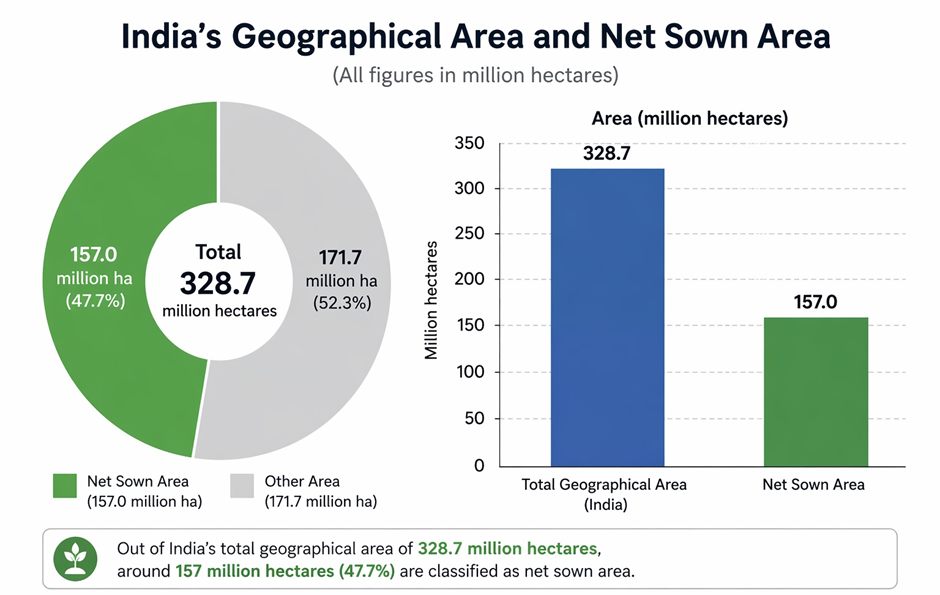
Source: Ministry of Agriculture and Farmer’s Welfare and Farmonaut
Increasing yield per hectare
Indian agriculture is increasingly confronted with challenges such as climate change, erratic monsoon patterns, groundwater depletion, declining soil fertility, and unstable farm incomes. In this scenario, expanding cultivable land is neither practical nor sustainable. Instead, the priority must shift toward unlocking and optimising the full potential of dryland agriculture.
Boosting agricultural output most effectively hinges on increasing yield per hectare through a combination of technological innovation and refined agronomic practices. Achieving this requires an integrated approach that brings together advancements in crop genetics, soil health management, water-use efficiency, and precision farming techniques.
Prof (Dr) C D Mayee, President, South Asia Biotechnology Centre, New Delhi; Chairman, AFC, Mumbai, Executive Board Member, ABNE (Burkina Faso), ISAAA (USA) and President, Indian Society for Cotton Improvement, Mumbai, advocates key strategy to improve agricultural productivity per hectare is to expand the area under irrigation. In Maharashtra, the gross cropped area stands at 23.6 million hectare, while the net cropped area is 16.7 million hectare. However, only about 17–19 per cent of this area is irrigated. Of the roughly 6 million hectare under irrigation, just 1.3 million hectare are covered by drip systems.
Mayee adds, “Although Maharashtra is among the leading states in adopting micro-irrigation, there remains substantial untapped potential. The state has set an ambitious target of bringing 30–35 per cent of its cultivated area under micro-irrigation over the next decade, which could significantly enhance crop productivity.”
Says C S Jadhav, CEO and Co-Founder of Hyderabad-based Nutricircle, “Adoption of heat-tolerant and short-duration crop varieties that can withstand terminal heat and erratic rainfall, ensuring crop stability and enabling better crop rotations. In parallel, precision irrigation and moisture conservation techniques, such as drip systems and water harvesting, can significantly improve water-use efficiency in rainfed regions. Further, integrated nutrient management, combining organic inputs with balanced fertilisation, is essential to restore soil health and enhance productivity.
Contingency plans
Currently, India is developing a contingency framework to address delayed and erratic monsoons, especially in rainfed regions such as Maharashtra and Rajasthan.
Research institutions such as the International Crops Research Institute for the Semi-Arid Tropics, Indian Institute of Pulses Research, Vasantrao Naik Marathwada Krishi Vidyapeeth, Indian Institute of Millets Research, Mahatma Phule Krishi Seva Kendra, Central Research Institute for Dryland Agriculture, and the Central Arid Zone Research Institute have developed a range of crop varieties tailored for rainfed ecosystems, featuring traits such as drought tolerance, early maturity, high yield potential, stress resilience, and enhanced protein content.
Shanmugam Sambanthan, Head- Agriculture (South Asia, Middle East and Africa), Novonesis, recommends the adoption of hybrid and climate-resilient seed varieties and scaling R&D activities related to it, improving irrigation infrastructure, inclusive of water harvesting and conservation and large-scale adoption of biosolutions for improving soil health and climate resilience.
How has acreage under Kharif and Rabi crops changed over the last 3–5 years?
Between 2020 and 2025, India’s cropping pattern reflects a relatively stable Kharif area with only modest expansion, while the Rabi-cropped area has shown a consistent upward trend. As a result, the overall gross cropped area has increased gradually—not through an expansion of net sown land, but due to rising cropping intensity and the wider adoption of multiple cropping systems.
Suresh Babu, Senior Research Fellow Emeritus at the International Food Policy Research Institute (Washington, DC), observes a clear shift in cropping patterns toward high-value segments such as fruits, vegetables, and inland fisheries. According to Suresh Babu, Andhra Pradesh, for instance, has emerged as a leading horticulture hub, while its coastal districts are witnessing a strong aquaculture boom. However, the continued policy emphasis on Minimum Support Prices (MSPs) for rice and wheat discourages farmers from transitioning to higher-value crops. In contrast, Telangana has rapidly evolved into a major rice-producing state, driven largely by recent expansions in irrigation infrastructure.
Restoring graded land
The cost to restore degraded land in India typically ranges from Rs 20,000 to Rs 1,00,000 per hectare, depending on the severity of degradation. Lightly degraded land requires minimal inputs, while moderately degraded land needs soil improvement and water management. Severely degraded land may involve reclamation measures and infrastructure, increasing costs. The overall cost depends on soil condition, water availability, and restoration methods used.
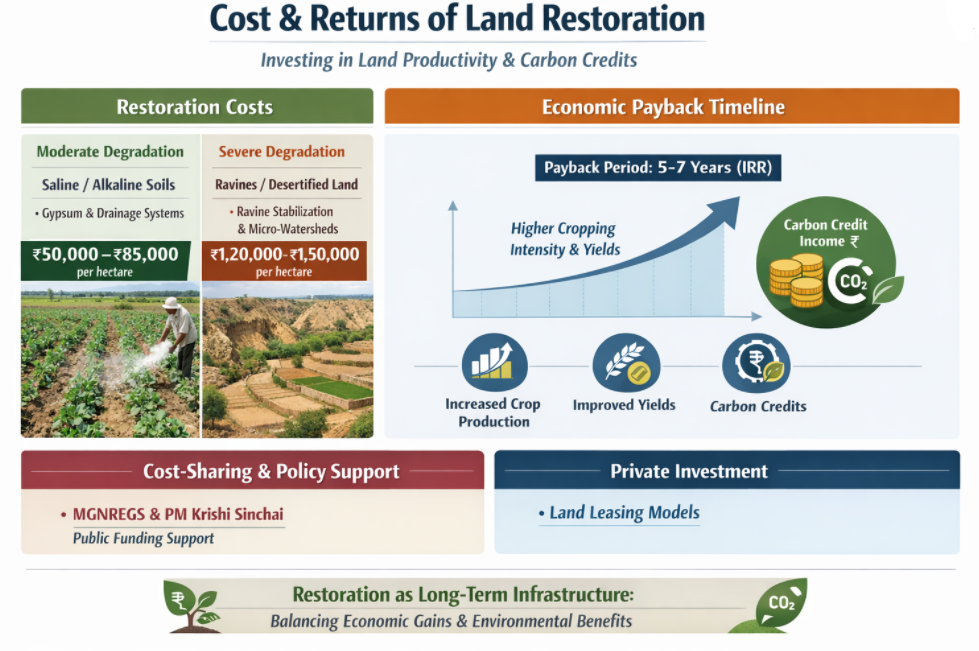
(With inputs from Somaiya Vidyavihar University)
Structural shift in cropping patterns
India’s agricultural growth is increasingly coming from higher-cropping intensity and diversification rather than expansion of cultivable land. Key drivers behind this shift include groundwater depletion in major rice-growing regions, climate variability affecting monsoons, supportive government policies promoting pulses and oilseeds, and evolving market demand for protein-rich and sustainable crops.
Dr Shalu Choudhary, Deputy Manager-Regulatory, Mahyco, mentions, “An effective strategy to increase yield per hectare involves integrating genetics, soil health, water management, and precise agronomy. This includes developing and using high-yielding, genetically improved crop varieties or hybrids with resistance to local pests and diseases and tolerance to stresses such as heat and drought. It also requires proper soil management, efficient water use, adoption of Integrated Pest Management (IPM) practices, effective weed control, and improved overall crop management practices.”
Says Prof Jagannath Nirmal, Agritech Expert and Professor, Somaiya Vidyavihar University, “We are seeing the beginning of a gradual diversification, though it is not yet a total structural retreat. While rice and sugarcane still recorded peak production in 2025-26, policy interventions like ‘Per Drop More Crop’ and ethanol blending targets are successfully nudging farmers toward maize and oilseeds. The shift is most visible in water-stressed regions of Haryana and Punjab, where state-led ‘Crop Diversification Programmes’ provide financial incentives to switch from paddy to pulses or horticulture.”
India’s fallow land issue
States like Rajasthan and Maharashtra resort to the fallow land strategy. This is mostly due to erratic monsoon and water scarcity. Farmers to ensure restoration of soil fertility, conserve moisture, control pest and disease cycles, irrigation issues, etc., resort to the fallow land strategy.
Long fallow land, left unused for several years, faces structural challenges such as soil degradation, water scarcity, and low economic viability. Key constraints across fallow categories include water limitations, declining soil health, fragmented landholdings, labour shortages, and weak value chains.
Outlook
India’s challenge is not the scarcity of land, but the declining quality of its productive land. The future of agriculture will depend less on expanding cultivated areas and more on restoring degraded land, improving soil health, and enhancing water retention. Sustainable gains will come from smarter land management and focused intensification. Well-designed policies, backed by timely and effective implementation, will be crucial for long-term success.
— Sanjiv Das ( sanjiv.das@mmactiv.com )