Saturday, 11 July 2026

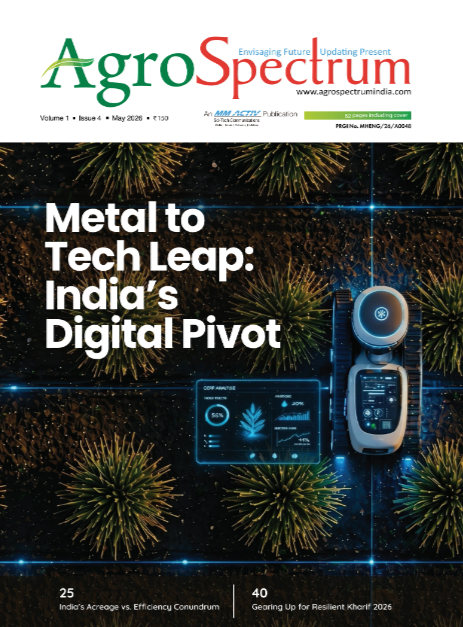
India’s farm mechanisation sector is rapidly evolving from conventional metal-based machinery to AI-driven precision tools, IoT-enabled systems, drones, and autonomous equipment, as rising labour shortages, sustainability demands, government-backed digital agriculture initiatives, and growing global demand for cost-effective low-horsepower machinery create new export and innovation opportunities for Indian manufacturers
India’s farm mechanisation sector is shifting from traditional metal-based machinery to digital technologies like IoT sensors, AI-driven precision tools, drones, and autonomous equipment, driven by labour shortages, sustainability needs, and government initiatives such as the Digital Agriculture Mission.
Driven by their ability to produce cost-effective, durable, and low-horsepower equipment suitable for small and medium-sized farms, Indian farm mechanisation companies are exploring significant opportunities in global markets. The global demand for agricultural machinery is rising, with a projected market value exceeding $400 billion by 2030, presenting a substantial growth opportunity for Indian manufacturers in Southeast Asia, Africa, and Latin America.
IoT devices and robotics allow real-time monitoring of soil health and automated tasks such as spraying and tilling, reducing manual labour. Government support through platforms like Agri-Stack and AI advisories further accelerates this digital leap.
Farm mechanisation is evolving significantly. The future farm mechanisation is not merely about larger machines but about smarter, more adaptable machines. Semi- and fully autonomous tractors, robotic harvesters, drone-based crop monitoring, and small modular equipment capable of operating efficiently in fragmented landholdings will become increasingly important. According to data from the Ministry of Agriculture & Farmers Welfare, farm mechanisation in India has reached 40–45 per cent across major states. This shows strong tractor use across key farming regions. Data from the Food and Agriculture Organisation (FAO) shows that using machines can increase farm output by 30–40 per cent, especially in developing countries like India.
According to a report by Crisil Ratings released in March 2026, India’s tractor sales are projected to grow by just 0–2 per cent in fiscal year 2027, translating to approximately 1.2 million units. The slowdown follows an estimated 22 per cent year-on-year rise in FY2026, making the current fiscal a difficult base for comparison.
Crisil expects operating margins to remain at 13.0 — 13.5 per cent in FY2027 despite the projected volume slowdown, in line with the current fiscal, aided by operating leverage and a stable pricing environment. Revenue growth is expected to track volume growth closely.
Capital expenditure for FY2027 is estimated at Rs 5,000–6,000 crore, which OEMs are expected to fund largely through internal accruals. As a result, balance sheets are projected to remain healthy, supported by a cash surplus, keeping credit profiles intact across the sector, as per Crisil report.
Farming conditions in India present a unique advantage. Landholdings are small, operations are fragmented, and mechanisation levels are still below 50 per cent. In several areas such as sugarcane harvesting and crop residue management, adoption remains low. This creates a strong environment to test and scale digitally led machines at a practical level. Technologies such as precision guidance, telematics, and remote diagnostics can be refined in real working conditions. This helps improve field efficiency, reduce fuel use, and ensure better machine uptime across varied terrains.
To read more, click: https://online.anyflip.com/unmb/pewj/mobile/index.html