Sunday, 12 July 2026

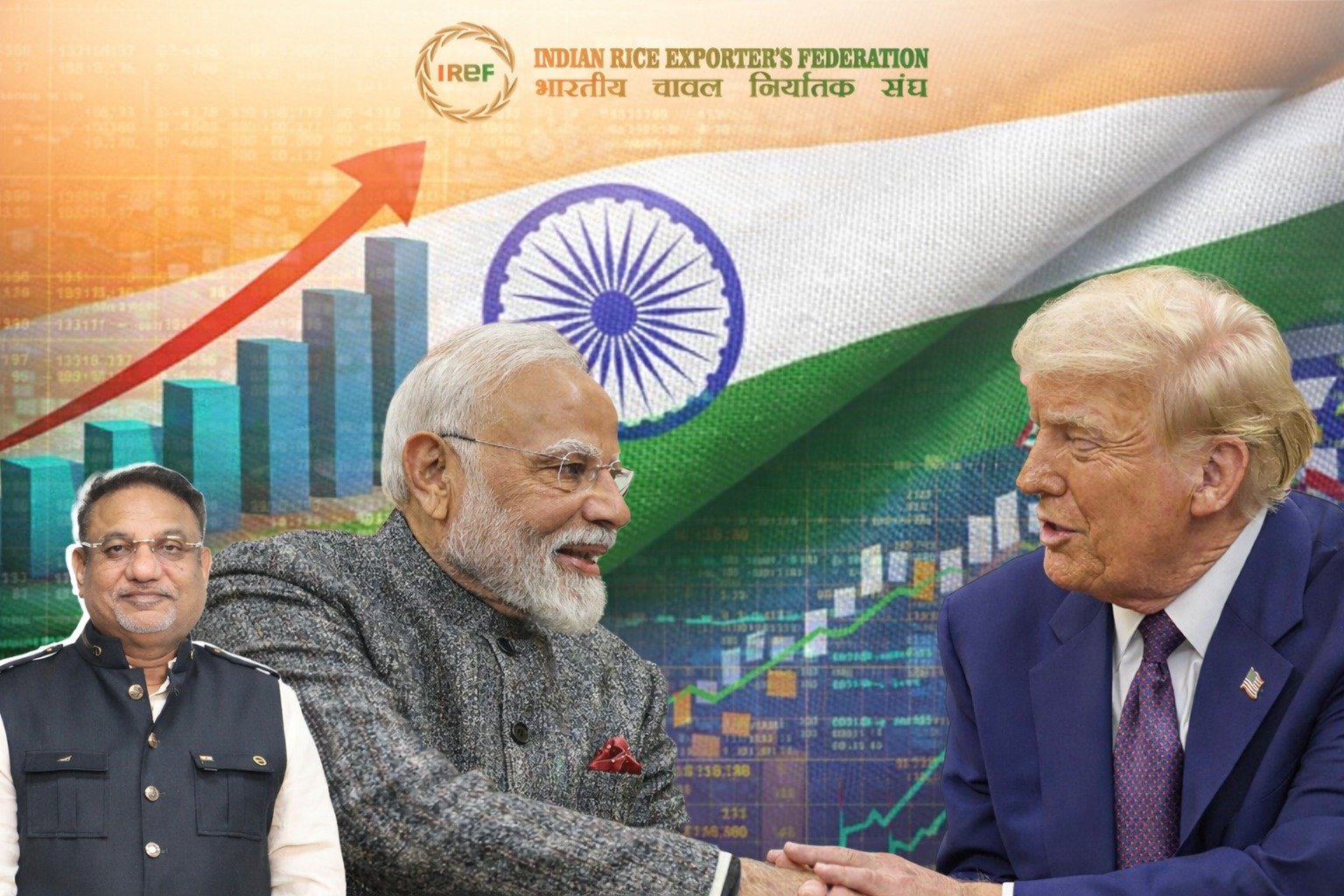
The Indian Rice Exporters Federation (IREF), clarifies the potential impact of the recently announced indication that Indian-made goods may be subject to an 18 per cent tariff, compared with the earlier 25 per cent rate.
The trade is also expecting that, in view of public statements by US authorities, the additional penalty being discussed in relation to India’s purchase of Russian oil may be waived. If confirmed, this would effectively reduce India’s tariff burden from the current elevated level to 18 per cent, restoring parity with key competing origins such as Thailand and Pakistan, where competitor nations are currently tariffed at around 19 per cent.
The Federation welcomes this move, and notes a wave of positive sentiment across the rice export industry, as tariff parity is expected to translate into improved competitiveness and stronger demand in key markets.
IREF views this as a meaningful positive for Indian rice exports at a time when India is entering the season with record production of approximately 149 million metric tonnes, strong availability, and resilient domestic fundamentals. Indian agri products continue to hold an indispensable position in global supply chains, and recent shipment patterns suggest clear demand resilience even under sharply higher duties.
Notably, India’s rice exports to the United States rose despite a steep increase in duty—from 10 per cent initially to 50 per cent—underscoring that Indian rice remains essential for buyers and consumers. This trend reinforces the Federation’s view that India’s competitiveness is structurally strong, and that tariff parity will translate quickly into higher volumes and improved price positioning.
A tariff reset would improve landed-price competitiveness and support stronger offtake across both basmati and non-basmati categories, enabling India to defend and expand market share in the United States while competing more effectively against other origins.
Separately, there have been questions on whether an additional tariff could be imposed in connection with India’s trade with Iran. The Federation notes that evolving trade frameworks, including prospective free trade agreements, often reflect broader strategic alignment and not only commercial considerations. Based on current visibility, IREF does not anticipate further disruption to India’s trade with Iran and expects continuity in export flows.
Dev Garg , Vice President, IREF, says that the Federation will continue engaging with stakeholders to ensure exporters are prepared for any procedural changes and to support stable, rules-based trade that benefits consumers and supply chains.