Saturday, 20 June 2026

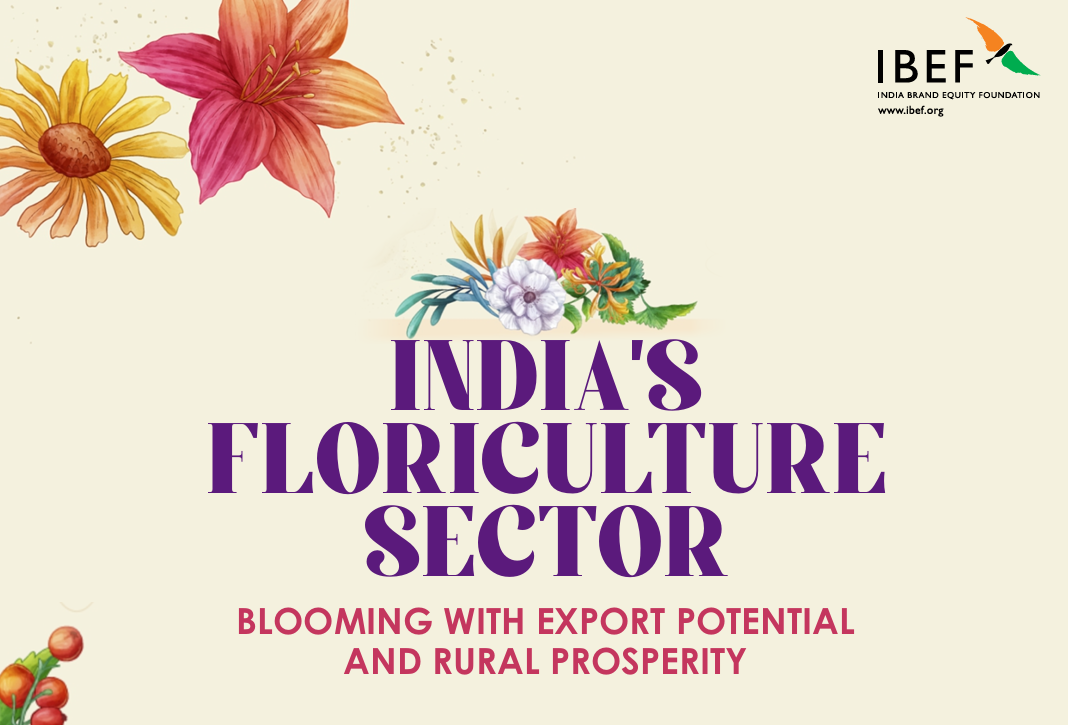
From temple garlands to premium export bouquets, flowers are fast becoming a serious economic crop.
India’s floriculture sector is shedding its image as a niche horticultural activity and emerging as a globally competitive industry with strong potential for rural income generation, export diversification, and employment creation. Backed by policy support, technological adoption, and rising global demand, floriculture is increasingly positioning itself as a strategic pillar of India’s agri-export economy, according to data and analysis from the India Brand Equity Foundation (IBEF).
With 2.85 lakh hectares under cultivation in FY24 and total flower production exceeding 3.2 million metric tonnes, India today ranks as the second-largest flower producer globally, after China. What was once dominated by small, localised markets has evolved into a modern, export-oriented value chain spanning cut flowers, ornamental plants, foliage, and high-value exotics.
From niche to national export engine
Long confined to religious use and local trade, the Indian floriculture industry has expanded into a dynamic segment of horticulture contributing to exports, rural livelihoods, and value-added agriculture. Advances in seed quality, greenhouse cultivation, cold-chain logistics, and government-backed subsidies have enabled a shift from subsistence farming to organised commercial production.
States such as Tamil Nadu (21 per cent), Karnataka (16 per cent), Madhya Pradesh (14 per cent), and West Bengal (12 per cent) dominate national output, while emerging regions like Mizoram and Sikkim are carving out niches in orchids and anthuriums. Each geography has leveraged agro-climatic strengths to specialise—marigolds and jasmine in Tamil Nadu, roses and gerberas in Karnataka, gladiolus and chrysanthemums in West Bengal.
Export clusters in Bengaluru, Pune, and Hosur have further integrated growers with global markets, reducing transaction costs and improving quality compliance.
Exports gain momentum
India’s floriculture exports have shown steady growth over the past five years, rising from Rs 1,600 crore in FY21 to nearly Rs 2,000 crore in FY25, as per IBEF and APEDA data. Fresh and dried cut flowers account for nearly 72 per cent of exports, followed by foliage, rooted cuttings, and planting material.
The United States has emerged as India’s largest export destination, followed by the Netherlands, Bangladesh, the UAE, and Malaysia—a mix that underscores India’s growing relevance in both mature and emerging flower markets.
A notable milestone was the successful export of Anthurium flowers from Mizoram to Singapore, demonstrating how targeted institutional support, farmer aggregation, and market linkages can unlock export potential even in remote regions.
Beyond beauty: livelihoods and value chains
Domestically, floriculture continues to play a vital cultural role—from worship and weddings to urban landscaping and gifting. But its economic footprint extends further into perfumery, cosmetics, pharmaceuticals, natural dyes, and wellness products, creating multi-sectoral value chains.
Rising urban incomes, event-led consumption, and hospitality demand are driving year-round demand for consistent quality, accelerating the shift toward protected cultivation and high-value hybrids. At the same time, women-led cooperatives, agri-startups, and NE-region producer groups are increasingly visible across the sector.
The road ahead
Despite strong fundamentals, IBEF notes that the sector’s full potential remains constrained by gaps in logistics, cold-chain infrastructure, quality certification, and export awareness. Addressing these bottlenecks will be critical if India is to compete with established global players like the Netherlands, Colombia, and Kenya.
Policy initiatives under the National Horticulture Mission, APEDA support, and state-level interventions have laid the groundwork. What’s needed next is a unified strategy that integrates infrastructure, innovation, inclusion, investment, and internationalisation.
Floriculture, once seen as ornamental, is now emerging as an instrument of sustainable livelihoods and inclusive growth. With coordinated stakeholder action, India’s flowers could soon become not just symbols of beauty—but of economic resilience and global ambition.
— With data and insights from the India Brand Equity Foundation (IBEF)