Monday, 15 June 2026


India’s 2030 farm vision centres on embedding drones within a larger digital agriculture ecosystem that links data, advisory, finance, and markets to empower small and marginal farmers. In this article, Agnishwar Jayaprakash, Founder and CEO of Garuda Aerospace, explains how drones are evolving from spraying tools into powerful “edge devices” that generate high-quality field intelligence, enable precision input use, and strengthen climate resilience. Supported by initiatives like Kisan Drones, Drone Shakti, and Drone Didi, drones are becoming integral to AgriStack, AI-driven advisory platforms, logistics, and insurance verification, helping reduce waste, lower chemical loads, and improve decision-making for smallholders. With phased implementation, skill development, and inclusive ownership models, drones can transform India’s rural economy and make the 2030 digital agriculture vision both scalable and equitable.
It is an unquestionable fact that many small and marginal farmers form the backbone of India’s food system. It is necessary to implement digital agriculture to benefit them and in turn us which can be done effectively through drones. By 2030, the aim is to make drones central to a wider digital farm ecosystem that links data, advisory, finance, and markets into one continuous value chain.
Envisioning a new world for Indian agriculture
In regards to the 2030 we’re envisioning in the agricultural field, a few things that are important are that the change must be data-driven, climate-resilient and inclusive with digitalization there from soil to supply chain. The central government’s Digital Agriculture Mission has been approved with a multi-thousand-crore outline which focuses on the creation of digital public infrastructure such as AgriStack, farmer registries, and decision-support systems to make services precise and targeted.
Pioneering technologies like drones, artificial intelligence and the Internet of Things are a gamechanger here being positioned as growth boosters in terms of productivity, cutting down input use and improving risk management for smallholders. This way, drones are not only gadgets but ‘edge devices’ that generate high-quality field data and execute precise operations within larger data platforms.
What drones actually do on Indian farms
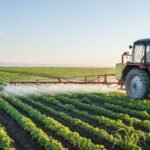
If it’s hard to imagine drones functioning on Indian farms, soon it will become the norm. Drones in India already function on a variety of tasks, such as pesticide and nutrient spraying, crop and yield assessment, soil and field mapping, and even limited crop transport and surveillance.
Drones can be fitted with multispectral and infrared cameras which will allow them to detect moisture stress, pest outbreaks, and nutrient deficiencies earlier than the naked eye, enabling faster and more targeted action. These capabilities directly translate into actual benefits: optimized use of fertilizers and pesticides, reduced labour in hazardous operations like spraying, and better yield forecasting for planning procurement and logistics. This enables smallholders to have more informed decisions on sowing dates, input doses, and risk mitigation with drone-generated data integrated with advisory apps.
Policy decisions and drones
After the highlighting of ‘Kisan Drones’ in the Union Budget, India’s policy ecosystem seems to be moving steadily in favour of drones. The Kisan Drone initiative promotes high-capacity drones for crop assessment, land record digitisation, and spraying, and is linked to subsidy support to build a network of service providers. Complementary schemes such as Drone Shakti and sectoral production-linked incentives aim to develop an indigenous drone manufacturing base and encourage start-ups to provide drone-based services, including in agriculture. Initiatives like Drone Didi, supplying thousands of drones to women-led self-help groups, indicate a deliberate effort to combine technology diffusion with rural livelihood creation.
The many ways drones can help in Indian farms
There is a wide variety of roles drones fulfill in the digital farm ecosystem. The first of these is data acquisition, as drones become the primary tool for generating high-resolution field imagery, crop health indices, and soil variability maps that feed into AgriStack and decision-support systems. Secondly, their ability to be precise in applications such as variable-rate spraying of pesticides, nutrients, and bio-inputs which will cut wastage, reduce environmental contamination, and improve input-use efficiency.
Drones also provide an edge in logistics and last-mile deliveries, with the ability to support short-distance transport of perishable produce, seeds, or critical inputs in difficult terrain. They are also indispensable in the field of security and monitoring in fields, with the capability to help crop theft, wildlife intrusion, and encroachment, especially in large or remote holdings. Aside from all this, drone imagery can serve as objective evidence for loss assessment and area verification, speeding up claims and reducing disputes.
The inclusion of drones with frontier technologies
The real power of drones emerges when combined with AI models and advisory platforms tailored to Indian conditions. AI systems trained on drone imagery can classify crop stress, predict yield, and recommend precise interventions, which can then be delivered to farmers via mobile apps or call centres in local languages. As 5G and rural connectivity improve, near-real-time data flows from drones to cloud-based analytics will become more feasible, making “satellite-plus-drone-plus-sensor” stacks a practical reality on the ground. This convergence also supports better integration with agri-fintech and insuretech solutions, where drone data helps de-risk lending and insurance for small farmers.
Implementing these changes
A pragmatic implementation strategy for India’s 2030 farm vision should focus on phased, inclusive scaling of drones alongside broader digital infrastructure. This includes concentrating drones in agro-climatic clusters (for example, cotton, paddy, or horticulture belts) which will allow rapid learning and demonstration of clear economic gains. Further encouraging farmer producer organisations and women’s self-help groups to own or manage drone fleets can spread costs, create local employment, and improve trust. Developing crop-wise standard operating procedures for drone-based spraying, mapping, and monitoring ensures safety, efficacy, and regulatory compliance. Training rural youth to be licensed drone pilots, technicians, and data interpreters will align with broader employment and skilling goals. Collaborations between start-ups, manufacturers, governments, and research institutions will be vital to align innovation with on-ground needs.
Towards a sustainable 2030
Drones can directly support India’s climate and sustainability objectives in agriculture by improving resource-use efficiency and enabling more precise, lower-chemical farming systems. Targeted spraying reduces chemical load on soil and water, while better detection of stress conditions can reduce crop failure and associated emissions from re-sowing and over-application of inputs. In rain-fed and climate-vulnerable regions, drone-enabled assessment of moisture and crop conditions can help tailor contingency plans, such as shifting varieties or scheduling protective irrigation, enhancing resilience. When integrated with programmes like the National Mission for Sustainable Agriculture, drones become part of broader climate-smart packages rather than isolated tools.
Conclusion
By 2030, the spread of drones in agriculture will also have spillover effects across the rural economy, from manufacturing and repair to data services and training. With deliberate design, programmes like Drone Didi can ensure that women and youth gain a significant share of these new opportunities, transforming drones from symbols of elite tech to everyday tools of inclusive progress. For India’s digital agriculture vision to succeed, drones must be made accessible, context-aware, and tightly woven into farmer-centric digital public infrastructure and local institutions. If executed well, they can help turn the 2030 farm vision from a policy document into visible change on fields; more productive, resilient, and dignified livelihoods for millions of farmers.