Saturday, 18 July 2026



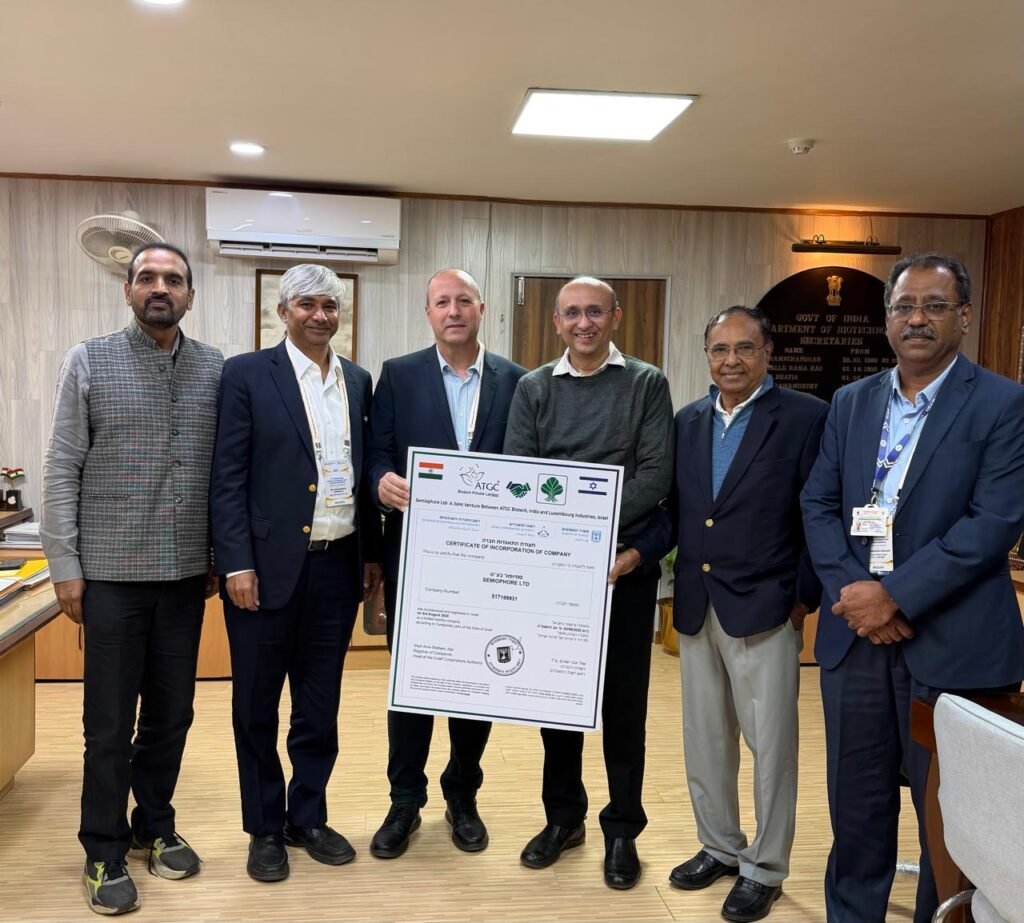
In an exclusive AgroSpectrum interview, Dr. Markandeya Gorantla, Chairman & Managing Director of ATGC Biotech, outlines how the newly formed Semiophore JV with Luxembourg Industries marks India’s first global-scale out-licensing of semiochemical IP and positions the country at the forefront of next-generation, residue-free pest management. He explains that the partnership merges ATGC’s decade-long leadership in pheromone biomanufacturing and controlled-release systems with Israel’s formidable regulatory and commercial networks, creating a platform capable of scaling 18 breakthrough technologies across world markets.
Dr. Gorantla highlights the JV’s sustainability edge—from ultra-low-dose, zero-water delivery to massive reductions in CO₂e, plastic waste, and insecticide load—supported by rigorous field data and lifecycle metrics. Looking ahead, he notes that Semiophore’s long-term roadmap spans next-generation pheromone chemistry, automated deployment, and climate-smart pest-management platforms, aiming to redefine global crop protection and unlock multi-billion-dollar opportunities for India and Israel.
Strategic Vision & Rationale
What was the strategic rationale behind forming the Semiophore JV with Luxembourg Industries, and how does this partnership position ATGC Biotech in the global semiochemical and pheromone market ?
The formation of Semiophore Ltd. with Luxembourg Industries is a strategic step that aligns ATGC’s scientific leadership with a global commercialization engine capable of taking India’s semiochemical technologies to international markets at scale. ATGC has spent more than a decade building deep capabilities in pheromone biomanufacturing, synthetic biology, and material-science–driven controlled-release systems, areas in which India had no industrial presence prior to our work.
Luxembourg Industries, on the other hand, brings more than 50 years of global experience in manufacturing, regulatory operations, and distribution across Israel, Europe, MENA, Latin America, and the United States. The rationale behind Semiophore is to combine India’s innovation strengths with Israel’s proven commercial networks in agriculture, enabling a partnership that neither company could achieve independently.
The JV positions ATGC at the forefront of the global pheromone market one of the fastest-growing segments in sustainable agriculture. It allows India not only to compete, but to lead, in an area historically dominated by European and North American players.
Semiophore represents India’s first international-scale out-licensing of semiochemical IP, a major milestone in India’s bioeconomy journey and a strong signal of confidence in the scientific quality of Indian innovation.
Technology Differentiation
Semiophore will deploy 18 advanced semiochemical and pheromone technologies. Could you elaborate on how these technologies differ from conventional chemical pest management methods in terms of efficacy, sustainability, and adoption potential?
The 18 technologies being deployed through Semiophore represent a fundamentally different approach to crop protection compared to conventional pesticides. Traditional insecticides operate through chemical toxicity they kill insects through neurotoxic or metabolic disruption and require large quantities, repeated spraying, water usage, and leave behind residues that affect human health, export compliance, and ecosystems.
In contrast, ATGC’s pheromone and semiochemical platforms work through behavioral ecology rather than toxicity. By interfering with the mating communication of pests what we describe as “Insect Family Planning” we prevent population buildup without killing beneficial organisms. This is a nature-aligned solution, not a chemical intervention.
Our technologies require just 5 grams per acre, compared to hundreds of grams of conventional pesticides. They offer season-long (up to 6 months) protection through advanced controlled-release systems made from mesoporous materials, nano-enabled matrices, and semi-solid emulsion delivery platforms. They require zero water, eliminating the need for spray equipment and mitigating runoff.
This combination of ultra-low dose, zero residues, and long-duration control positions the technology as one of the most sustainable pest management systems available worldwide, with adoption potential across smallholder and commercial agriculture.
Global Market Deployment: Expected Challenges
With regulatory approvals and registrations planned across Israel, Brazil, Australia, and Africa, what are the major scientific, regulatory, or market challenges you anticipate in scaling these technologies internationally?
Scaling semiochemical technologies across Israel, Brazil, Australia, and Africa involves navigating scientific, regulatory, and market complexities.
Scientifically, pheromone systems are highly pest-specific. Each geography has different climatic conditions temperature, humidity, canopy structure that influence release kinetics and behavioral response. Semiophore will work closely with agricultural universities, entomology departments, and local regulators to optimize dose, spacing, and delivery parameters for each region.
From a regulatory standpoint, every country has its own framework for approving biochemical pesticides, which requires field trials, toxicology assessments, environmental impact data, and manufacturing audits. ATGC’s existing regulatory experience in the US, India, and multiple international programs provides a strong foundation for navigating these pathways.
Marketwise, the largest challenge is behavioral farmers are accustomed to chemical sprays. Semiophore will address this through demonstration farms, season-long monitoring, and extension partnerships that show the tangible economic benefits of shifting to pheromone-based systems.
Despite these challenges, the global shift toward residue-free, climate-positive agriculture creates unprecedented demand for precisely the technologies ATGC has developed.
Sustainability Impact & Metrics
Semiophore emphasizes residue-free, pollinator-safe, and climate-resilient crop protection. How do you quantify or measure the environmental benefits—such as reduced insecticide use, lower CO₂e, water, and plastic footprint—of these technologies?
Semiophore’s technologies are inherently sustainable because they eliminate the externalities associated with conventional chemical pesticides. We quantify these benefits using a combination of field data, lifecycle assessment, and modeling.
Insecticide reduction is measured by comparing conventional spray schedules with 8 to 15 sprays totaling hundreds of grams of active ingredient against pheromone technologies that require only 5 grams per acre.
CO₂e avoidance is calculated from reductions in chemical synthesis, transportation, storage, and repeated spraying operations. Based on ATGC’s current deployments, we estimate 2.5 million tons of CO₂e could be avoided as the technology scales.
Water savings come directly from the zero-water nature of the system; farmers no longer rely on 200–400 liters of water per spray round. Across millions of acres, this results in over 20 billion liters of water saved.
Plastic waste reduction is measured through reduced pesticide container usage, eliminating up to 40,000 tons of plastic annually in large-scale programs.
Together, these metrics create a compelling climate and ESG case for Semiophore, opening the door to carbon-credit generation, green financing, and sustainability-linked partnerships.
Adoption by Farmers
What strategies will Semiophore employ to drive adoption among smallholders and large-scale growers, particularly in regions where conventional chemical pest control is entrenched?
Adoption depends on demonstrating a clear, tangible difference in farmer outcomes. Semiophore will deploy a multi-layered adoption strategy.
For smallholders, the focus will be on simplicity and cost:
A 5-gram product that requires no water
Season-long control
No need for repeated spraying
Compatibility with organic and IPM systems
These advantages significantly reduce farmer labor, costs, and risk.
For large-scale growers, the emphasis is on export compliance and predictability. Pheromone solutions eliminate residues, protect pollinators, and reduce variability in pest pressure critical factors for global markets. Semiophore will also deploy drone-based deployment systems and automation for plantation crops.
The JV will work closely with government programs, cooperatives, and agricultural extension networks, supported by strong data dashboards and field teams. Demonstration plots will serve as the anchor of adoption strategy, showing farmers real-season results.
Innovation, IP, and R&D Leadership
How will ATGC Biotech’s IP, R&D, and technology leadership be leveraged within the JV to ensure continuous innovation and competitive advantage in the global semiochemical space?
ATGC contributes a deep technology stack to Semiophore: 26 granted patents, multiple international filings, and some of the world’s most advanced biochemical delivery systems. Our synthetic biology platform enables cost-efficient pheromone biomanufacturing an area where traditional chemical synthesis has historically been expensive.
Semiophore will benefit not only from ATGC’s existing innovations but from a continuous pipeline of next-generation technologies: enhanced blends, improved release kinetics, hybrid peptide pheromone solutions, nano-enabled matrices, and drone compatible formats.
The JV structure ensures that ATGC retains IP ownership while providing Semiophore with global commercialization rights. This creates a competitive moat that strengthens over time, allowing the JV to lead the semiochemical space with sustained innovation.
Commercial & Economic Impact
Could you share projections for revenue, market capture, and job creation across India and Israel, and how the JV aims to create measurable socio-economic impact in these regions?
The Semiophore JV is expected to catalyze significant economic gains for both India and Israel. In India, it will expand ATGC’s R&D, regulatory, and manufacturing footprint, creating jobs in synthetic biology, analytical chemistry, formulation science, engineering, agronomy, and field operations. The India-based manufacturing and export ecosystem will grow as new markets scale.
In Israel, the JV will generate new employment opportunities in manufacturing, quality control, agronomy, regulatory affairs, and distribution. It will also strengthen Israel’s portfolio of sustainable agricultural inputs, opening export channels for green technologies.
The global semiochemical market is projected to surpass USD 10–12 billion over the coming decade; Semiophore aims to capture a meaningful share of this through differentiated technologies and strategic international partnerships.
Long-term Roadmap & Expansion
Beyond the initial 18 products, what is the long-term vision for Semiophore in terms of expanding the portfolio, integrating next-generation delivery systems, and shaping the global landscape of sustainable, behavior-based crop protection?
Semiophore’s long-term vision extends far beyond the initial set of 18 products. The JV will progressively expand into:
Next-generation pheromone blends
Solid and semi-solid delivery systems optimized for varied climates
Encapsulated peptides, kairomones, and biological synergists
Automated application technologies, including drones and ground rigs
End-to-end precision-pest-management platforms
Integrated climate-smart solutions aligned with carbon markets
The end goal is to build the world’s most advanced behavior-based crop protection platform one that replaces chemical insecticides across millions of acres while enabling nations to meet their sustainability and climate targets.
— Suchetana Choudhury (suchetana.choudhuri@agrospectrumindia.com)