Friday, 12 June 2026

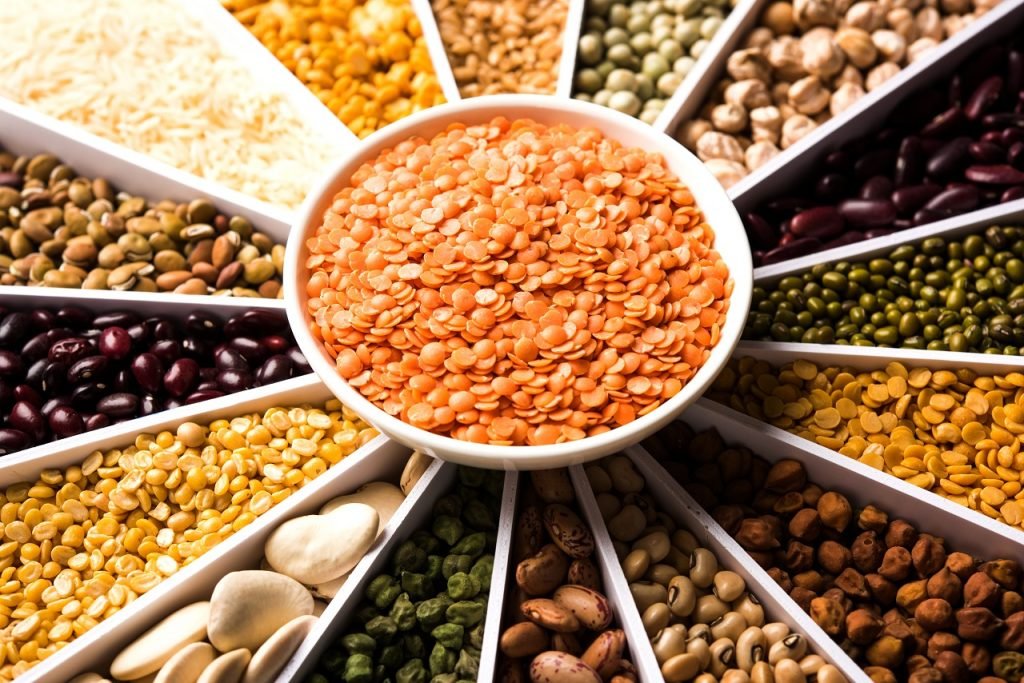
Wholesale mandi trends reveal improving market sentiment, though growers of Gram, Moong and Lentil continue to face pricing pressure
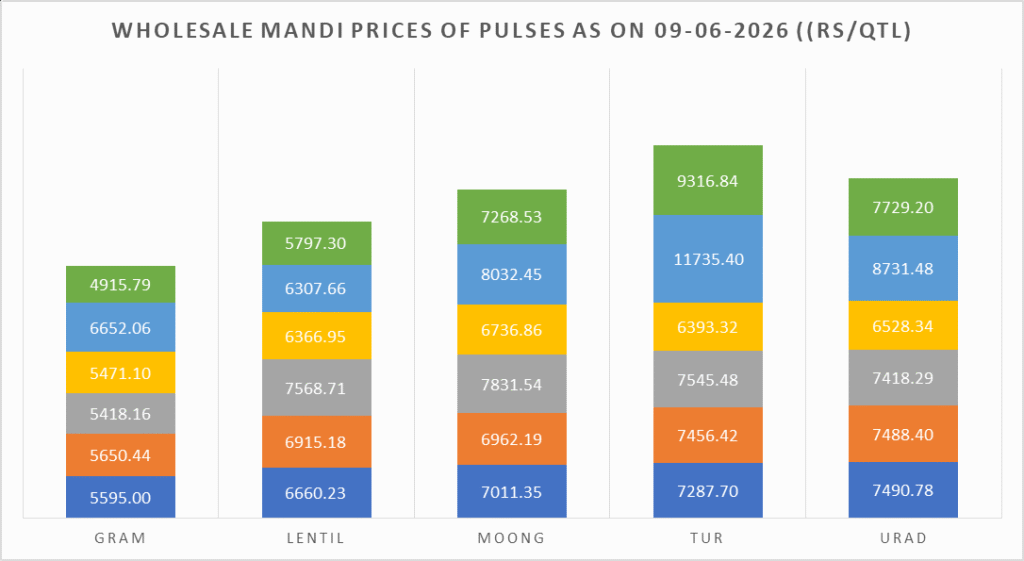
India’s pulse markets are displaying a mixed pricing trend, with wholesale mandi rates for Tur (Arhar) and Urad posting strong year-on-year gains, while Gram (Chana), Lentil (Masur), and Moong continue to face pressure despite recent recoveries. The latest wholesale mandi price data released by the Department of Agriculture & Farmers Welfare through Agmarknet reveals a market balancing between improving demand fundamentals and ample domestic supplies.
Among the major pulse crops, Urad recorded the strongest annual growth, with mandi prices reaching Rs 7,490.78 per quintal on June 9, 2026, up 14.74 per cent from Rs 6,528.34 per quintal a year earlier. The crop also registered a modest monthly gain of 0.97 per cent, reflecting relatively firm market sentiment. However, prices remain slightly below the government’s Minimum Support Price (MSP) of Rs 7,800 per quintal, indicating that market fundamentals have improved but are yet to fully translate into MSP-level realizations.
Tur prices also remained resilient, climbing to Rs 7,287.70 per quintal, marking a significant 13.98 per cent increase over the corresponding period last year. Nevertheless, the crop witnessed a short-term correction of 2.26 per cent over the past week and 3.41 per cent over the past month, suggesting some easing in market tightness following earlier price rallies. Despite the recovery, Tur continues to trade below its MSP of Rs 8,000 per quintal, underscoring the challenges farmers face in realizing remunerative prices.
In contrast, Gram (Chana), India’s most widely consumed pulse, remained under pressure, with mandi prices averaging Rs 5,595 per quintal, nearly 4.8 per cent below the MSP of Rs 5,875 per quintal. Although Gram prices improved by 3.26 per cent over the past month and were 2.26 per cent higher year-on-year, they declined by 0.98 per cent over the past week, indicating persistent supply-side pressure. Compared with two years ago, Gram prices have fallen sharply by 15.89 per cent, highlighting the long-term impact of robust domestic production and procurement interventions.
Lentil (Masur) presented another mixed picture. Prices stood at Rs 6,660.23 per quintal, significantly below the MSP of Rs 7,000 per quintal, while registering a 4.60 per cent year-on-year increase. However, the crop recorded the steepest monthly decline among major pulses, falling 12 per cent from May levels, suggesting weak market momentum and adequate availability in key producing regions.
Moong prices, meanwhile, reached Rs 7,011.35 per quintal, reflecting a modest 4.07 per cent annual increase and a 0.70 per cent weekly gain. Yet the crop remains substantially below its MSP of Rs 8,768 per quintal, pointing to continued market oversupply and subdued procurement support. Compared with two years ago, Moong prices have declined by 12.71 per cent, emphasizing the prolonged pressure on grower margins.
The broader market trend suggests that while pulse prices have generally strengthened compared to last year, most crops continue to trade below MSP levels, raising concerns over farm profitability. The notable exceptions remain Tur and Urad, where tighter supplies and stronger consumption demand have supported prices. However, even these commodities have yet to consistently breach government support price benchmarks.
From a longer-term perspective, the data reveals significant structural shifts in India’s pulse economy. Tur prices are down nearly 38 per cent compared to two years ago, while Gram remains almost 16 per cent lower than 2024 levels. Urad has declined 14.2 per cent over the same period, and Moong is down 12.71 per cent, indicating that recent gains are occurring from relatively depressed price bases.