Thursday, 11 June 2026

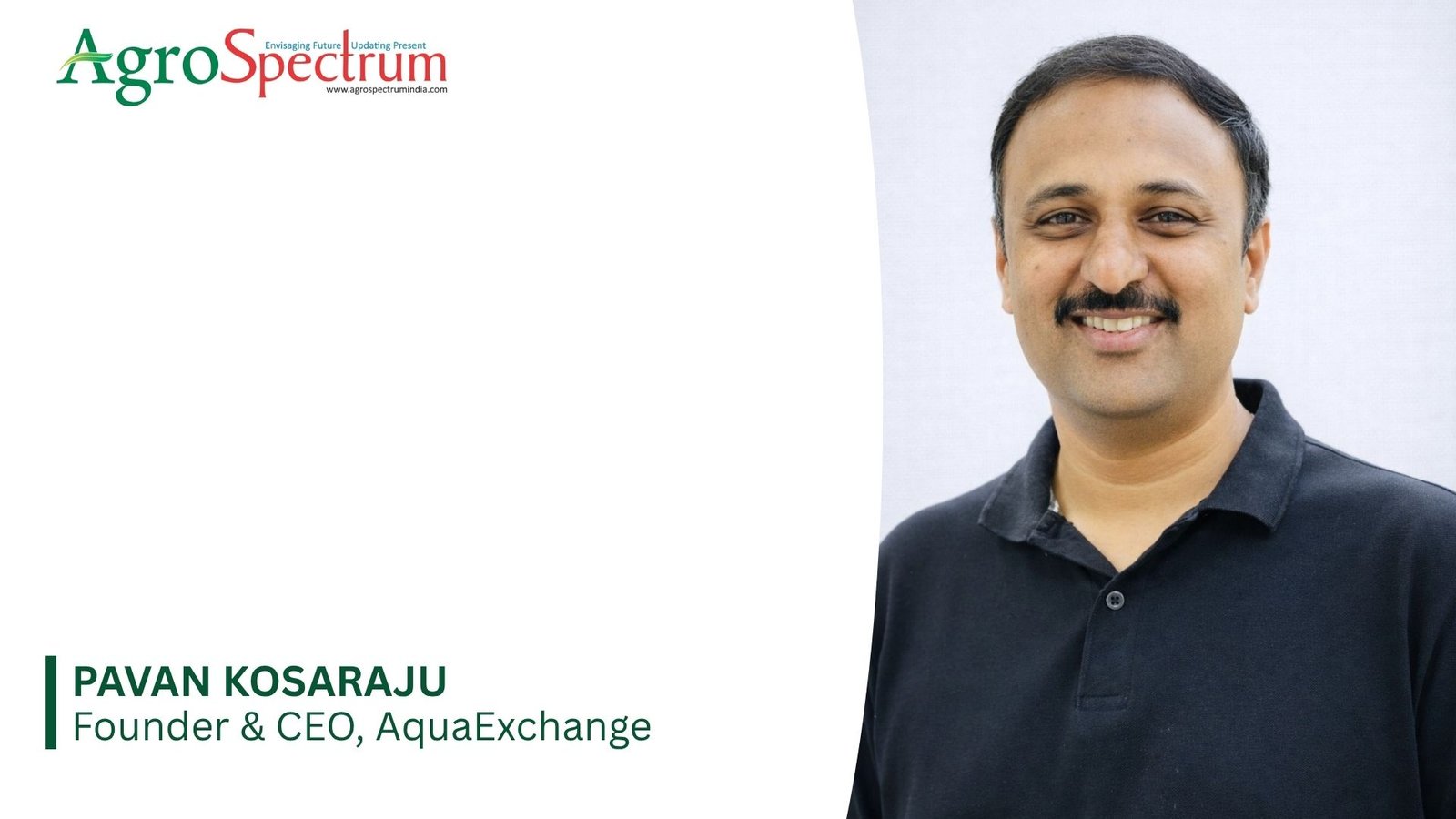
In an exclusive interview with AgroSpectrum Pavan Kosaraju, Founder & CEO, AquaExchange explains why data is the new collateral in aquaculture and why embed finance could be the biggest breakthrough in Indian aquaculture. Edited excerpts:
What role can embed finance and insurance play in aquaculture supply chains in India?
For most of this industry’s history, finance and insurance existed entirely outside the farm. A farmer seeking a crop loan for shrimp from a bank was, in practice, attempting something that did not exist. There is a reason this has become a national priority, with a strong push from NABARD and the finance ministry, and the Finance Minister herself underlined in the last budget that aquaculture farmers, especially shrimp farmers, should be able to access bank finance, because the sector had depended almost entirely on informal credit at a very high cost of capital.
Such bank finance as did exist was based purely on collateral, an urban property or agricultural land the farmer could pledge. The banker did not particularly mind how the money was used, as long as the collateral was there, so a priority sector loan (PSL) specific to the crop simply never served the purpose it was intended to. Embedded finance changes that, because it is crop specific finance delivered into the workflow of running the crop itself, at the point the farmer needs it.
Insurance followed a similar pattern. Parametric cover for events such as natural disasters had existed for over a decade through insurers like Oriental Insurance and Agriculture Insurance Company of India, but penetration was barely 2 to 3 per cent. Using live data from the farms, we are now able to enable not only parametric cover but crop disease insurance, which is being offered for the first time. A farmer who suffers a loss before the breakeven point of a crop, typically within the first 45 to 60 days, can now recover around 80 per cent of his input costs, which can be the difference between sustaining and falling into a debt trap after two failed crops.
What makes this possible is that we monitor and record critical risk events, the power fluctuations, disease events and similar incidents that insurers need to understand. When a claim arises, the insurer can see exactly what happened and when, which is the information they have always asked for and never previously had. That evidence is what allows them to underwrite this risk with confidence.
How is alternative operational data being used to underwrite aquaculture risk?
Alternative data enables us to move beyond reliance on collateral alone. Rather than requiring a farmer to mortgage a property, we assess how he actually operates his farm: his aeration patterns, his feeding behaviour, the progression of his crop cycle and the performance of his previous crops. Tracked over time, this data reveals a great deal about how well a farm is managed and how likely it is to perform.
We developed this into our proprietary Farm Risk Score, or FRS, which gives lenders the confidence to extend collateral free working capital to farmers who were previously difficult to serve. The lender, too, operates with full visibility. He can review every farm he has funded, identify which crops are active, and see which ones require attention, down to the individual pond. We also ensure the capital is used as intended: rather than disbursing cash, we have the farmer sign a disbursement request and supply the feed, seed and health products against it, so the funds are applied directly to the crop.
Why did India’s shrimp industry remain underserved by formal finance for years?
At its core, it was an information gap. Lending functions best when the lender can observe cash flows, monitor the asset and assess the risk, and in aquaculture none of that was possible. Consider a banker trying to evaluate a farm where the crop, the shrimp itself, is underwater and entirely out of sight. He cannot readily tell when a crop began, whether it is progressing well, or how it ultimately performed. When the asset cannot be seen, the risk cannot be priced.
It was never only a question of the farmer’s capacity to repay; intent mattered too, and both came under real strain. After 2018, as new producing countries in Latin America, Ecuador in particular, expanded, farm gate prices contracted and margins narrowed, while post-covid supply chain disruptions and viral outbreaks led to crop losses that genuinely affected farmers’ ability to repay. A few banks that attempted pilots over the past 7 to 8 years saw those loans go bad, and crucially they had no way to verify what had actually happened, whether a crop loss was caused by a power failure, a disease event or something else. Insurers faced the same blind spot, unable to confirm what had gone into a pond or what had triggered a loss. Without that verification, formal finance could not scale.
What has changed is that these critical risk events are now visible, and we also help the farmer succeed in the first place. The industry benchmark for crop success has long sat at roughly 55 to 60 per cent, as the 2020 BCG report noted, and on farms we support that has risen to north of 84 to 85 per cent. That matters for repayment, because when a crop succeeds the farmer’s intent to repay is rarely in question, in roughly 97 per cent of cases; difficulty arises only when the crop fails.
So, technology gives the lender three things that did not exist before: visibility and control over the underlying asset, the shrimp itself; control over the end use of funds, so the capital is spent on the crop rather than diverted to property purchases or other purposes; and, through close monitoring and timely harvest, control over the recovery of funds. Those enablers were missing for years, which is precisely why formal finance never scaled in shrimp farming, and why it now can.
What are the biggest challenges India’s aquaculture industry is facing today and what are the future opportunities?
The central challenge is visibility. For many years, the farmer and those who supported him had very limited real time insight into what was actually happening beneath the surface of the water. Closing that gap is what we set out to do. When a farm is connected digitally and the farmer is given continuous visibility into his own operations, better decisions follow, and so do better financing, insurance and supply chain outcomes.
Having spent the last several years working directly with shrimp farmers, I believe the opportunity before the industry is substantial. India is among the world’s largest producers of seafood and one of the leading exporters of shrimp, and global demand for affordable, high-quality protein continues to rise. This positions the country to further strengthen its standing in international markets.
The opportunity I consider most important is improving productivity and predictability. Shrimp farming is a precise and scientific undertaking. A farmer manages oxygen, feed, water and the health of the animal every day, and conditions in a pond can change significantly within hours, often without any visible sign. Even modest improvements in survival rates, feed efficiency and harvest timing can meaningfully increase a farmer’s income.
What role do AI, data analytics and machine learning play in your platform?
Collecting the data was itself a genuine challenge, and one that is easily underestimated. Shrimp farmers are protective of their farms, and with good reason, because the risk of virus contamination is real and people moving from one farm to another can carry it with them. Many were therefore reluctant to allow access or to share farm level data. By installing our own devices, principally the ‘Powermon’ (short for power monitoring) and APFC ‘Automatic power factor controller’, we generate a large and reliable volume of operational data without anyone having to intrude on the pond. The harder and more enduring task is making sense of it. Our models analyse electricity patterns, feeding activity, the progression of the crop cycle and the performance of past crops, and they surface insights a person would otherwise miss. We can read feeding activity, for instance, because aerators are switched off or reduced during the several feeding intervals each day, a pattern that holds across every kind of farm.
We apply the same approach to the biology of the crop. Each week, our technician collects a sample from the pond and examines the shrimp’s hepatopancreas, its gut and the water under a microscope. We trained an AI tool on those images and readings so that it assesses the animal’s health and guides the farmer, rather than leaving him to wait for a visible symptom to appear. Timing is the reason these matters. In an open pond the animal cannot be observed directly, and if its health deteriorates, a significant portion of the crop can be lost very quickly. Our objective is to help the farmer make a timely harvest decision well before that point is reached.
What does AquaExchange’s expansion reveal about the future of aquaculture and rural fintech in India?
Our growth points to something important. Farmers will invest in technology when it delivers a clear and rapid return. Today our platform monitors more than 90,000 acres of shrimp farms (roughly 27 per cent of India’s shrimp farming area) across over 6,500 farmers, through roughly 21,000 connected devices, and farmers have remained with us even after 6-8 crop cycles now, because they see the benefit within the first weeks of a crop rather than years later. A substantial portion of that growth has come through one farmer recommending us to another, and that word of mouth is the strongest indication we have that the value is real.
A clear example of this shift is automatic feeding. Auto feeders are not a new idea; the concept has existed for about a decade, and several companies had tried to introduce them to Indian shrimp farmers over many years. Yet adoption remained negligible, with fewer than 1,000 units in the field across the entire market until about a year ago. In the last year alone, we have deployed roughly 1,500 auto feeders, and we expect to add another 3,500 to 4,000 units by the end of the year, taking the total close to 5,000. Two industry tailwinds are driving this. Feed, which accounts for around 65-70 per cent of a farmer’s production cost, has seen price inflation of roughly 12 to 15 per cent over the past couple of years, and labour has become genuinely hard to find since the pandemic, with farmers increasingly dependent on workers who travel from other states and rarely stay long. Automatic feeding addresses both, by improving feeding efficiency and reducing the labour a farm requires. Historically, buying an auto feeder outright meant an investment of around 50,000 to 60,000 rupees per unit, with one typically required for each pond of 2 to 3 acres. By re-engineering the product to bring that cost down and offering it on a per crop subscription rather than an outright purchase, we have made that adoption possible at scale.
– Dipti Barve
dipti.barve@mmactiv.com