Friday, 29 May 2026

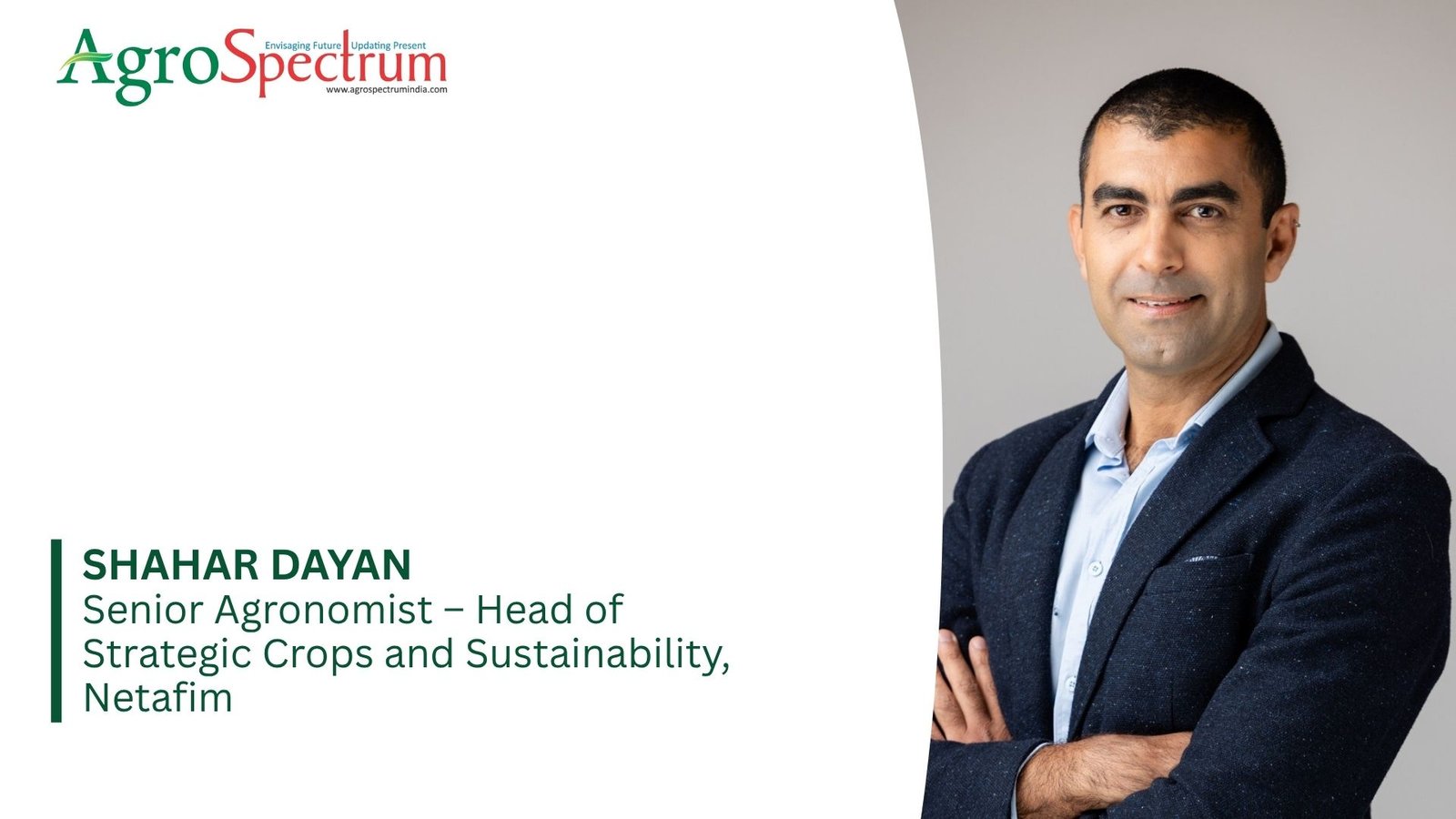
Netafim’s Shahar Dayan discusses how drip irrigation, digital agronomy and resource-efficient farming could reshape the future of coffee production worldwide
In an exclusive interview with AgroSpectrum, Shahar Dayan, Senior Agronomist – Head of Strategic Crops and Sustainability at Netafim, argues that precision irrigation is rapidly evolving from a sustainability initiative into a strategic necessity for the global coffee industry amid escalating climate volatility. Drawing on Life Cycle Assessment (LCA)-backed evidence from Vietnam and broader global field experience, Dayan explains how drip irrigation is delivering measurable gains in yield stability, water efficiency and input optimisation across major coffee-growing regions. He emphasises that while reported outcomes such as 60 per cent lower carbon footprint, 56 per cent water savings and yield gains exceeding 50 per cent vary across geographies, the broader trend is unmistakable: precision irrigation is fundamentally reshaping the economics and resilience of coffee cultivation.
The discussion also explores how resource-efficient irrigation systems could redefine long-term supply stability, reduce climate-linked production risks and gradually narrow operational disparities between large estates and smallholder farmers. Dayan further stresses that future agricultural productivity will increasingly depend on integrated systems combining precision irrigation, advanced agronomy, genetics and digital intelligence rather than traditional land expansion models alone.
Does the reported 60 per cent reduction in carbon footprint signal a structural breakthrough in coffee production economics, or is it primarily a controlled-condition outcome dependent on specific geographies like Dak Lak, Vietnam?
This is more than a single-site result. It builds on over 30 years of Netafim’s agronomic experience working with coffee growers in a wide range of regions, where our irrigation and fertigation protocols have consistently improved productivity and resource efficiency.
The Vietnam study puts numbers behind a broader pattern we have seen globally: while the scale of the impact may differ by region, the direction is consistent. Precision irrigation improves both economic and environmental performance.
The findings mark an important environmental and operational benchmark, backed by decades of field experience and supported across multiple growing environments.
At the same time, the results should be read in context. They come from specific agronomic and geographic conditions, with irrigation methods evaluated side by side under controlled comparisons.
To what extent can drip irrigation-driven yield gains of 50 per cent be generalized across heterogeneous coffee-growing ecosystems in Latin America, Africa, and Asia without diminishing marginal returns?
The reported 50 per cent + yield increase shows what precision irrigation can deliver in the right conditions, but it should not be treated as a guaranteed outcome everywhere.
Yield response depends on climate, soil conditions, plant variety, and farm management. What matters most is not the exact percentage, but the consistency of the result: drip irrigation is a reliable way to improve yield, stability, and input efficiency, especially under growing climate variability.
Based on our experience across major coffee-growing regions, including Brazil, Colombia, Central America, Southeast Asia, Africa, and India, we have seen strong yield gains in both Arabica and Robusta systems:
Arabica: yields can increase from ~20–25 bags/ha to 70–80 bags/ha under optimized irrigation
Robusta (Conilon): yields can rise from ~40 bags/ha to over 100 bags/ha
Results vary, but the broader pattern is clear: precision irrigation consistently improves productivity and efficiency and can create value for both traditional smallholders and larger, more modern coffee operations.
Is precision irrigation becoming a prerequisite for coffee supply chain survival under climate volatility, rather than a discretionary ESG upgrade for premium producers?
Climate volatility is already affecting yield stability, water availability, and crop quality across major coffee-producing regions.
That is why more growers are adopting drip irrigation, not just for ESG reasons, but because it helps them manage production more reliably under tougher growing conditions. Adoption will still vary by region and farm economics, but precision irrigation is becoming an important part of long-term supply reliability in coffee.
How should investors interpret the trade-off between higher upfront capital expenditure in drip systems and long-term reductions in water, energy, and chemical input costs?
Investors should view drip irrigation as more than an upfront infrastructure cost. It is long-term investment in stronger, more efficient farm performance.
While the initial spend can be significant, the economics tend to improve over multiple seasons. Lower input use and more dependable output can strengthen the return over time. The key is to evaluate total value, not just upfront cost.
The LCA also shows that higher yields with lower resource use can materially improve production efficiency.
Could widespread adoption of drip irrigation fundamentally alter global coffee pricing structures by decoupling yield stability from climatic unpredictability?
Global coffee prices are influenced by many factors, including demand, trade, and broader economic conditions, so it would be too much to say precision irrigation alone will reshape pricing.
What broader adoption can do is improve yield consistency, strengthen climate resilience, and reduce some of the production uncertainty facing coffee-growing regions today. Over time, that could support a more predictable supply outlook and ease some weather-related volatility.
Does a 56 per cent reduction in water use meaningfully address systemic water scarcity risks, or does it merely shift the efficiency baseline without resolving regional hydrological stress?
A 56 per cent reduction in water use per ton is a meaningful gain in water efficiency and can help ease pressure on limited water resources, especially in climate-sensitive coffee-growing regions.
At the same time, water scarcity is shaped by broader regional and watershed conditions. Precision irrigation can help agriculture use water more efficiently and sustainably, while supporting stronger long-term resilience in water-stressed areas.
Addressing regional or national water stress requires a broad, multi-stakeholder effort, and agriculture is an important part of that picture. As one of the most proven water management methods, is a practical way to support that effort.
To what extent might ESG-driven adoption of precision irrigation create a competitive divide between technology-enabled large holders and smallholder coffee farmers?
We are seeing more practical models emerge to make precision irrigation more accessible across the coffee value chain through partnerships, agronomic support, and innovative financing or risk-sharing approaches. That helps reduce the risk of a wider competitive gap.
For example, in Vietnam, Netafim has partnered to introduce a dedicated insurance model for smallholders adopting drip irrigation, helping reduce risk and improve accessibility for smaller-scale farmers.
In practice, drip irrigation solutions can be adapted to different farm sizes and operating models. While differences will remain between large, well-financed operations and smallholder farms, that gap can be narrowed through efficient system design, stronger agronomic practices, and smart irrigation and fertigation protocols. Smaller growers can also benefit from being more agile in day-to-day decision-making.
Are chemical reductions of 46 per cent sufficient to reposition coffee cultivation within regenerative agriculture frameworks, or do they remain incremental improvements within conventional systems?
A 46 per cent reduction in chemical use per ton reflects a significant improvement and points to a more targeted approach to crop management.
Precision irrigation is becoming an important part of regenerative agriculture because it helps growers optimize water and nutrient delivery, reduce unnecessary inputs, and support healthier, more resilient farming systems. Regenerative agriculture also depends on broader practices related to soil health, biodiversity, and ecosystem restoration, but technologies that improve resource efficiency and plant performance help make those systems more practical at scale.
Overall, the LCA suggests drip irrigation can support more sustainable and regenerative coffee production, especially by helping reduce chemical use.
Does the growing body of LCA-backed evidence indicate that irrigation technology—not genetic improvement or land expansion—will be the dominant lever of future agricultural productivity gains?
LCA-backed evidence suggests precision irrigation is one of the clearest ways to improve productivity while reducing environmental impact, especially as water, land, and climate pressures intensify.
Beyond coffee, Netafim’s LCAs in crops such as corn and potatoes show similar gains in output and resource use.
That said, future productivity gains will come from integrated approaches that combine precision irrigation with genetics, agronomy, and digital tools. Precision irrigation is a key part of that mix, not the only one.
Our LCAs reinforce what growers have seen in practice: precision irrigation delivers real value, especially when combined with other advances in genetics and crop management.
— Suchetana Choudhury (suchetana.choudhuri@agrospectrumindia.com)