Thursday, 16 July 2026

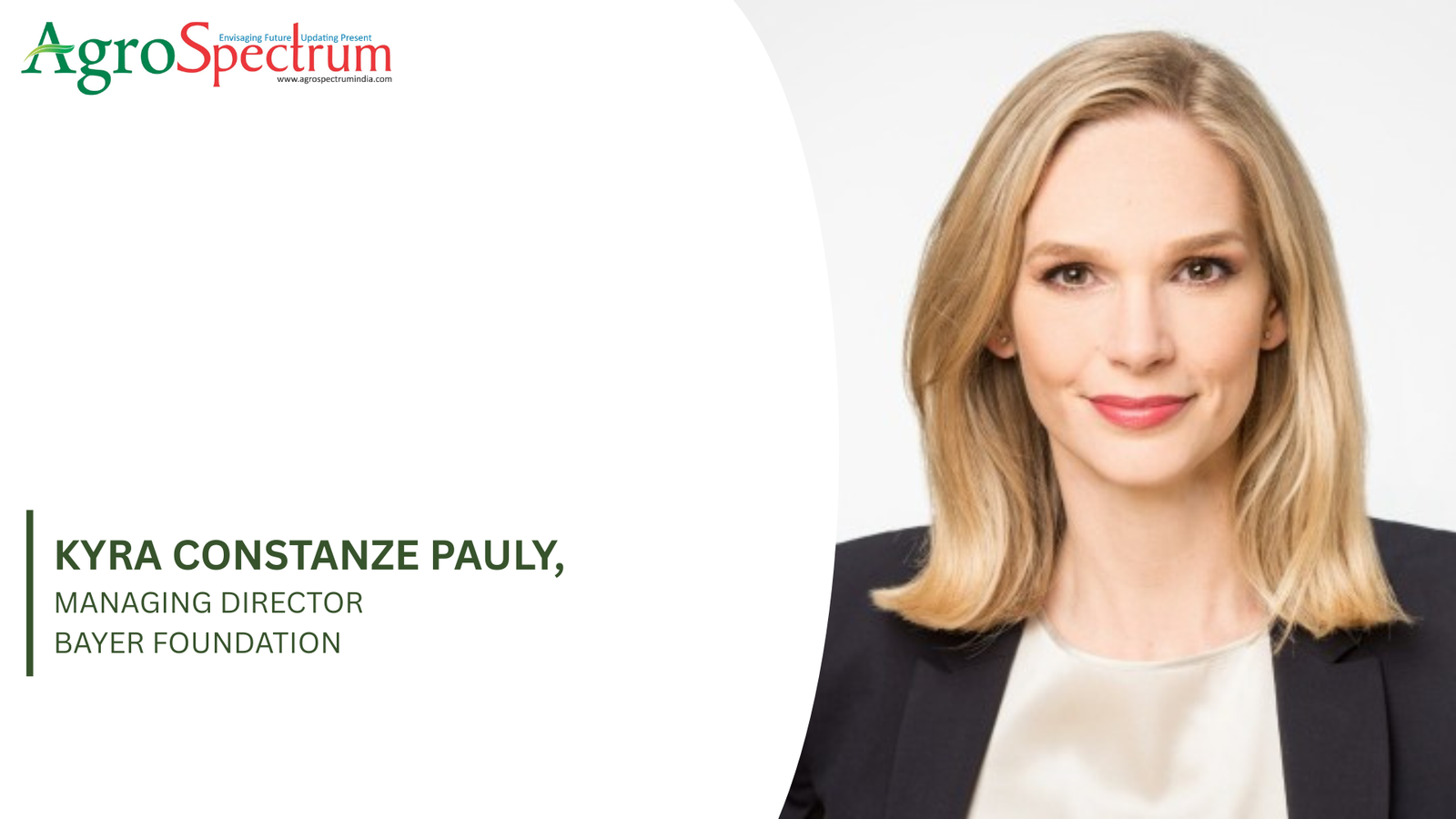
Exclusive AgroSpectrum interview with Kyra Constanze Pauly, Managing Director of Bayer Foundation, on catalytic capital, smallholder resilience, and the new Bayer Foundation–UNCDF investment push in African agri-food markets
The conversation comes as Bayer Foundation and United Nations Capital Development Fund announced the inaugural investments under the Food Systems Innovation Finance Facility (FSIFF), extending two local currency loans of $500,000 each to Omia Agribusiness in Uganda and SokoFresh in Kenya to expand farmer services, reduce food loss, improve cold storage infrastructure, and strengthen market access for smallholders. Kyra highlighted that the initiative reflects a broader shift beyond traditional grant-based development models toward blended finance structures that combine philanthropic capital with market-compatible instruments to drive long-term agricultural resilience, farmer incomes, and food-system sustainability.
As concessional funding declines globally, how does Bayer Foundation justify deploying catalytic capital in ways that may blur the line between philanthropy and market-making?
Effective and inclusive markets are a good thing. When markets work better, they deliver tangible benefits for people on the ground – from more reliable access to nutritious food to stronger livelihoods for smallholder farmers and more resilient local economies.
In many low- and middle‑income countries, particularly in food systems, promising solutions fail to scale because early risks are too high, and traditional funding falls short. This is where we see a clear role for catalytic philanthropic capital. By deploying it thoughtfully, we can help de‑risk early innovation, unlock additional capital, and ensure that limited philanthropic resources achieve greater, longer‑lasting impact.
Working with partners like the United Nations Capital Development Fund, who combine deep development expertise with fair and responsible financial instruments, helps us keep social impact firmly at the center. Finance, for us, is not an end in itself. It is a practical tool to leverage resources, help markets serve people better, and create durable change where purely grant‑based approaches or commercial capital alone are insufficient.
In partnering with United Nations Capital Development Fund, what structural advantage does this model have over traditional grant-based development approaches in actually transforming food systems?
Grant‑based support has an important role and remains essential, especially at very early stages or in fragile contexts. At the same time, on its own, it has often proven insufficient to sustain or scale transformation in food systems over the long term. Social entrepreneurs – who are among the key changemakers we support – need access to the full spectrum of capital, from grants to loans and equity. In low‑ and middle‑income countries, access to capital and opportunity to build equity remains limited, or available only under unfavorable conditions.
Our partnership with the United Nations Capital Development Fund allows us to address this gap. By combining grants with responsible, market‑compatible financial instruments, we can focus not just on funding individual projects, but on improving how food systems work for smallholder farmers and underserved communities more structurally.
UNCDF’s rigorous approach, strong alignment with the international agreed Sustainable Development Goals, and deep on‑the‑ground expertise help ensure that capital responds to real needs and contributes to lasting, system‑level change. Importantly, UNCDF also brings credibility as a trusted global institution and acts as a convener – mobilizing additional public and private capital beyond our initial contribution. This enables impact to go further than traditional, project‑based grants alone, while strengthening markets and livelihoods in a responsible and inclusive way.
The FSIFF aims to “crowd in” private capital – what specific risk-return signals must be proven before institutional investors take these markets seriously?
UNCDF absorbs early-stage risk to incentivize investment and crowd-in private capital into underserved markets and deliver concrete development results for people, small businesses, and vulnerable communities.
Institutional investors will step in, when they see that markets are built on real, everyday value – for farmers, businesses, and food systems. That means solutions genuinely solve problems on the ground, can operate reliably, and continue to deliver benefits over time. For Bayer Foundation, the most important signal is that financial sustainability supports social impact: better incomes for farmers, population food security, less food loss, and stronger food systems resilience. When impact is real and lasting, financial confidence follows.
Investments like Omia and SokoFresh target systemic inefficiencies – how do you ensure these interventions create durable market infrastructure rather than isolated success stories?
We collaborate with UNCDF, whose rigorous due‑diligence process and strong focus on SDG impact help ensure that investments address real systemic gaps rather than short‑term opportunities. Bayer Foundation, UNCDF and its partners in the UN ecosystem support the ventures beyond granting loans through the facility. We facilitate the link of the ventures to other local partners which helps them develop true local ecosystems. This combination helps ensure that investments like Omia and SokoFresh strengthen market infrastructure and create lasting benefits for smallholder farmers and food systems, well beyond a single success story.
How do you rigorously measure impact in complex ecosystems where outcomes are influenced by multiple external variables?
We focus on whether our interventions are contributing to real improvements in farmers’ lives and local food systems. That means tracking practical indicators like income increase and reduced losses over time and grounding these insights in feedback from partners working closely with farming communities. Impact for us is about long‑term resilience, not short‑term attribution.
To measure results with FSIFF, companies report on impact annually as part of portfolio management, including, for example, data points on job creation and earnings of smallholder farmers and changes in market access. A successful project sees a return of capital, which enables recycling of funds into more impactful investments and improved food security and more resilient livelihoods in underserved communities.
To what extent should philanthropic capital tolerate underperformance org. failure in fragile, last-mile economies?
Philanthropic capital bears 100 per cent risk anyway, because its purpose is to be given away for free. So, in principle a higher risk can be tolerated. Still, the FSIFF is thoroughly assessing each venture’s financial health and has return expectations, also to sustain and grow the loan facility over time. Here, the facility’s pipeline coming from the wider UN ecosystem and partner organizations like Bayer Foundation helps to manage risk.
Does the use of concessional finance risk distorting local markets, or is it essential to correcting structural inequities that traditional finance ignores?
Concessional finance plays an important role where markets don’t yet work for everyone. When used thoughtfully, it helps correct structural inequalities and gives smallholder farmers and local enterprises a fair chance to participate. The goal is always to support markets that can eventually function on their own – not to replace them and to encourage commercial investment.
Looking ahead, do you see blended finance vehicles like FSIFF becoming dominant or remaining niche?
Blended finance is an important tool that helps bridge the gap between philanthropy and private investment, especially where risks are high and impact potential is strong. Through the Food Systems Innovation Finance Facility (FSIFF), we use this approach to support solutions that can grow, attract additional capital, and create lasting benefits for smallholder farmers and food systems.
Used responsibly, blended finance enables impact‑driven solutions to scale and endure, while keeping social impact clearly at the center. We also see growing momentum in working together with a wide range of partners – from public institutions to private and philanthropic actors – to bring the right kinds of support together and help impact‑driven solutions succeed.
— Suchetana Choudhury (suchetana.choudhuri@agrospectrumindia.com)