Saturday, 13 June 2026

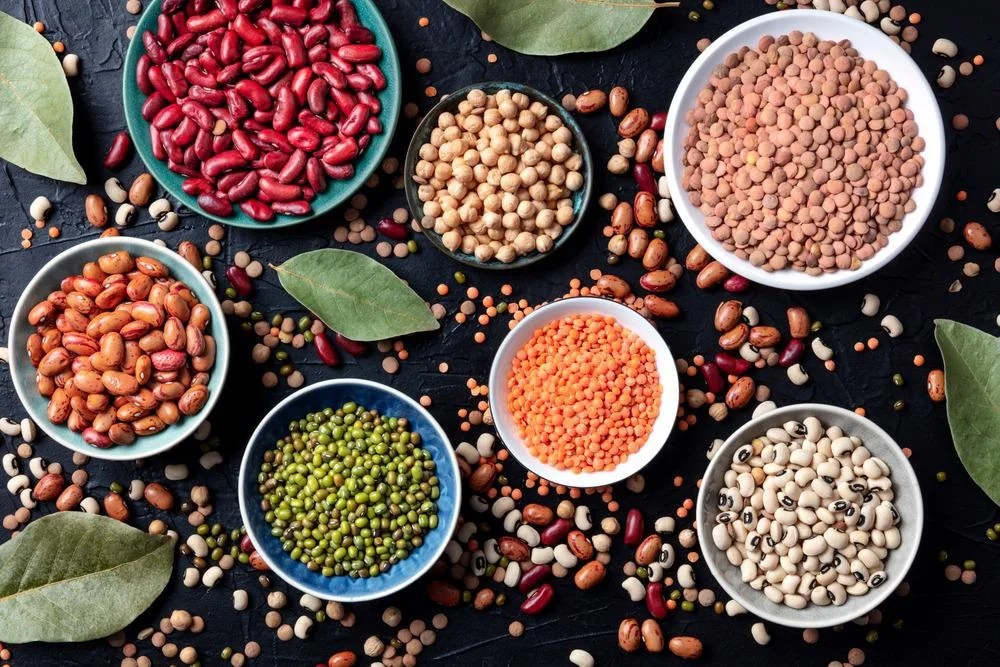
Urad posts strong gains while gram and moong remain subdued, pointing to shifting consumption and supply dynamics
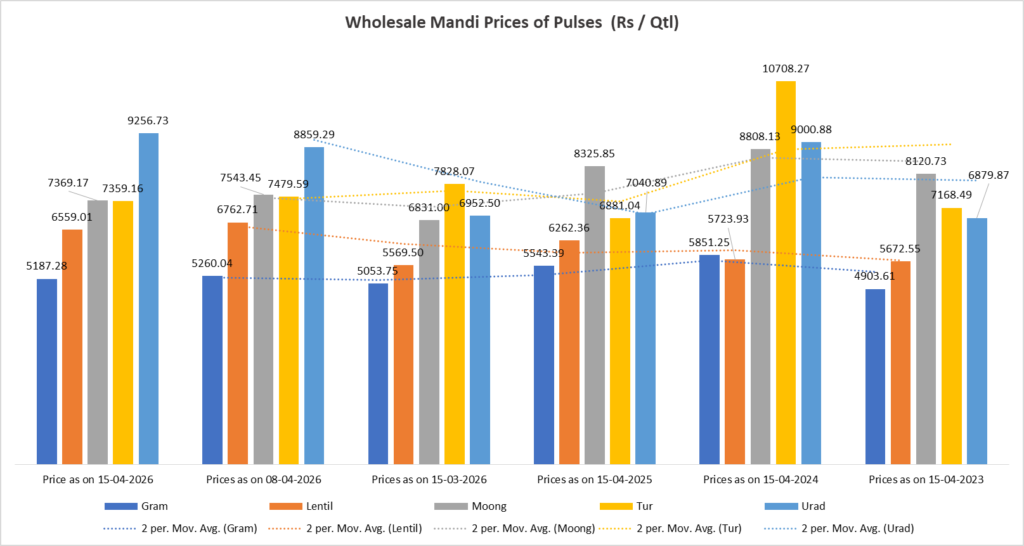
India’s wholesale pulse markets are witnessing divergent price movements, reflecting a complex interplay of supply dynamics, demand shifts, and policy signals, according to the latest data released by the Department of Agriculture & Farmers Welfare (DA&FW) based on Agmarknet inputs.
As of April 15, 2026, wholesale mandi prices across major pulses—gram, lentil, moong, tur, and urad—show significant variation when compared across weekly, monthly, and longer-term timelines, highlighting ongoing volatility in the sector.
Gram prices stood at Rs 5,187 per quintal, below the Minimum Support Price (MSP) of Rs 5,762.5, registering a 1.38 percent decline over the past week despite a modest 2.64 percent increase over the past month. On a year-on-year basis, gram prices remain under pressure, declining by 6.42 percent, and are down 11.34 percent compared to two years ago, although they show a 5.78 percent increase over a three-year period.
Lentil prices, in contrast, demonstrated resilience, reaching Rs 6,559 per quintal against an MSP of Rs 6,850. While prices declined by 3.01 percent over the past week, they recorded a sharp 17.76 percent increase over the past month. Year-on-year, lentil prices are up 4.73 percent and have posted steady gains of 14.58 percent and 15.62 percent over two- and three-year periods, respectively, indicating sustained demand strength.
Moong prices remained subdued at Rs 7,369 per quintal, significantly below the MSP of Rs 8,768. The commodity declined by 2.31 percent over the past week but showed a 7.87 percent recovery over the past month. However, longer-term trends remain negative, with prices down 11.49 percent year-on-year and declining further by 16.33 percent and 9.25 percent over two- and three-year periods, respectively.
Tur prices were recorded at Rs 7,359 per quintal, also below the MSP of Rs 8,000, reflecting a 1.61 percent weekly decline and a 5.99 percent drop over the past month. Despite this short-term weakness, tur prices are up 6.94 percent compared to last year. However, they remain significantly lower than two years ago, with a steep 31.27 percent decline, before stabilizing with a modest 2.65 percent gain over three years.
Urad emerged as the standout performer among pulses, with prices reaching Rs 9,256 per quintal, well above its MSP of Rs 7,800. The commodity recorded a strong 4.48 percent increase over the past week and a sharp 33.14 percent surge over the past month. Year-on-year, urad prices have climbed 31.47 percent and continue to show steady growth over two- and three-year periods, rising by 2.84 percent and 34.54 percent, respectively.
The contrasting price trends underscore structural imbalances within the pulses market. While crops like urad are benefiting from tighter supply and strong demand, others such as gram and moong continue to face downward pressure due to higher production levels or weaker market absorption.
Market analysts note that the gap between mandi prices and MSP levels for several pulses raises concerns around farmer realization, particularly for gram, moong, and tur, where prices remain below support levels. At the same time, the sharp rise in urad prices signals potential supply constraints that could influence sowing decisions in upcoming seasons.
The data also reflects broader challenges in balancing domestic production, imports, and price stability in India’s pulses sector, which remains critical for food security and inflation management.