Tuesday, 14 July 2026

Latest data reflects effective price stabilization, with cereals showing lower volatility than pulses
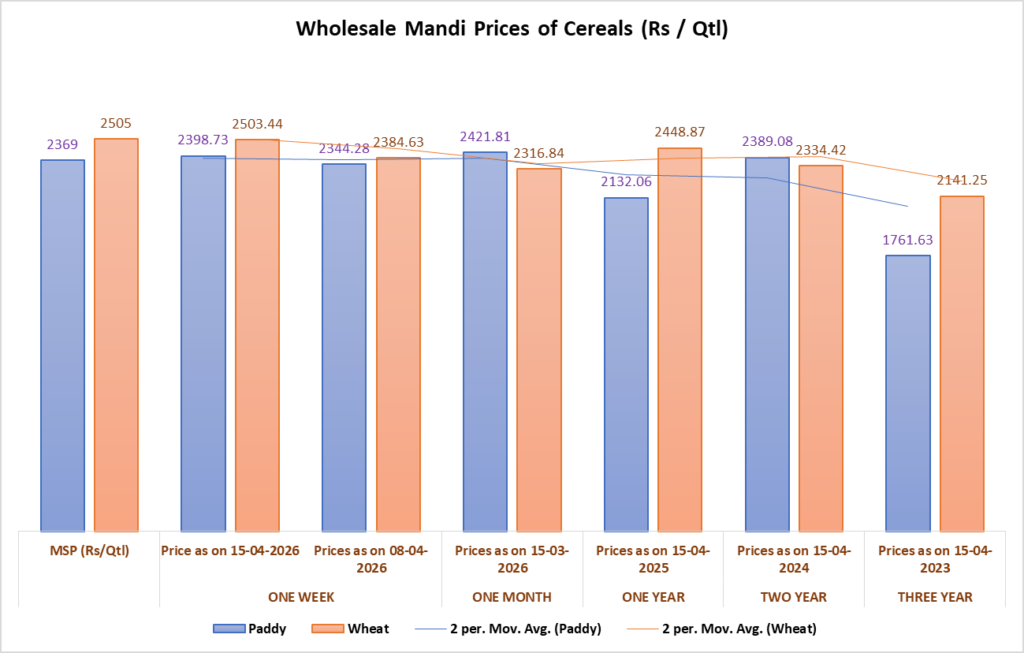
India’s cereal markets are showing signs of stability with modest upward momentum, as wholesale mandi prices for both paddy and wheat remain at or above Minimum Support Price (MSP) levels, according to the latest data released by the Department of Agriculture & Farmers Welfare (DA&FW) based on Agmarknet inputs.
As of April 15, 2026, paddy prices were recorded at Rs 2,398.73 per quintal, marginally above the MSP of Rs 2,369. The crop registered a 2.32 percent increase over the past week, indicating short-term strengthening in market demand. However, on a monthly basis, prices dipped slightly by 0.95 percent, suggesting a mild correction after recent gains. On a year-on-year basis, paddy prices rose by 12.50 percent, reflecting improved price realization compared to 2025 levels. Over a longer horizon, prices remained largely stable with a 0.40 percent increase over two years, while showing a substantial 36.16 percent rise over three years, highlighting sustained long-term growth.
Wheat prices, meanwhile, stood at Rs 2,503.44 per quintal, closely aligned with the MSP of Rs 2,505. The commodity recorded a robust 4.98 percent increase over the past week, the highest short-term gain among major cereals. Monthly trends also remained positive, with prices rising by 8.05 percent, indicating strengthening market sentiment. On a year-on-year basis, wheat prices increased by 2.22 percent, while longer-term gains stood at 7.24 percent over two years and 16.91 percent over three years, pointing to consistent, albeit moderate, growth.
The data reflects a relatively balanced cereal market compared to more volatile segments such as pulses, with both paddy and wheat benefiting from strong procurement systems, stable demand, and policy support mechanisms. The alignment of mandi prices with MSP levels suggests effective price stabilization, ensuring minimum returns for farmers while maintaining supply availability.
Market observers note that the steady performance of cereals is critical for India’s food security framework, particularly as wheat and rice form the backbone of the public distribution system. The recent upward trend in wheat prices may also reflect tightening supply conditions or increased procurement activity, while paddy’s stability indicates a well-balanced supply-demand equation.