Tuesday, 14 July 2026

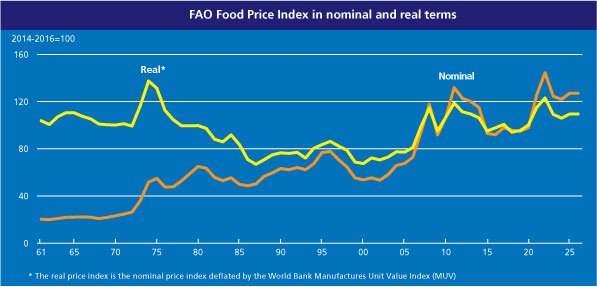
Index also impacted by increases in cereal and rice prices amid disruptions linked to Strait of Hormuz crisis
The benchmark of world food commodity prices rose in April for a third consecutive month amid elevated energy costs and disruptions caused by the conflict in the Near East, according to the latest release by the Food and Agriculture Organization of the United Nations (FAO).
The FAO Food Price Index, which tracks monthly changes in the international prices of a basket of globally traded food commodities, averaged 130.7 points in April, up 1.6 percent from its revised March level and 2.0 percent higher than a year ago.
The FAO Cereal Price Index rose by 0.8 percent from March and was up 0.4 percent from a year ago, reflecting higher prices across major cereals, except sorghum and barley. World wheat prices increased by 0.8 percent, due to concerns over drought in parts of the United States of America and a higher likelihood of below-average rainfall in Australia. The increase was further reinforced by expectations of reduced wheat plantings in 2026, with farmers shifting to less fertilizer‑intensive crops amid high fertilizer prices – driven by elevated energy costs and disruptions associated with the effective closure of the Strait of Hormuz.
“Despite the disruptions linked to the crisis in the Strait of Hormuz, global agrifood systems continue to show resilience. Cereal prices have increased only moderately so far, supported by relatively strong stocks and adequate supplies from previous seasons. Vegetable oils, however, are experiencing stronger price increases, driven largely by higher oil prices, which are increasing demand for biofuels and putting additional pressure on vegetable oil markets,” said FAO Chief Economist Máximo Torero.
Global maize prices increased by 0.7 percent, underpinned by seasonally tighter supplies and weather-related concerns in Brazil, as well as dry conditions affecting sowing in parts of the United States of America. Additional upward pressure came from firm ethanol demand amid elevated crude oil prices and ongoing concerns over fertilizer affordability. By contrast, world sorghum prices dropped by 4.0 percent, largely due to weaker global import demand and improved supply prospects in key producing and exporting countries.
The FAO All Rice Price Index rose by 1.9 percent in April, driven by higher Indica and fragrant rice prices, reflecting increased production and marketing costs in most rice-exporting countries following the surge in the prices of crude oil and its derivatives.
The FAO Vegetable Oil Price Index increased by 5.9 percent from March, reaching its highest level since July 2022. The rise was driven by higher prices of palm, soy, sunflower and rapeseed oils. International palm oil prices rose for the fifth consecutive month in April, largely underpinned by prospective stronger demand from the biofuel sector, supported by policy incentives in several producing countries and higher crude oil prices. Additional upward pressure stemmed from concerns over lower production in Southeast Asia in the coming months.
The FAO Meat Price Index reached a new record high in April, rising by 1.2 percent from March and 6.4 percent from a year ago. World bovine meat prices climbed to a new peak, underpinned by higher export quotations in Brazil amid limited supplies of slaughter-ready cattle, reflecting ongoing herd rebuilding. Pig meat prices also rose, driven by firmer quotations in the European Union amid rising seasonal demand, though partly offset by lower prices in Brazil due to ample supplies.
By contrast, the FAO Dairy Price Index declined by 1.1 percent from March, mainly reflecting lower international quotations for butter and cheese amid abundant milk supplies in the European Union and stronger-than-expected late-season output in Oceania.
The FAO Sugar Price Index also dropped, down 4.7 percent from March and as much as 21.2 percent from a year ago. The decrease was largely driven by expectations of ample global supplies in the current season, reinforced by improved prospects in key Asian producing countries, notably China and Thailand. The start of the new harvest in Brazil, the world’s largest sugar producer, further contributed to the downward pressure on sugar prices.
Cereal markets remain well supplied but uncertainties loom
FAO on Friday also raised its 2025 production forecast for most major cereals, further strengthening indications of a generally favourable supply situation in 2025/26. Global cereal production is now forecast at 3 040 million tonnes, representing an increase of 6.0 percent compared to the previous year.
For the 2026 crops, FAO’s latest forecast for world wheat production has been revised slightly down this month and now stands at 817 million tonnes. This represents a decline of around 2 percent from the previous year, although output is still expected to remain above the last five-year average. The outlook continues to face uncertainty amid the effective closure of the Strait of Hormuz, which has raised input costs – notably for energy and fertilizers – alongside relatively softer wheat prices.
Agricultural Market Information System update
The Agricultural Market Information System (AMIS), hosted by FAO, also published its monthly Market Monitor on Friday. In addition to the regular updates, the report highlighted that global markets faced renewed pressures in April as the effective closure of the Strait of Hormuz continued to disrupt fertilizer supply, driving up urea and phosphate prices, further undermining fertilizer affordability and increasing risks to future agricultural production.