Wednesday, 1 July 2026

Indian states have increasingly taken a proactive approach in announcing dedicated agriculture budgets, tailoring allocations to address the specific needs of their farming communities. By focusing on region-specific priorities—such as irrigation, crop diversification, input subsidies, and market access—these budgets play a crucial role in strengthening rural economies and enhancing farm productivity. Aligned with the broader national budget, they act as targeted policy instruments that not only support farmers but also drive overall economic growth by reinforcing the agriculture sector’s contribution to state and national development.
A great deal of attention is usually focused on the Union Budget presented that is announced every year on February 1. However, the state budgets that follow are equally significant, as they determine how policies and financial priorities are implemented at the regional level. Once the Union Budget outlines the broader economic direction, individual states present their own budgets, aligning their spending plans with local developmental needs and sectoral priorities.
Especially in agriculture, state budgets play a crucial role. India having 28 states and eight Union Territories, each states try to protect the farmer’s interest as the agricultural sector holds great value for the state’s progress in the long run. The focus is also because a large rural population is dependent on farming. The common agriculture related announcements made during the state budgets focus on farm loan waivers, irrigation projects, subsidies for seeds, fertilisers and farm equipment, crop insurance, allocations for dairy, fisheries and horticulture, minimum support price for farmers etc.
Rising allocations for agriculture and allied sectors

Agrarian states in India viz. Punjab, Uttar Pradesh, Maharashtra and Madhya Pradesh prioritise agriculture and keep a special focus on budgets announced by respective states. Akshat Gupta, Principal, Food And Agriculture, Praxis Global Alliance, mentions, “Recent state budgets show rising allocations for agriculture and allied sectors reflecting continued expansion in agri spending through the decade. Recent budget discussions highlight a shift toward digital agriculture, research, and high-value crops to drive productivity growth in the coming years. Many states still allocate large amounts to farm power or input
subsidies, indicating continued political and fiscal dependence on subsidies. At the same time, states are funding equipment subsidies, crop diversification, and water-saving technologies such as DSR and stubble-management equipment.”
Gupta adds, “Wealthier states (e.g., Maharashtra) are investing in solar irrigation, renewable energy integration, and mechanisation initiatives for agriculture. Fiscal constraints limit investment capacity in other states. State finance data shows growing debt and guarantee exposure, which constrains the ability of some states to fund large modernization projects.”
Transformation focussed investment model
State agriculture budgets are gradually transitioning from a traditional support-oriented framework toward a transformation-focused investment model. Between FY 2026–27 and the medium-term horizon of 2031, one can see higher allocations toward infrastructure, technology integration, climate resilience, and value chain development.
Says, Dr Umesh Kamble, Founder & Advisor, F2F Corporate Consultant, Chairman, ASSOCHAM Maharashtra State Development Council, Hon.Secretary, Chamber for Advancement of Small and Medium Businesses, Vice President, Association of Food Scientists & Technologists (India) – AFST(I) opines, “Many states are recognising that long-term agricultural competitiveness will depend on post-harvest infrastructure, agri-processing, digital agriculture platforms, and irrigation modernisation. The next five years will therefore reflect a shift from short-term relief mechanisms toward strategic investments that improve productivity, farmer income stability, and supply chain efficiency.”

How aligned are state budgets with the Centre’s schemes?
Central schemes remain foundational—over Rs 4 lakh crore transferred through PM-Kisan and ~Rs2 lakh cr insurance claims settled under PMFBY, encouraging states to structure complementary programmes. State programmes often complement national priorities such as crop diversification, irrigation efficiency, and farmer risk reduction—areas that overlap with central agriculture missions.
Recent policy discussions emphasise agri-startups, incubators, and agri-entrepreneurship to
create rural jobs and attract youth to agriculture-adjacent businesses.
Dr Kamble mentions that state budgets are increasingly aligned with central priorities, particularly through co-funded and complementary programmes. Schemes like PM-Kisan, PM Fasal Bima Yojana, and PM Krishi Sinchai Yojana have created a strong policy framework that states are integrating into their agricultural strategies.
Many states are building state-level extensions and top-ups around these schemes—such as additional insurance coverage, localised crop advisory systems, and improved digital farmer databases. This alignment helps ensure policy coherence while allowing states to tailor implementation based on regional crop patterns, climatic risks, and farmer needs.
According to Ricky Thaper, Joint Secretary, Poultry Federation of India, under the constitutional framework, agriculture, including animal husbandry, forestry and fisheries fall under the a ‘State’ subject, while central government provides vital support to the sector through various schemes as minimum support price (MSP) operations and providing highly subsidised fertilizer and other schemes. Several state governments have announced budgets for the 2026-27 financial year recently focusing on boosting the agricultural value chain aimed at boosting exports, crop diversification and promoting usage of Artificial Intelligence.

Sandeepa Kanitkar, Managing Director, Kan Biosys, mentions, “India’s fertilizer subsidy regime—currently at Rs 2 lakh crore—requires structural realignment towards efficiency and sustainability. With fertilizer use efficiency below 30 per cent, PM-PRANAM presents a strategic opportunity to rebalance nutrient management by integrating biologicals and organic inputs into mainstream agriculture. However, without dedicated budgetary backing and policy mandates to reduce urea dependence, the transition will remain incremental. Redirecting subsidies towards R&D and mandating bio-input inclusion could unlock a Rs 30,000 crore market while strengthening long-term soil health and productivity.”
Key Takeaways
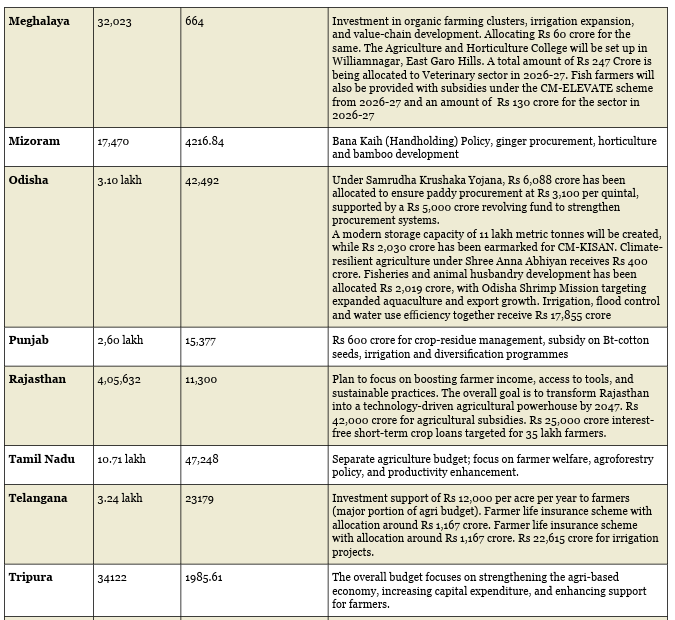
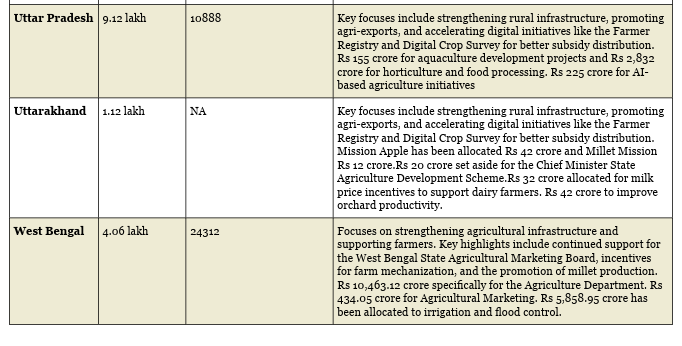
Uttar Pradesh: The Government of UP has allocated Rs 10,888 crore for the sector that was 20 per cent more than in 2025-26. In 2026-27, the state govt set a target of producing over 753 metric tonnes of foodgrains and 48.18 MT of oilseeds. An allocation of Rs 245 crore for UP Agriculture Growth and Rural Enterprise Eco System Strengthening, a World Bank-assisted project.
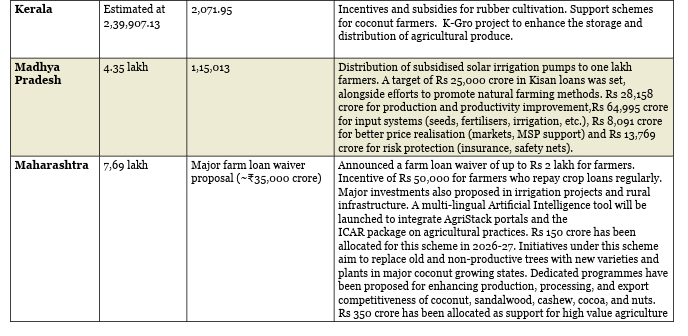
Maharashtra: The Chief Minister of Maharashtra Devendra Fadnavis, who also holds the portfolio of Finance, recently presented the Budget for 2026-27. The CM announced a loan waiver scheme for farmers, under which those with loans pending till September 30, 2025, will be eligible for a waiver of up to Rs 2 lakh. Also announced to provide Rs 20,000 crore for electricity bill waiver for farmers with 7.5 HP water pumps.
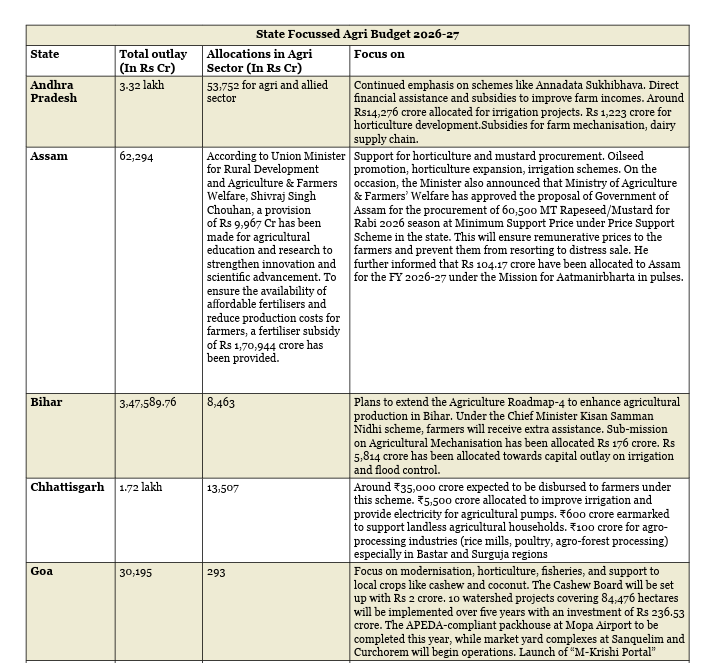
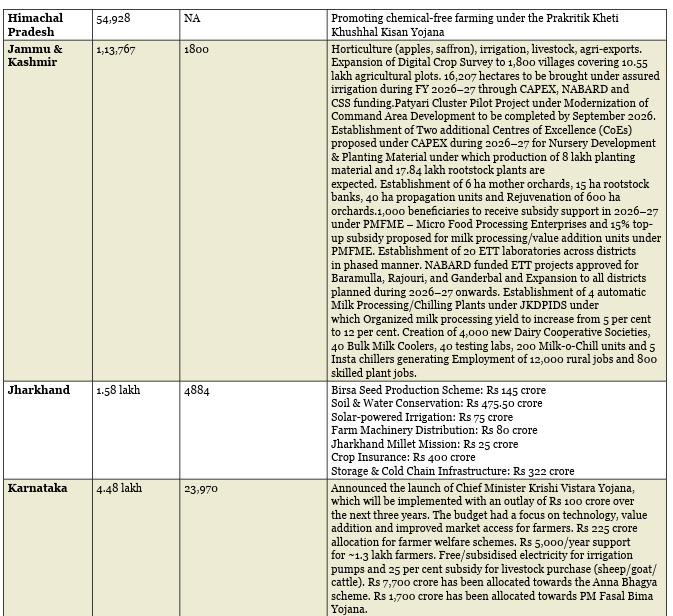
Karnataka: The state announced the launch of Chief Minister Krishi Vistara Yojana, which will be implemented with an outlay of Rs 100 crore over the next three years. The budget had a focus on technology, value addition and improved market access for farmers.
Four key pillars viz. scientific farming guidance, financial assistance to farmers, supply of high quality agri inputs and crop management and expansion of post-harvest storage infrastructure were announced.
Karnataka government announced setting up of millet hub as a single window system to promote millet and organic produce. The Farmer Call Centre is likely to see upgrades using AI to help in accurate advisory on crop management, pest control and weather- related issues.
Punjab: Focusing on Punjab, the state budget allocated Rs 15,377 crore for agriculture and allied sectors with an enhanced budgetary provision of Rs 600 crore for crop residue management. According to Gurmeet Singh Khudian, Rs 7,715 crore has been allocated towards power subsidy for agriculture, welcomed Rs 100-crore provision for fair milk procurement prices and gave a thumbs up towards the production of 1500 lakh quality fish seed and addition of 3000 acre under fish culture.
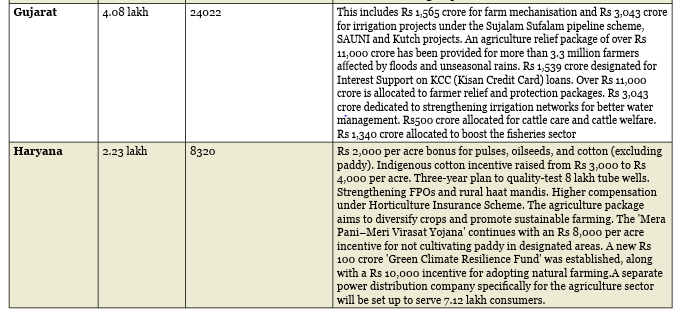
Haryana: The agri budget from Haryana proposes primary agricultural credit societies. The creation of power distribution company Haryana Agri DISCOM will manage 5,084 agricultural feeders, ensuring uninterruptedpower for 7.12 lakh consumers. Through it, tubewell connections will be provided to farmers.
Tamil Nadu: In the Interim Budget for 2026-27, an amount of Rs 47,248.24 crore has been allocated to the Agriculture and Farmers’ Welfare Department.
Bihar: In 2026-27, under the Jananayak Karpoori Thakur Kisan Samman Nidhi, the Bihar government increased annual assistance to Rs 9000 per year for eligible farmers, an increase of Rs 3000.
Gujarat: The Gujarat government has allocated Rs 24,022 crore to the Agriculture, Farmers’ Welfare & Cooperation Department in the 2026-27 state budget.
Jammu and Kashmir: For the 2026-27 financial year, the Jammu and Kashmir government has allocated Rs 1,878 crore to the Agriculture and Allied Sectors. Presented by Chief Minister Omar Abdullah on February 6, 2026, the budget focuses on transitioning J&K’s agrarian economy from subsistence farming to a modern, market-oriented system.
Assam: Ajanta Neog, the finance minister of Assam for the financial year 2025-226 announced an agri budget of Rs 2173 crore.
Jammu and Kashmir: In 2025-26, agriculture, manufacturing, and services sectors are estimated to contribute 20 per cent, 19 per cent, and 61 per cent to Jammu and Kashmir’s economy, respectively.
Jharkhand: For 2026-27, Govt of Jharkhand has allocated Rs 4884 crore dedicated to the agriculture and allied sector. The budget aims at enhancing the rural economy through improved irrigation (including solar-powered pumps), soil conservation, and certified seed production.
Kerala: The Kerala State Budget 2026-27, presented by Finance Minister KN Balagopal earmarked Rs 2,071.95 crore for agri-allied sectors, with Rs 234.73 crore anticipated as the Central share.
Outlook
Since agriculture is a state subject in India’s federal structure, state governments are better positioned to execute schemes, monitor outcomes, and make quick policy adjustments. This reduces delays and improves the last-mile delivery of benefits to farmers. In tandem with the General Budget, state budgets over the years have increasingly focused on farmer-friendly policies, which are crucial for driving India’s economic growth. In essence, state agriculture budgets are not just financial documents—they are strategic roadmaps that shape the future of agriculture at the grassroots level. They bridge policy intent with on-ground realities, making them critical for achieving long-term sustainability, enhancing farm incomes, and building a resilient and inclusive agricultural ecosystem.
Sanjiv Das
sanjiv.das@mmactiv.com