Saturday, 27 June 2026

National average edges higher, even as most states report sustained year-on-year price corrections
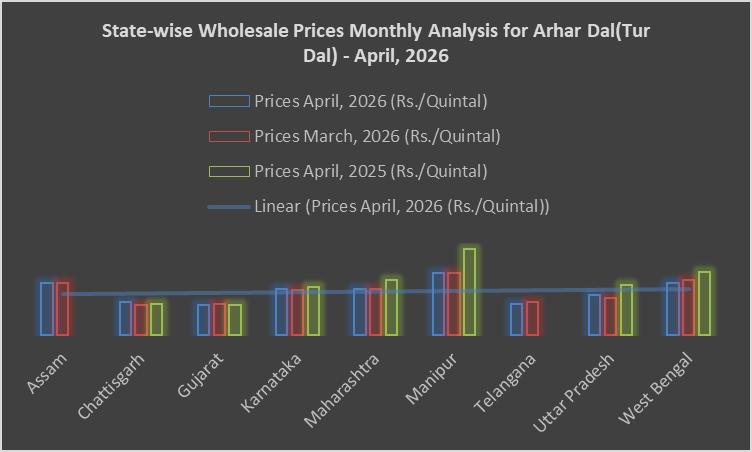
Wholesale prices of Arhar Dal (Tur Dal) in India displayed mixed trends in April 2026, with the national average inching up marginally to Rs 9,522.60 per quintal from Rs 9,507.28 in March 2026. However, prices remain significantly lower than Rs 11,363.32 recorded in April 2025, indicating continued year-on-year pressure despite early signs of recovery in select markets.
Partial Recovery After March Decline
After a broad-based decline in March, several states reported price rebounds in April. Chhattisgarh recorded the sharpest monthly increase of 8.9 per cent, with prices rising from Rs 6,605.21 to Rs 7,193.83. Uttar Pradesh also saw a strong recovery of 6.7 per cent, while Karnataka posted a 1.7 per cent increase.
Maharashtra remained largely stable with a marginal 0.1 per cent rise, maintaining prices at Rs 10,000 per quintal.
Continued Softness in Several Markets
Despite the recovery in some regions, multiple states continued to witness price declines. Telangana recorded a 4.6 per cent drop, while West Bengal saw prices fall by 4.5 per cent, reversing the sharp gains observed in March.
Gujarat and Assam also registered declines of 2.0 per cent and 0.6 per cent, respectively. Manipur reported a marginal decrease of 0.7 per cent, continuing its gradual downward trend.
Year-on-Year Decline Persists Across Major States
On an annual basis, Arhar Dal prices remain under pressure across most states, reflecting a correction from elevated 2025 levels.
Manipur recorded the steepest decline of 28.1 per cent, followed by Uttar Pradesh (-20.4 per cent), West Bengal (-17.2 per cent), and Maharashtra (-16.7 per cent).
Karnataka saw a relatively moderate decline of 4.8 per cent, while Chhattisgarh and Gujarat emerged as exceptions, recording year-on-year increases of 4.9 per cent and 1.2 per cent, respectively.
Price Dispersion Highlights Regional Imbalances
Significant inter-state variation persists in April. Manipur reported the highest price at Rs 13,531.05 per quintal, followed by West Bengal (Rs 11,477.20) and Assam (Rs 11,344.62).
At the lower end, Gujarat (Rs 6,605.06) and Telangana (Rs 6,812.92) reported the lowest prices, indicating relatively better supply conditions in these regions.
Market Outlook: Stabilization with Downside Risks
The marginal rise in the national average suggests early signs of stabilization following March’s decline. However, the persistence of year-on-year declines across most states indicates that the market remains under structural pressure.
Improved supply availability, possibly supported by domestic production and imports, appears to be keeping prices in check. At the same time, localized fluctuations—such as rebounds in Chhattisgarh and Uttar Pradesh—highlight ongoing regional demand-supply adjustments.
Going forward, the Arhar Dal market is expected to remain range-bound, with intermittent volatility driven by regional factors, while broader price recovery will depend on sustained demand and supply tightening.