Friday, 3 July 2026

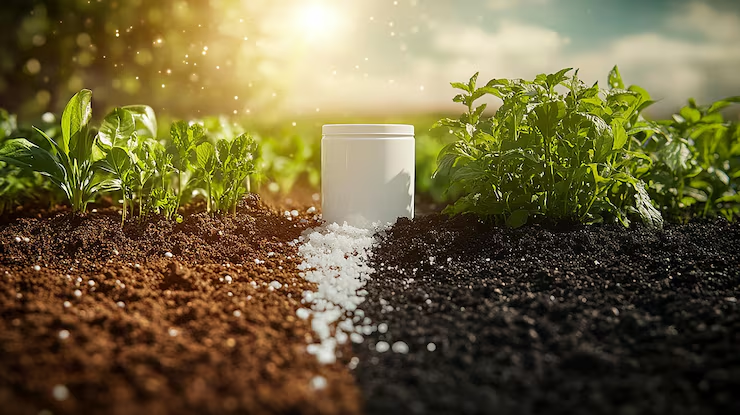
India builds a fertilizer buffer with higher output, diversified imports, and early stockpiling before Kharif 2026.
In a decisive move to shield Indian agriculture from global supply disruptions, the Government of India has ramped up domestic fertilizer production and diversified import channels, ensuring adequate availability ahead of the critical Kharif 2026 sowing season.
Amid geopolitical uncertainty in West Asia and disruptions to key trade routes, policymakers have adopted a multi-pronged strategy combining increased natural gas allocation, higher domestic output, and proactive global procurement.
Gas Supply Push Drives Surge in Urea Production
At the core of the strategy is a significant boost in natural gas supply to urea manufacturing plants. Following successful bidding by the Empowered Pool Management Committee (EPMC), the government secured an additional 7.31 MMSCMD of gas on a spot basis.
This has increased total gas availability to 39.31 MMSCMD, up from 32 MMSCMD—a rise of approximately 23 per cent. The impact on production has been immediate: domestic urea output is projected to increase from 54,500 metric tons per day to 67,000 metric tons per day, also reflecting a 23 per cent jump.
The enhanced allocation has improved gas supply fulfillment to 76 per cent of plants’ requirements, up from 62 per cent, significantly easing operational constraints across the sector.
Strong Inventory Position Provides Buffer
Complementing the production boost is a marked improvement in fertilizer stock levels, offering a critical buffer ahead of the sowing season.
As of March 19, 2026, urea stocks stand at 61.14 lakh metric tonnes (LMT), compared to 55.22 LMT a year earlier. Even more striking is the surge in Di-Ammonium Phosphate (DAP) inventories, which have more than doubled to 24.24 LMT from 11.85 LMT last year.
Stocks of complex fertilizers (NPKs) have also risen sharply to 57.21 LMT, up from 34.44 LMT, while Single Super Phosphate (SSP) and Muriate of Potash (MOP) remain broadly stable.
Taken together, these figures indicate a significantly more comfortable supply position compared to previous years, reducing the risk of shortages during peak demand.
Diversified Imports and Diplomatic Coordination
Beyond domestic measures, the government has moved aggressively to secure fertilizer imports through global tenders and diplomatic engagement.
Speaking at an inter-ministerial press briefing, Randhir Jaiswal, spokesperson for the Ministry of External Affairs, emphasized that India is well-positioned to meet demand.
“We have adequate stocks; we are comfortable,” he said, noting that global tenders were issued well in advance and have received strong responses. He added that the bulk of contracted supplies from multiple international sources is expected to arrive before the end of March.
The approach reflects a deliberate shift toward diversification, reducing reliance on any single supplier or region and mitigating risks arising from geopolitical volatility.
Proactive Strategy Shields Farmers
The government’s coordinated response highlights a broader policy focus on supply security in essential agricultural inputs. With global fertilizer markets facing uncertainty, India’s ability to combine domestic production gains with strategic imports is emerging as a key advantage.
Ensuring that the bulk of fertilizers is stocked in warehouses ahead of the sowing season not only stabilizes prices but also provides farmers with the confidence needed to plan crop cycles effectively.
Strengthening Food Security Through Resilience
As global supply chains become increasingly unpredictable, India’s strategy underscores the importance of resilience in agricultural policy. By simultaneously boosting production, maintaining strong inventory levels, and diversifying import sources, the government has taken a proactive stance to safeguard the Kharif 2026 season.
The result is a more secure fertilizer supply chain—one that positions Indian agriculture to better withstand external shocks while supporting long-term food security goals.