Sunday, 12 July 2026

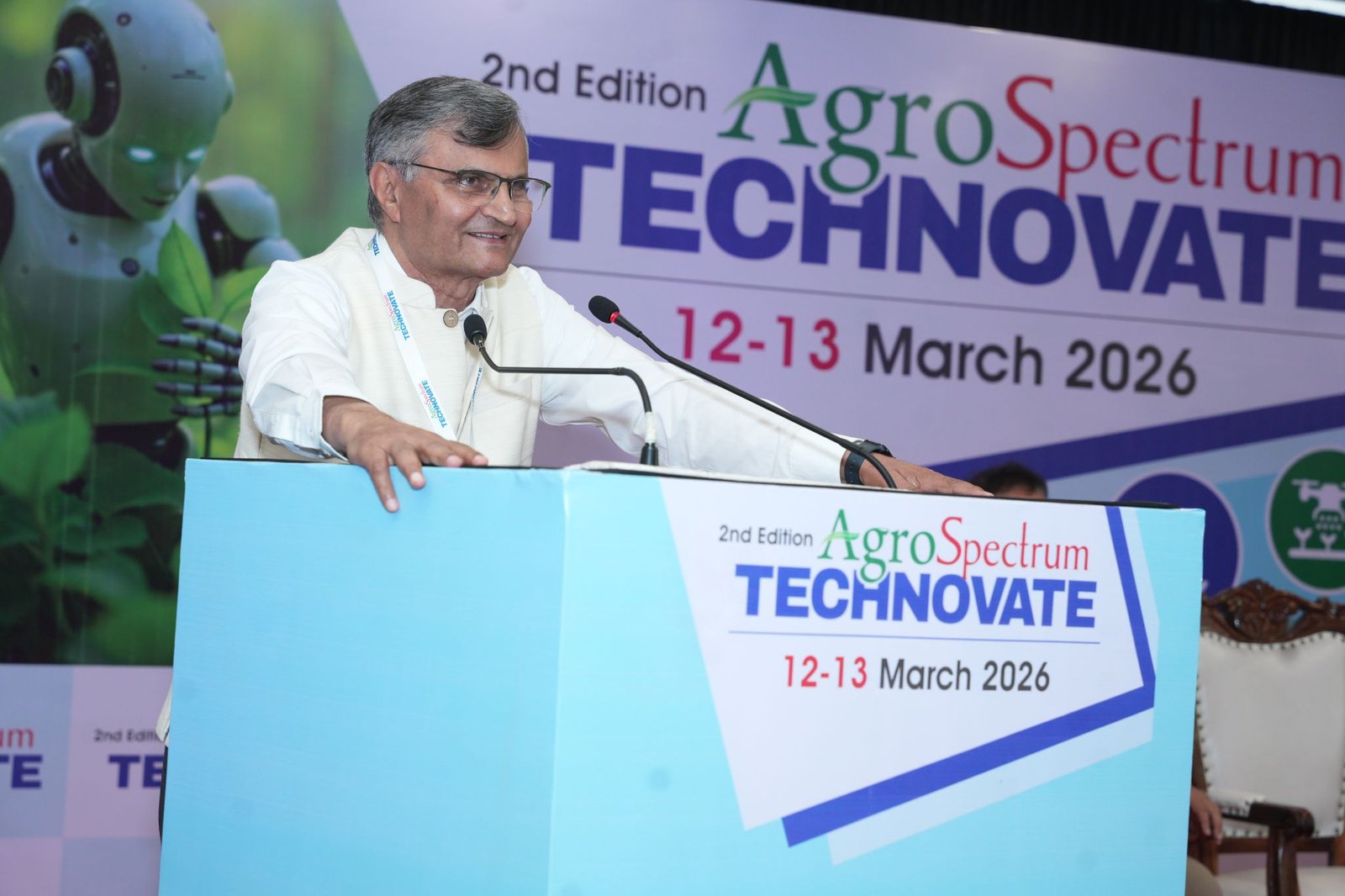
At AgroSpectrum Technovate 2026, Ramesh Chand highlights AI, digital agriculture and mechanisation as pillars of the next agritech revolution.
India’s agriculture sector stands at a defining moment where technology, innovation and collaborative ecosystems will determine the trajectory of future growth. This was the key message delivered by policymakers, scientists and industry leaders at AgroSpectrum Technovate 2026, a national platform bringing together stakeholders to explore the next phase of India’s agritech transformation.
The conference opened with a welcome address by Ravi Boratkar, Publisher & Managing Editor of AgroSpectrum and Managing Director of MM Activ Sci-Tech Communications Pvt. Ltd., who highlighted the urgency of innovation-driven solutions in agriculture.
“Agriculture today is at a critical juncture. We must feed a growing population while simultaneously tackling climate change and resource constraints,” Boratkar said. “Innovations such as digital agriculture, climate-smart agriculture (CSA) and artificial intelligence represent the new wave of transformation in the sector.”
He emphasised that Technovate 2026 aims to build partnerships, accelerate innovation and foster collaboration across the agritech ecosystem.
Highlighting a successful example, Boratkar pointed to the Baramati AI model in sugarcane cultivation, where farmers have reported yield improvements of up to 60 percent through data-driven decision-making. The model is expected to be replicated across other crops such as citrus and cotton, particularly in regions like Vidarbha.
“Technovate 2026 will spark thought-provoking discussions and meaningful networking that will help shape the future of agriculture in India,” he added.
Technology as the Foundation of Agricultural Vision
Delivering the Vision Talk, Prof Ramesh Chand, Member of NITI Aayog, underscored the fundamental relationship between technology and agricultural progress.
According to Prof Chand, every long-term agricultural vision rests on the effective use of technology. Innovations such as artificial intelligence, mechanisation and biotechnology have the potential to unlock efficiencies across the value chain, although technology alone cannot alter the inherent biological potential of crops.
“The real gains from technology come when we are able to produce more with fewer resources,” he said. “Farm mechanisation reduces drudgery, particularly for farm women, and technological innovation deserves recognition for the productivity gains it delivers.”
Prof Chand noted that India’s agricultural growth rate over the past decade has been historically high and among the best globally. Agricultural prices have risen by nearly 40 percent over the last ten years, a factor that can stimulate growth when accompanied by productivity improvements.
With India’s population growth declining to less than one percent, and the food sector expanding at around 2.5 percent annually, he projected agricultural growth could stabilise around four percent in the coming years. However, domestic markets alone may not absorb future increases in production.
“In the future, incremental growth in agricultural production will require access to international markets,” Chand said. “Agribusiness models must be designed to make Indian produce globally competitive, and technology will play a central role in achieving that.”
He also emphasised that technological advancement would accelerate the vision of Viksit Bharat 2047, particularly if India’s economy grows at 8 percent while agriculture grows at 4 percent.
Productivity, Sustainability and Market Innovation
Prof Chand pointed out that India has historically invested heavily in boosting agricultural production but has paid relatively less attention to marketing technologies and value chain innovation.
“There is a significant opportunity to harness consumer willingness to pay for premium quality food,” he noted. “Technology in marketing and supply chain management will be essential to capture this value.”
Sustainability challenges also demand urgent attention. Prof Chand highlighted that producing one kilogram of rice in India currently consumes about 3,200 litres of water, largely due to traditional flood irrigation practices.
“Even in a water-scarce country, we continue to use inefficient irrigation methods. Technologies such as drones for pesticide spraying can reduce human health risks and improve precision in farming operations,” he said.
The productivity gap across crops remains a major concern. Prof Chand cited contrasting examples from Indian agriculture.
India’s basmati rice revolution, he noted, represents a 100 percent indigenous technological success, making the country a global leader in premium rice exports.
Similarly, maize production has expanded significantly—from 22 million tonnes to about 40 million tonnes—supported by technological breakthroughs that have also helped India achieve 20 percent ethanol blending targets.
In contrast, soybean yields have stagnated for decades.
“Globally, edible oil crops have benefited from genetically modified technologies, while India remains 60 percent dependent on imports due to limited technological adoption,” he explained.
“Technology determines empowerment in agriculture. When it is adopted, sectors flourish. When it is absent, dependence increases.”
Emerging Pillars of Agritech
Prof Chand identified biotechnology, digital technologies, space science and advanced engineering as the four pillars of the emerging agritech revolution in India.
These technologies will be essential for enhancing productivity, reducing production costs, mitigating climate risks and ensuring sustainability.
He also cautioned that global research collaboration has weakened due to stricter germplasm-sharing agreements and intellectual property frameworks, making domestic innovation even more critical.
Highlighting policy initiatives, Prof Chand noted that Maharashtra’s Artificial Intelligence Policy is among the pioneering frameworks in the country. However, he stressed that AI can only deliver meaningful outcomes when developed in close collaboration with agricultural scientists and farmers.
“For AI to become real intelligence in agriculture, it must work alongside ground-level expertise and agricultural science,” he said.
Bridging Technology and Farmers
Dr. C. D. Mayee, Chairperson of the Conference Committee at AgroSpectrum Technovate 2026, stressed that technological advancements must ultimately reach farmers in practical and affordable forms.
“Technology is the future of farming, but its true value lies in adoption at the farm level,” Dr. Mayee said.
He highlighted the pink bollworm outbreak in cotton, which has caused severe economic losses for farmers in several regions. To address this challenge, an AI-driven pest prediction model has been deployed across Punjab, Haryana, and central India, enabling farmers to anticipate pest outbreaks and take preventive measures.
The model integrates farm-level weather stations that provide real-time intelligence to growers.
“In the last three years, cotton farmers in Maharashtra using these systems have avoided major losses,” Dr. Mayee noted.
Research organisations are also working on technologies that enable cotton boll baling directly in the field and on-site fibre testing, allowing farmers to assess quality instantly and improve market transparency.
Mechanisation and the Future of Farm Operations
T. R. Kesavan, Director on the Board and Group President at TAFE Ltd, highlighted the role of mechanisation in improving efficiency and addressing labour shortages in agriculture.
“The central objective is to produce more with fewer resources,” Kesavan said. “The right mechanisation solutions at the farm level will define the next phase of agricultural transformation.”
He emphasised that the future of mechanisation will not necessarily lie in larger equipment but rather in smaller, more precise machines designed for specific farming operations.
Technologies such as selective fertiliser spraying and precision application systems can significantly improve resource efficiency, while mechanisation across the farm-to-fork value chain will enhance productivity and traceability.
However, affordability remains a critical challenge for farmers.
Kesavan proposed “Agriculture as a Service” as a national priority model, allowing farmers to access equipment without owning it outright.
TAFE has already implemented a farmer-to-farmer equipment rental platform as part of its corporate social responsibility initiative. The model recorded a market value of Rs 2,500 crore in transactions last year, demonstrating strong demand for shared mechanisation services.
“Farm mechanisation cannot be driven by industry alone,” Kesavan said. “We need bold institutional frameworks and government support to scale these solutions.”
He also pointed to policy imbalances in agricultural spending, noting that India currently spends about ₹2 lakh crore annually on fertiliser subsidies, suggesting that a portion of these resources could be strategically redirected toward productivity-enhancing technologies.
Shaping the Future of Indian Agriculture
Discussions at AgroSpectrum Technovate 2026 collectively underscored that productivity enhancement, technological innovation and market competitiveness will define the next chapter of Indian agriculture.
As India advances toward the goal of becoming a developed nation by 2047, agriculture will need to evolve beyond food security and become a driver of economic growth, export competitiveness and sustainable development.
Technologies ranging from AI and biotechnology to precision mechanisation and digital agriculture platforms are expected to play a transformative role in achieving this vision.
AgroSpectrum Technovate 2026 continues to serve as a national platform for dialogue, innovation and collaboration, bringing together policymakers, scientists, agribusiness leaders and farmers to shape the future of India’s agricultural ecosystem.
— Suchetana Choudhury (suchetana.choudhuri@agrospectrumindia.com)