Friday, 10 July 2026

Experts call for integrated data platforms, consent-driven data sharing and blockchain traceability to unlock scalable innovation in the farm economy
The transformation of Indian agriculture will increasingly depend on robust digital public infrastructure (DPI) capable of integrating data, enabling predictive intelligence, and connecting farmers with markets, finance, and advisory services. This central theme dominated discussions at AgroSpectrum Technovate 2026, where policymakers, technology leaders, and agri-market innovators examined how India’s emerging digital frameworks can reshape agricultural decision-making and value chains.
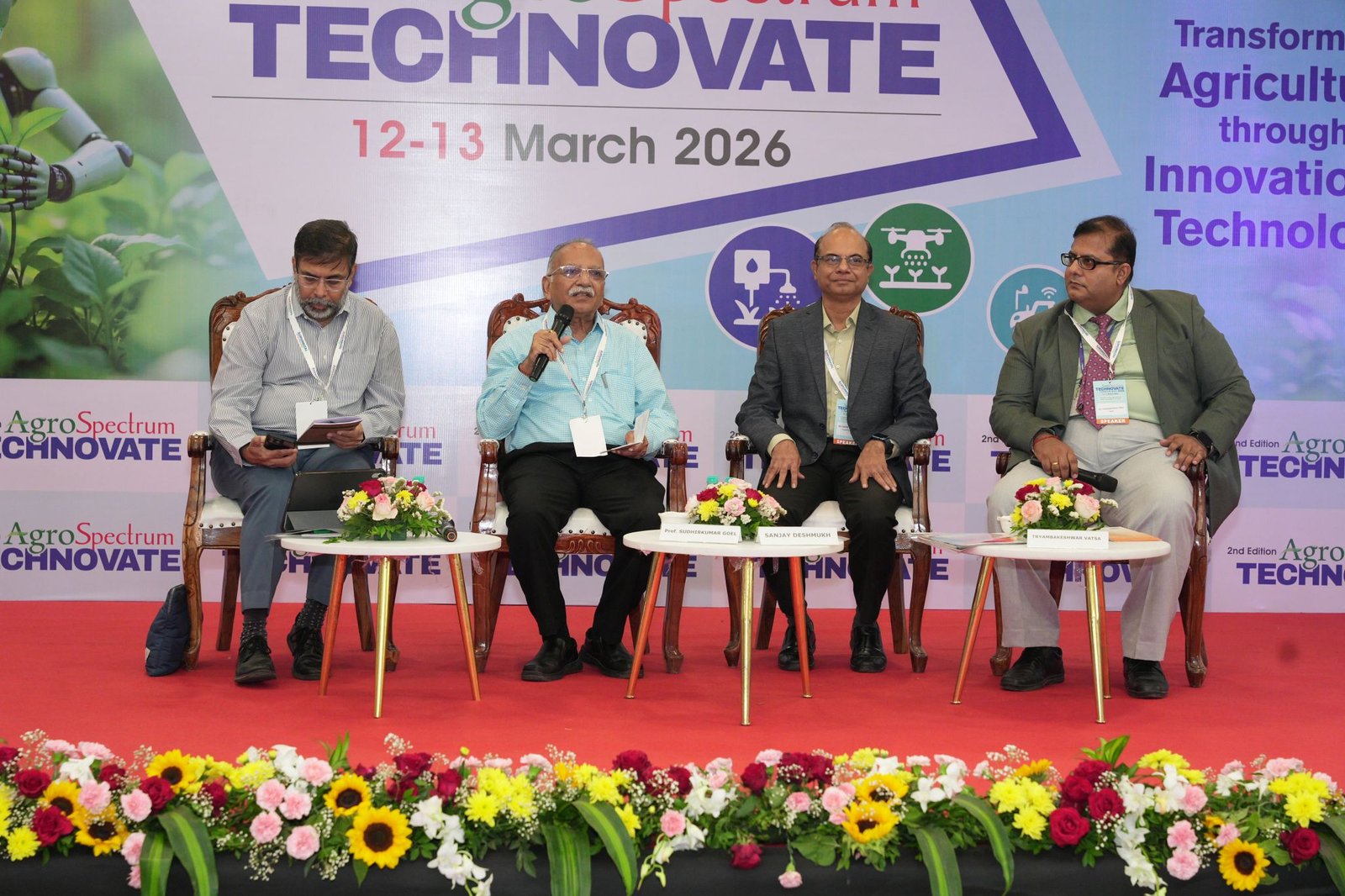
The panel featured Dr. Sudhirkumar Goel, Former Additional Chief Secretary, Agriculture & Marketing, Government of Maharashtra; Mr. Sanjay Deshmukh, COO, Findability Sciences; Tryambakeshwar Vatsa, CTO, NeML; and Dr. Mahesh Patankar, Managing Director, MP Ensystems Advisory Pvt. Ltd. The discussion focused on the role of Agristack, data platforms, artificial intelligence, and blockchain technologies in building a unified digital ecosystem for agriculture.
Opening the session, Dr. Sudhirkumar Goel emphasized that digital public infrastructure is poised to play a transformative role in agriculture much like digital payment systems did for India’s financial ecosystem. According to him, the development of Agristack, which includes farmer IDs, geo-tagging of agricultural fields, and digital land data integration, represents a foundational step toward creating a comprehensive agricultural data architecture.
Dr. Goel explained that the promise of DPI in agriculture lies in its ability to enable predictive and data-driven farming. With robust digital infrastructure, systems could forecast acreage patterns, provide insights on optimal cropping choices, guide farmers on the best time to sow, and offer irrigation recommendations based on climate and soil conditions. Advanced digital platforms can also support remote sensing, crop monitoring, and quality testing, enabling farmers and institutions to access real-time intelligence.
He noted that the long-term vision is to build an agricultural platform ecosystem comparable to India’s Unified Payments Interface (UPI). Just as UPI created an interoperable financial system, a similar integrated digital platform for agriculture could allow multiple stakeholders—from farmers and agritech startups to financial institutions and agribusinesses—to operate within a shared digital framework. For this vision to materialize, however, a unified and reliable agricultural database must first be established.
Expanding on the data dimension, Tryambakeshwar Vatsa highlighted that while India has invested significantly in digital infrastructure, the real challenge lies in understanding the needs of the end user—the farmer—and ensuring that data systems are accurate and reliable. He described the concept of an Agri Data Exchange as a powerful mechanism that could enable seamless sharing of agricultural information across institutions, platforms, and service providers.
However, he pointed out that one of the biggest bottlenecks in India’s agricultural digitisation journey is the absence of comprehensive digital records. A large portion of agricultural data, including land records and farm-level information, remains either fragmented or not fully digitised. Without reliable digital datasets, advanced technologies such as artificial intelligence cannot operate effectively.
“AI requires digital foundations,” Vatsa explained, stressing that systems must first transition from manual to digital processes before advanced analytics can be deployed at scale. He also described digital public infrastructure as a middleware layer that enables interaction among different service providers and platforms. In such an ecosystem, data sharing must be governed by clear consent mechanisms to protect farmer interests while enabling innovation.
Vatsa further emphasized the importance of integrating agricultural marketing into the digital ecosystem. Platforms such as e-Samriddhi, which assist farmers in selling their produce, demonstrate how digital systems can improve market access. He argued that agricultural marketing must be closely linked with banking infrastructure because financial liquidity is essential for efficient agricultural trade. Emerging technologies such as blockchain-based traceability systems could also enhance transparency and trust in agricultural supply chains.
Offering the technology implementation perspective, Sanjay Deshmukh noted that Agristack represents an important milestone in India’s digital agriculture journey, although the initiative is still in its early stages. According to him, several pilot projects are currently underway to test how Agristack can be integrated with real-world agricultural operations and digital services.
Deshmukh explained that Agristack’s value lies in its ability to aggregate data from land records and other agricultural sources, which can then be harmonised and transformed into actionable insights. For technology providers and agritech innovators, this unified dataset could significantly reduce the cost and complexity of developing digital agricultural services.
At Findability Sciences, Deshmukh said the company has been developing predictive analytics solutions for agriculture using satellite data and artificial intelligence. The company currently works closely with sugar mills and sugarcane farming ecosystems, where predictive models help analyse crop patterns, yield potential, and farm management practices. These insights are then translated into AI-driven advisory services delivered directly to farmers.
He explained that the company is currently collaborating with six sugar mills, each of which has its own network of farmers within defined catchment areas. By combining satellite data with predictive analytics, the system can provide targeted recommendations that improve productivity and resource efficiency. However, Deshmukh stressed that for digital agriculture solutions to scale effectively, two key principles must guide their design: affordability and adaptability. Technology must remain accessible to farmers while being flexible enough to operate across diverse agricultural contexts.
He also noted that once digital public infrastructure becomes fully operational, the cost of accessing agricultural data will decrease significantly. This will create a more enabling environment for innovation by lowering entry barriers for agritech startups and service providers.
Concluding the discussion, Dr. Mahesh Patankar highlighted the importance of building integrated digital ecosystems that connect multiple stakeholders. Drawing parallels with the energy sector, he explained that digital energy systems operate with numerous service providers who interact within a shared digital infrastructure. A similar model could be applied to agriculture, where different actors—from satellite data providers and agritech startups to financial institutions and government agencies—can operate within a unified digital framework.
In such a system, data generated by different service providers could flow through a single pipeline, creating a rich and continuously expanding repository of agricultural intelligence. Historical datasets, when combined with predictive analytics, could significantly enhance resource management, particularly in areas such as water use and irrigation planning.
Patankar emphasized that predictive analysis built on robust historical data can transform decision-making in agriculture. For instance, better data integration could enable accurate water demand forecasting, helping farmers and policymakers manage irrigation resources more efficiently. This capability will become increasingly critical as climate variability intensifies and water scarcity emerges as one of the defining challenges of modern agriculture.
The discussions at AgroSpectrum Technovate 2026 reinforced a growing consensus among policymakers, technology providers, and industry stakeholders that digital public infrastructure will serve as the backbone of India’s agricultural transformation. While the journey toward fully integrated digital agriculture is still underway, initiatives such as Agristack signal a structural shift toward data-driven farming systems.
If successfully implemented, DPI could enable India to build a unified agricultural ecosystem where farmers, markets, financial institutions, and technology providers interact seamlessly through shared digital platforms. Such an ecosystem would not only improve farm productivity and market efficiency but also unlock a new wave of innovation capable of reshaping the country’s agricultural economy in the decades ahead.
— Suchetana Choudhury (suchetana.choudhuri@agrospectrumindia.com)