Friday, 3 July 2026

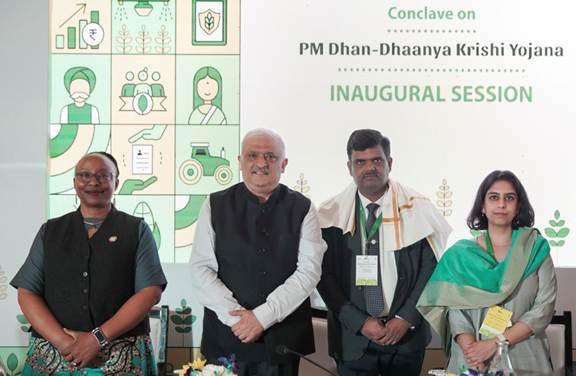
High-Level CSR Conclave in New Delhi signals public–private push to transform 100 agricultural districts
The Department of Agriculture & Farmers Welfare (DA&FW), under the Ministry of Agriculture & Farmers Welfare, in collaboration with United Nations Development Programme and the Bill & Melinda Gates Foundation, convened a high-level CSR Conclave today on the theme “Leveraging PM Dhan-Dhaanya Krishi Yojana (DDKY) for Farmer Prosperity.”
The conclave brought together senior government officials, financial institutions, corporate CSR leaders, Farmer Producer Organisations (FPOs), and development partners to explore structured collaboration under the newly launched PM Dhan-Dhaanya Krishi Yojana (DDKY) — a six-year initiative aimed at transforming 100 agricultural districts across India.
With 65 participants representing major corporates including Unilever, Reliance Foundation, ITC Limited, Axis Bank, Tata Consultancy Services, and JK Cement, the event underscored growing corporate interest in aligning CSR capital with national agricultural priorities.
A First-of-Its-Kind Agriculture-Focused District Model
Launched on 11 October 2025 by the Prime Minister for a period of six years, DDKY is inspired by NITI Aayog’s Aspirational District Programme but marks the first initiative exclusively dedicated to agriculture and allied sectors.
The scheme seeks to enhance agricultural productivity, promote crop diversification and sustainable practices, expand post-harvest storage at panchayat and block levels, improve irrigation infrastructure, and strengthen access to both long-term and short-term credit. Implementation is designed around convergence — bringing together 36 existing schemes across 11 departments, alongside state-level initiatives and structured private-sector partnerships.
Unlike standalone subsidy models, DDKY is architected as a systems-based intervention — integrating finance, infrastructure, extension services, and market linkages to create durable district-level transformation.
Government Calls for Deeper Private Sector Engagement
In his inaugural address, Devesh Chaturvedi, Secretary, DA&FW, emphasized that the private sector’s role must extend beyond conventional CSR funding. He called for active engagement through manpower deployment such as Young Professionals (YPs), strengthening FPO linkages, farmer education, and the promotion of climate-resilient agriculture.
He further highlighted the pivotal role of Lead Banks in driving financial inclusion through focused implementation of schemes such as the Kisan Credit Card (KCC) and Pradhan Mantri Fasal Bima Yojana (PMFBY), reinforcing that credit access remains central to agricultural transformation.
The message was clear: scalable impact requires convergence of public policy, financial systems, and corporate capability.
Development Partners Emphasize Scale and Sustainability
In her special address, Angela Lusigi, Resident Representative, UNDP India, noted that CSR engagement aligned with national priorities like DDKY can strengthen public systems while enabling measurable, scalable outcomes for smallholder farmers. She underscored the central role of FPOs in poverty reduction and in unlocking economic opportunities for rural communities.
Saachi Bhalla, Deputy Director, Gender Equality at the Gates Foundation, highlighted the importance of catalytic partnerships in strengthening livelihoods and accelerating sustainable agricultural models. Her remarks reflected a growing consensus among development institutions that blended financing and cross-sector collaboration are critical to achieving rural transformation at scale.
Financial Institutions Step Forward
A key moment during the conclave was the felicitation of Sunit Kumar Singh, Deputy General Manager, Canara Bank, for extending a CSR grant of Rs 50 lakh to a DDKY district. The recognition underscored the vital role of financial institutions in supporting localized agricultural development.
The participation of major banks signaled a broader alignment between commercial finance and developmental priorities — a shift that could strengthen credit penetration in underserved districts.
Technical Deliberations: From Financing Models to Climate Resilience
Detailed presentations outlined DDKY’s structural features, followed by technical sessions led by senior Government of India officials. Discussions focused on innovative financing models, climate-resilient agricultural practices, integration with rural livelihood missions, and mechanisms for aligning CSR investments with DDKY objectives.
In a separate corporate panel, representatives from Unilever, Reliance Foundation, ITC, and Axis Bank shared practical insights into CSR–FPO collaborations, discussing operational challenges, impact measurement frameworks, and strategies for scaling successful models across geographies. Long-term engagement, capacity building, technology integration, and robust monitoring systems emerged as recurring themes.
Momentum for Youth Engagement and Start-Up Support
Participants expressed strong interest in channeling CSR funds toward deploying Young Professionals in DDKY districts and supporting agri-startups that can drive innovation at the grassroots level. Corporates were invited to engage directly with the 100 DDKY districts through the Department’s weekly webinar platform, creating a structured interface between district administrations and potential CSR partners.
The conclave effectively initiated discussions around financial commitments, value chain development, and market linkages — critical components for ensuring that productivity gains translate into tangible income growth for farmers.
A Strategic Inflection Point for Agricultural Transformation
As India seeks to modernize its agricultural ecosystem while strengthening climate resilience, DDKY represents a strategic inflection point. By combining government convergence, financial inclusion, FPO-led aggregation, and corporate participation, the initiative attempts to bridge policy intent with district-level execution.
The CSR Conclave signals that agricultural transformation is no longer the sole domain of public spending. It is increasingly becoming a shared national enterprise — one where corporate strategy, development expertise, and public policy converge to reshape rural prosperity.
If commitments made at the conclave translate into sustained partnerships, DDKY could emerge as a defining model for integrated agricultural development in India’s next growth cycle.