Saturday, 18 July 2026

A Trade Signal That Goes Beyond Pulses
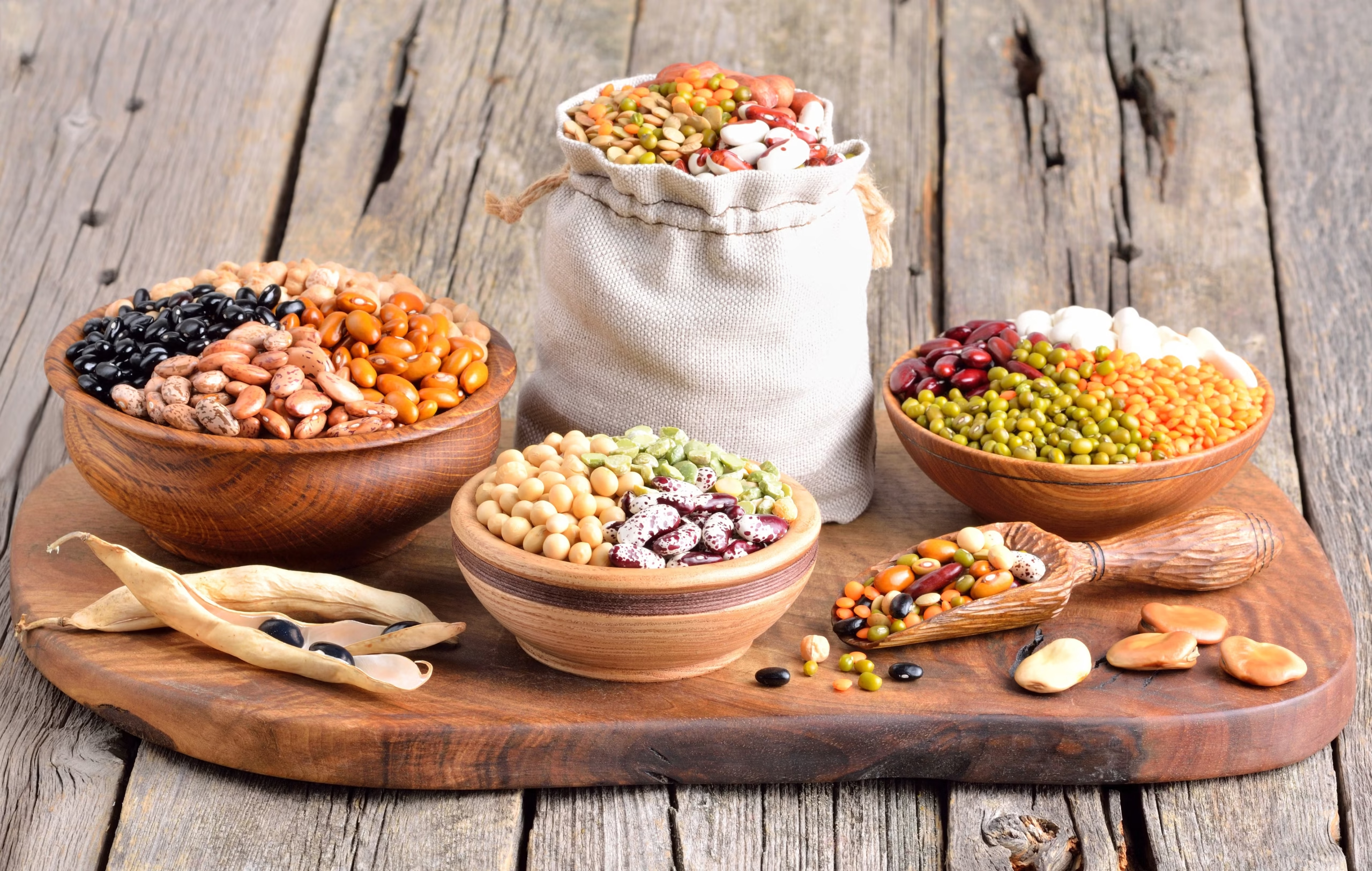
India’s decision to impose a 30 per cent retaliatory tariff on imports of U.S. pulses is ostensibly a sector-specific trade action. In reality, it represents a far broader assertion of India’s evolving trade posture—one that places agriculture, food security, and farmer incomes at the center of economic diplomacy.
At a time when global supply chains are fragmenting, trade negotiations are increasingly politicised, and food systems are under stress from climate change and inflation, the move signals that India is willing to absorb short-term friction to protect long-term domestic priorities. Pulses may be the immediate flashpoint, but the implications ripple across global agricultural trade, bilateral relations, commodity markets, and investment strategies.
Why Pulses Matter So Much to India
Pulses occupy a unique position in India’s political economy. Unlike cereals such as wheat or rice, pulses are both a nutritional staple and a persistent policy challenge. They are critical to protein security for a largely vegetarian population, yet domestic production has historically struggled to keep pace with demand.
India is simultaneously the world’s largest producer, consumer, and importer of pulses. Any fluctuation in supply or prices has immediate consequences for food inflation, farmer incomes, and political sentiment. This makes pulses highly sensitive to trade interventions.
Imports—particularly from countries like the U.S., Canada, and Australia—have long acted as a buffer during supply shortfalls. However, when imports surge during peak domestic harvest periods, they depress farm-gate prices, undermining India’s efforts to incentivise domestic pulse cultivation.
The 30 per cent tariff reflects an attempt to correct this imbalance and send a message that import dependence cannot come at the cost of farmer viability.
India – US Trade Dynamics
U.S. pulse exports to India are highly volatile and driven more by policy than by market demand. Although India accounts for only 8–12 per cent of total U.S. pulse exports, its position as the world’s largest consumer and importer gives it disproportionate influence over trade flows. Before the 30 per cent tariff, U.S. pulses entered India at low or zero duty, creating a predictable trade balance: American exporters supplied counter-seasonal demand, while Indian buyers used U.S. pulses to hedge against price volatility in Canada, Russia, and Australia.
Historical data from 2015 to 2025 illustrates the fragility of this relationship. Exports peaked at $166.5 million in 2016, fell to $68.8 million in 2017 and $16.9 million in 2018, rebounded to $80.2 million in 2024, and then collapsed to $4.2 million in the first three quarters of 2025 following the tariff. Yellow peas, the dominant export, concentrate risk for U.S. growers.
The tariff disrupted the previous equilibrium, forcing Indian buyers to shift sourcing to Canada, Russia, Ukraine, and Australia, raising global prices and reducing arbitrage opportunities. For U.S. exporters, landed costs increased 25–30 per cent, inventory pressures rose, and alternative markets are smaller and less liquid. Strategically, this episode demonstrates that pulses, though low-profile, now function as a geopolitical lever, influencing global sourcing, domestic politics, and price stability. The U.S.–India pulse trade exemplifies how policy-driven asymmetries can turn even niche agricultural markets into arenas of strategic economic significance.
Impact on Bilateral Trade Talks
The tariff introduces a new layer of complexity into India–U.S. trade negotiations, even if it stops short of triggering an outright confrontation. Formally, both sides have maintained diplomatic restraint, signaling a willingness to keep dialogue open. Substantively, however, the move hardens negotiating positions by elevating agriculture from a chronic irritant to a high-stakes pressure point.
For the United States, pulses exports carry political weight disproportionate to their headline trade value. Farmers in key pulse-producing states form an influential domestic constituency, and reduced access to India—the world’s largest pulse market—translates quickly into political pressure on trade negotiators. This constrains Washington’s room for manoeuvre and increases the incentive to seek concessions, whether through tariff adjustments, quota arrangements, or broader trade-offs in other sectors.
For India, the credibility cost of retreat is equally significant. Rolling back the tariff without tangible gains would weaken New Delhi’s bargaining power and undermine its narrative of defending farmer interests and strategic autonomy. The decision therefore locks India into a firmer negotiating stance, where concessions are likely to be conditional, reciprocal, and framed within a wider package rather than sector-specific compromises.
As a result, agriculture—long treated as a sensitive but peripheral issue in India–U.S. trade talks—now moves closer to the centre of negotiations. Pulses become not just a commodity dispute, but a test case for how both countries balance domestic political economy pressures with the ambition of a deeper strategic and economic partnership.
Policy Signaling: A Farmer-First Trade Doctrine
The tariff also serves as a clear policy signal domestically, reinforcing a farmer-first trade doctrine that has steadily taken shape in India’s agricultural strategy. Over the past decade, successive policy interventions have sought to correct the structural imbalance that favoured rice and wheat at the expense of pulses and oilseeds. Significant public investment has flowed into pulse productivity enhancement through improved seed varieties, agronomic research, and extension services. MSP mechanisms have been expanded on paper, while policy rhetoric has increasingly emphasised crop diversification away from water-intensive cereals toward climate-resilient, nutrition-rich crops such as pulses.
However, these production-side efforts risk being undermined if market prices collapse due to unrestricted imports at moments of domestic surplus. Allowing low-cost imports to depress farm-gate prices would directly contradict the intent of MSP assurance and diversification incentives, sending a contradictory signal to farmers who are being asked to shift cropping patterns in the national interest. The retaliatory tariff therefore functions as a corrective tool—bridging the gap between production policy and market outcomes.
More broadly, the move underscores a willingness to absorb short-term trade friction in order to preserve the credibility of domestic agricultural policy. For farmers, the message is unambiguous: policy support does not end at the farm gate. By extending protection into the market domain, the government signals that investments in pulse cultivation—often riskier due to yield variability and price volatility—will be backed by a more predictable policy environment. This assurance is critical to encouraging longer-term investment in improved inputs, mechanisation, and sustainable practices in pulse-growing regions.
In effect, the tariff elevates farmers from passive beneficiaries of subsidy-driven policy to central stakeholders in trade decision-making. It reflects a political economy calculation that farmer income stability and confidence are as strategically important as trade openness, particularly in a sector that underpins food security, rural livelihoods, and nutritional outcomes.
Conclusion: Agriculture at the Frontline of Trade Politics
The pulse tariff episode captures a defining shift in global trade dynamics. Agriculture—once treated as a technical sector governed by yield forecasts and freight costs—is now firmly at the frontline of economic diplomacy.
India’s move reflects a broader recalibration: balancing openness with resilience, trade with sovereignty, and efficiency with equity. Whether this approach leads to more stable outcomes or deeper fragmentation will depend on how negotiations unfold in the months ahead.
What is clear, however, is that the era of frictionless agri-trade is over. Policymakers, investors, and agribusiness leaders must now operate in a world where food systems are inseparable from geopolitics—and where every tariff tells a larger story.
— Suchetana Choudhury (suchetana.choudhuri@agrospectrumindia.com)