Monday, 29 June 2026

A new digital compliance tool aims to anchor Vietnam’s one-million-hectare climate-smart rice programme and unlock premium global markets
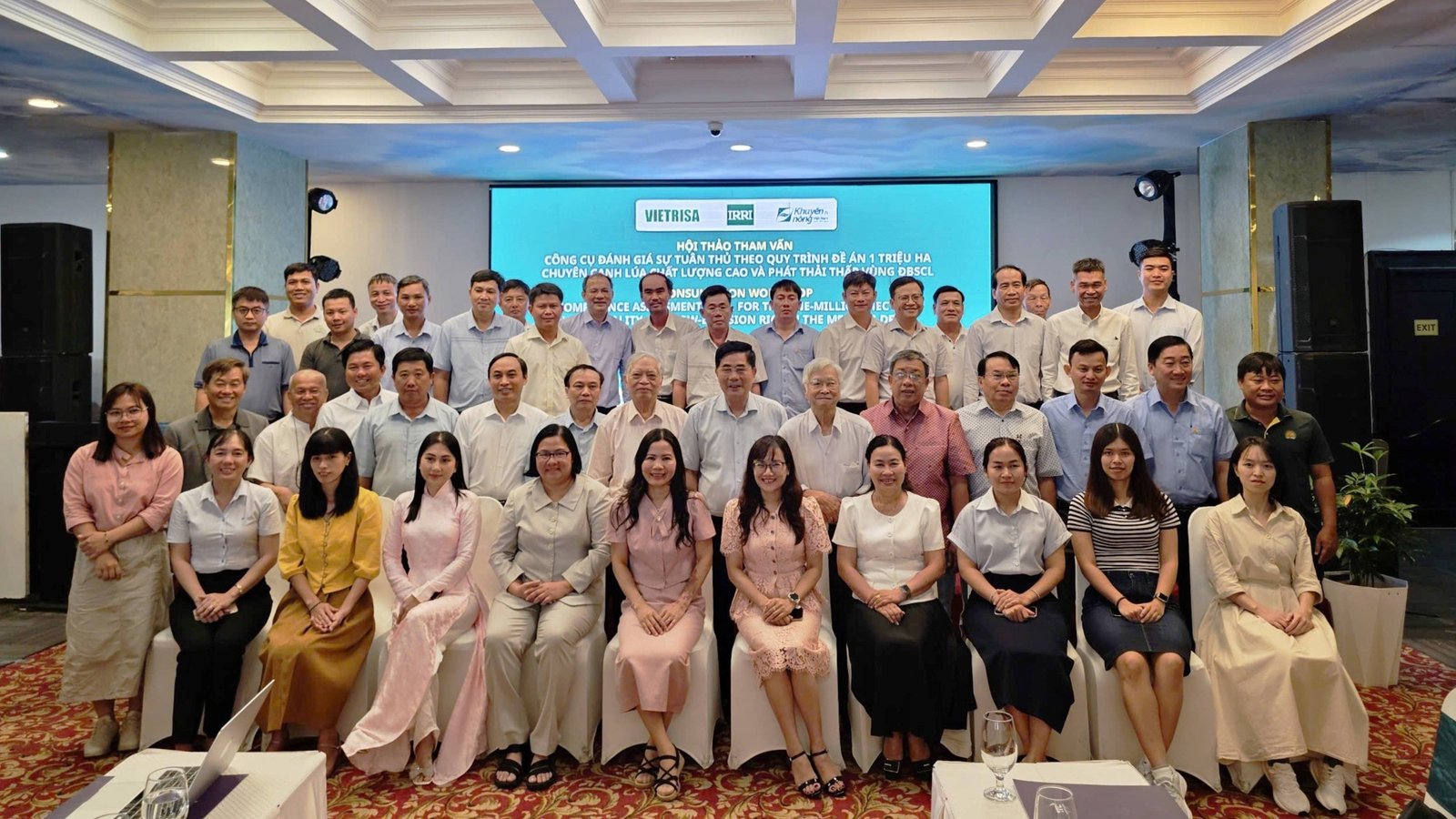
In a major step toward climate-smart rice production, the International Rice Research Institute (IRRI) and the Vietnam Rice Sector Association (VIETRISA) have unveiled ViRiCert, a digital compliance and certification mechanism designed to underpin Vietnam’s flagship One Million Hectares of High-Quality, Low-Emission Rice Programme in the Mekong Delta.
Launched during a multi-stakeholder consultation workshop, ViRiCert is positioned as a scalable, data-driven tool to transform how sustainable rice cultivation is measured, verified, and rewarded—moving the sector closer to transparent, market-aligned climate action.
A digital ‘green compass’ for rice farmers
Developed jointly by IRRI and VIETRISA, with coordination support from the National Agricultural Extension Center (NAEC) and the World Bank, ViRiCert is envisioned as a digital “green compass” that can guide millions of farmers toward low-emission, high-quality production practices.
According to Dr. Bui Ba Bong, Chairman of VIETRISA, the platform offers “an efficient, accurate, objective, and cost-effective mechanism” to assess farmer compliance with climate-smart rice guidelines. Beyond monitoring, the system is designed to create credible proof of sustainability, enabling farmers and enterprises to assert the value of their green rice in domestic and international markets.
“This is not just a measurement tool,” said Le Thanh Tung, Vice Chairman of VIETRISA. “It establishes transparency and lays the foundation for certifying rice under the ‘Vietnam Green – Low-Emission Rice’ label.”
How ViRiCert works
At the core of ViRiCert is a science-based scoring framework built around 10 key practices spanning the entire paddy production cycle—from pre-season water management and land preparation to fertilization, pest control, harvesting, and rice-straw management.
Each practice is scored from 0 to 3, with a maximum total score of 36 points, explained Dr. Nguyen Van Hung, Senior Scientist at IRRI. Crucially, two practices are non-negotiable for certification:
Mid-season drainage applied at least once or twice (each lasting a minimum of three days), and
Zero burning of rice straw in the field.
“These interventions deliver the largest greenhouse gas reductions in rice systems,” Dr. Hung noted, making them central to Vietnam’s climate commitments.
Based on performance, farms are classified into three tiers:
Level 0: Not eligible (compliance below 50 per cent or mandatory criteria unmet)
Level 1: Minimum compliance (≥50 per cent, at least one mid-season drainage, no straw burning)
Level 2 – Full Compliance: ≥85 per cent compliance, at least two drainage cycles, no straw burning—effectively a ‘green passport’ for accessing stringent international markets.
Pilots, branding, and traceability
VIETRISA outlined a near-term rollout plan that leverages extension officers, local technicians, and enterprises as the backbone of farmer support and on-field verification. The first pilot phase will cover around 10 cooperatives, each spanning 500 hectares, with the goal of certifying 20,000 tonnes of rice during the Winter–Spring 2025–26 season.
Experts stressed that certification must be matched with brand protection and traceability. Stakeholders urged swift registration of the “Green Vietnamese – Low-Emission Rice” trademark and the development of an integrated digital traceability system to prevent fraud and maintain consumer trust.
Raising the bar on food safety and value chains
The consultation also surfaced calls for tighter standards. Former Agriculture Minister Dr. Cao Duc Phat proposed reclassifying herbicide and plant protection product residues as a zero-tolerance criterion, reflecting rising consumer sensitivity around food safety. Both Dr. Phat and World Bank representative Cao Thang Binh emphasized that benchmarking should extend beyond the farm gate to include post-harvest handling and the quality and safety of milled rice.
Toward climate-aligned rice exports
With its beta version now live, ViRiCert represents more than a compliance tool—it is an attempt to align Vietnam’s rice economy with global climate, safety, and traceability expectations. By translating best practices into verifiable digital scores, IRRI and VIETRISA are laying the groundwork for a rice value chain where emissions reduction, farmer incentives, and market access move in lockstep.
As rice-exporting nations face growing scrutiny from regulators, buyers, and consumers alike, Vietnam’s ViRiCert may offer a glimpse of the future: certification not as paperwork, but as a strategic gateway to green growth.