Monday, 13 July 2026

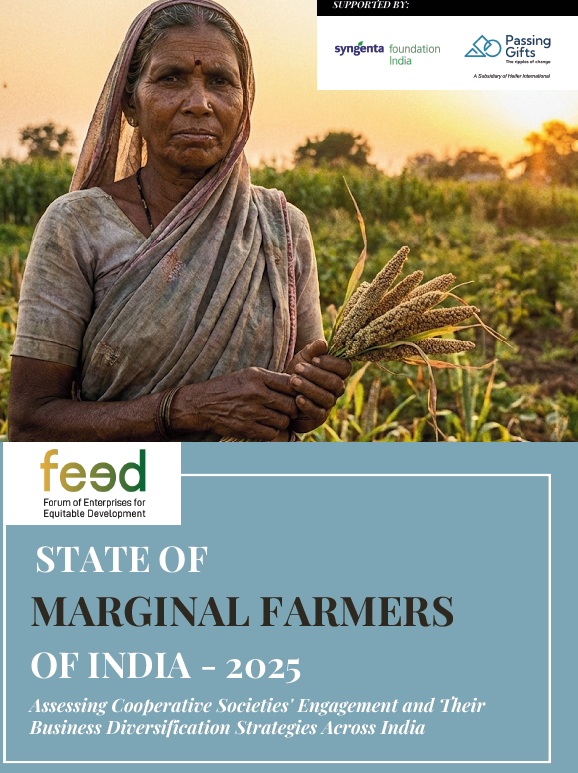
The State of Marginal Farmers in India 2025 underscores PACS as pivotal multi-service rural institutions
India’s New Cooperative Policy 2025 marks a decisive shift toward a mission-driven, farmer-first model, positioning cooperatives as modern, technology-enabled enterprises central to agri-food transformation. A new report, The State of Marginal Farmers in India 2025, assesses the untapped potential of integrating marginal farmers—the largest and most vulnerable segment of India’s agrarian economy—more deeply into the cooperative system.
India’s cooperative ecosystem—globally unmatched in scale and density—forms the backbone of the rural economy. With over 8.2 lakh cooperatives and nearly 29.98 crore members, it spans 98 per cent of rural India. Cooperatives account for 31 per cent of national sugar production, 25 per cent of fertiliser production, and manage 35 per cent of fertiliser distribution. Their financial footprint is equally significant, with rural and urban cooperative banks holding deposits of Rs 6.53 lakh crore and Rs 5.5 lakh crore, respectively. At the grassroots, Primary Agricultural Credit Societies (PACS), with more than 13 crore members, procure 20 per cent of India’s paddy and 13 per cent of its wheat, anchoring national food security.
Against this backdrop, the report examines marginal farmers’ engagement with PACS across six states—Andhra Pradesh, Bihar, Himachal Pradesh, Maharashtra, Tripura, and Uttarakhand. The findings reveal sharp state-level variation in basic awareness of PACS. Awareness is high in Andhra Pradesh (86.2 per cent) and Uttarakhand (71.9 per cent), moderate in Maharashtra (47.6 per cent), and strikingly low in Bihar (22.1 per cent), Himachal Pradesh (31.4 per cent), and Tripura (2.3 per cent). These disparities point to uneven cooperative visibility, outreach capacity, and institutional presence across regions.
While awareness is a necessary first step, it does not consistently translate into participation or service utilisation. The report finds that cooperatives deliver the strongest outcomes where they function as multi-service platforms—combining credit, inputs, marketing support, extension services, and digital tools under one roof. In states where PACS remain single-function, under-capitalised, or weakly staffed, their impact on marginal farmers remains limited.
The report concludes that PACS are highly relevant institutions, but their effectiveness hinges on accessibility, transparency, organisational capacity, and digital enablement. Strengthening PACS as inclusive, well-governed, and digitally empowered rural service hubs—particularly for women and marginal farmers—will be essential to translating India’s vast cooperative scale into durable income growth, resilience, and rural transformation.