Saturday, 20 June 2026

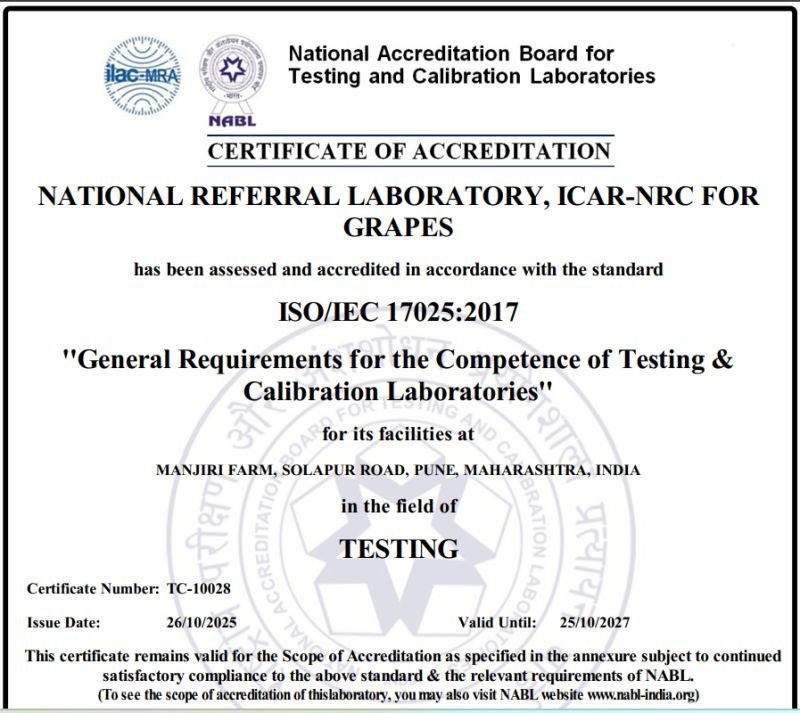
India’s food safety and agri-export testing infrastructure received a major institutional boost as the National Referral Laboratory (NRL) of the ICAR–National Research Centre for Grapes successfully completed the ISO/IEC 17025:2017 renewal assessment conducted by the National Accreditation Board for Testing and Calibration Laboratories (NABL) on 11–12 October 2025. The laboratory has been granted renewed accreditation for a two-year period, from 26 October 2025 to 25 October 2027.
As part of the renewal, the laboratory significantly expanded its accredited testing scope, nearly doubling its pesticide residue analysis capability from 351 to 779 pesticides. The expanded scope covers an extensive range of agricultural and food matrices, including fresh fruits and fruit products, fresh vegetables and vegetable products, cereals and pulses, spices and herbs, nuts and nut products, oils and fats, oilseeds and by-products, milk and dairy products, as well as tea and coffee. This expansion substantially strengthens the laboratory’s ability to support national food safety surveillance, regulatory compliance, and export certification requirements.
The enhanced accreditation aligns closely with the regulatory frameworks of the Food Safety and Standards Authority of India (FSSAI) and the Agricultural and Processed Food Products Export Development Authority (APEDA), reinforcing India’s capacity to meet stringent domestic and international food safety standards. For exporters, the expanded scope translates into faster, more comprehensive testing support across multiple commodities, reducing compliance risk in increasingly demanding global markets.
With the latest accreditation, ICAR–NRC for Grapes has also achieved a national distinction by holding the highest number of pesticides under the scope of ISO/IEC 17025 accreditation among all government institutions in India. The milestone underscores the centre’s growing role as a critical backbone institution for food safety assurance and export competitiveness in India’s agri-food ecosystem.