Tuesday, 7 July 2026

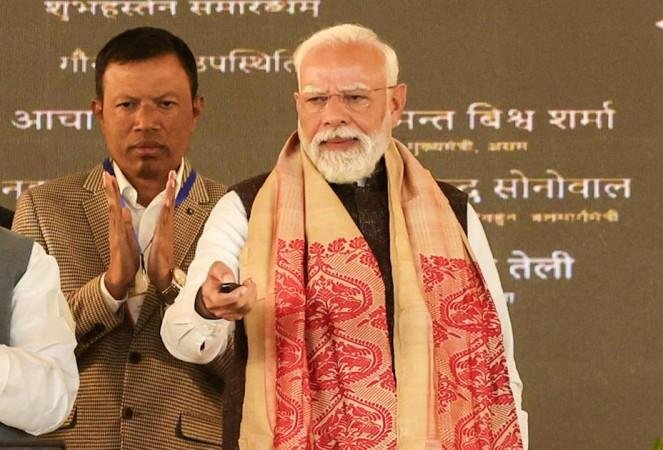
Prime Minister Narendra Modi laid the foundation stone of the Ammonia–Urea Fertiliser Project of Assam Valley Fertilizer and Chemical Company Limited at Namrup in Dibrugarh, positioning the project as a cornerstone of India’s push towards fertiliser self-reliance and Eastern India’s emergence as a new industrial growth engine. The ceremony marked a significant milestone for Assam and the North East, with the Prime Minister framing the investment as both an economic and strategic intervention in India’s farm security architecture.
Addressing a large gathering, Modi said Assam had entered a new phase of development momentum, driven by a combination of industrial revival, infrastructure expansion and agricultural reform. He linked the Namrup project with broader connectivity upgrades, including the inauguration of the new terminal at Guwahati airport, arguing that the convergence of industry and logistics was reshaping the region’s growth prospects. In a developed India, he said, Assam would reclaim a position of economic strength comparable to its historical role during the Ahom era.
The Prime Minister underscored that farmers’ welfare sits at the centre of the government’s policy framework, noting that ensuring uninterrupted fertiliser supply is critical to agricultural stability. The Namrup project, with an investment of around Rs 11,000 crore, is expected to produce more than 12 lakh metric tonnes of fertiliser annually. Localised production, he said, would shorten supply chains, reduce logistics costs and insulate farmers from global price volatility, reinforcing India’s efforts to de-risk its fertiliser imports.
Beyond farm inputs, Modi highlighted the employment potential of the project, stating that the plant would generate thousands of direct and indirect jobs. Permanent local employment, allied services such as maintenance and logistics, and ancillary economic activity were expected to provide new opportunities for youth in the region, reinforcing Assam’s industrial base after decades of stagnation.
The Prime Minister contrasted the current expansion with what he described as years of neglect, recalling that Namrup was once a critical fertiliser hub for the North East before outdated technology and policy inaction led to plant closures. He argued that the shutdowns had hurt farmers’ incomes and weakened regional agriculture, a legacy the current Union and state governments were now reversing. Similar revivals in Gorakhpur, Sindri, Barauni and Ramagundam, he said, illustrated a national turnaround in fertiliser manufacturing.
Modi said India had made substantial progress towards urea self-sufficiency, with domestic production rising from about 225 lakh metric tonnes in 2014 to nearly 306 lakh metric tonnes today, even as annual demand stands at around 380 lakh metric tonnes. He emphasised that despite high global prices, the government continues to shield farmers from cost pressures, subsidising imported urea so that farmers pay roughly Rs 300 per bag while the state absorbs costs running close to Rs 3,000 per bag.
Framing fertiliser security as part of a wider farm-support ecosystem, the Prime Minister pointed to direct income transfers under PM-Kisan, crop insurance coverage, improved procurement systems and expanded access to credit. Nearly Rs 4 lakh crore has been transferred directly to farmers’ accounts under PM-Kisan, while Kisan Credit Card coverage has been extended to livestock and fisheries, with credit support exceeding Rs 10 lakh crore this year alone.
Modi highlighted recent initiatives such as the PM Dhan Dhanya Krishi Yojana and the Dalhan Atmanirbharta Mission, launched this year with an outlay of Rs 35,000 crore, aimed at boosting farm incomes and reducing import dependence. He also cited policy measures such as GST reduction on bio-fertilisers, promotion of natural farming through a national mission, and the creation of 10,000 Farmer Producer Organisations to strengthen aggregation and market access.
The Prime Minister placed special emphasis on the North East, noting targeted interventions such as oil palm expansion to raise farm incomes and reduce edible oil imports, alongside welfare measures for tea garden workers, including universal Jan Dhan account coverage and improved access to public services. He said these initiatives reflected the government’s Sabka Saath, Sabka Vikas vision, which he credited with lifting an estimated 25 crore people out of poverty over the past decade.
Positioning the Namrup fertiliser project as emblematic of this transformation, Modi said Eastern India and the North East are increasingly central to India’s growth story. Fertiliser produced at Namrup will supply not only Assam but also Bihar, Jharkhand, West Bengal and eastern Uttar Pradesh, reinforcing the region’s contribution to national food security. The Prime Minister concluded by asserting that projects of this scale signal the North East’s evolution into a key pillar of a self-reliant India, with Assam at the heart of that transition.