Friday, 10 July 2026

July showers narrow national rainfall deficit from 40 per cent to 15 per cent, but delayed sowing, uneven precipitation and emerging El Niño conditions keep kharif outlook on edge
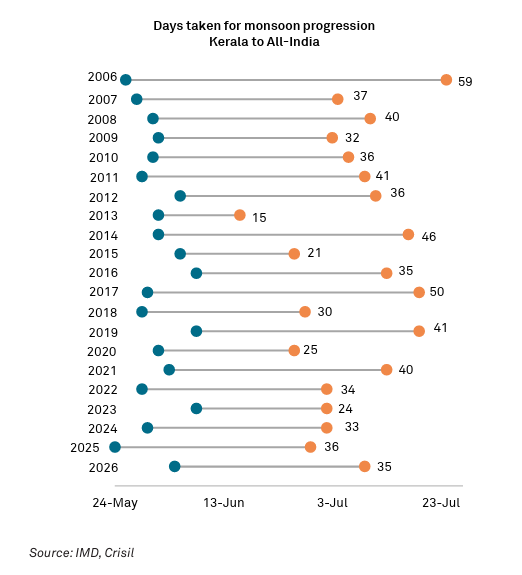
India’s southwest monsoon has staged an impressive comeback after one of the driest starts in recent years, but the dramatic recovery is concealing mounting risks for the country’s agricultural economy. While heavy July rains have sharply reduced the national rainfall deficit and revived hopes for the kharif season, uneven rainfall distribution, delayed sowing and emerging El Niño conditions continue to cast a shadow over crop production, according to Crisil’s latest Deficient Rainfall Impact Parameter (DRIP) assessment. The turnaround has been swift. After recording a severe 40 per cent rainfall deficit in June, the southwest monsoon gathered momentum, reducing the all-India rainfall shortfall to 15 per cent as of July 8. The monsoon also covered the entire country in 35 days, broadly in line with its long-term average, easing immediate concerns over its delayed progress.
However, Crisil cautions that the speed of monsoon advancement should not be mistaken for the strength of the season. Historical evidence suggests that rapid geographical coverage has only a weak correlation with total seasonal rainfall. In both 2019 and 2021, for instance, the monsoon required 40 to 41 days to cover the country, yet both years ultimately delivered healthy rainfall. The real determinant of agricultural performance lies not in how quickly the rains arrive, but in how much rain falls and, more importantly, where and when it is distributed. That distinction assumes greater significance this year.
The India Meteorological Department (IMD) has forecast July rainfall at six per cent below the long-period average. Given the exceptionally heavy rainfall recorded during the first half of the month, the forecast suggests that rainfall could weaken considerably during the remaining weeks of July, potentially interrupting crop establishment during one of the most critical stages of the kharif season. Adding to the uncertainty is the growing influence of El Niño conditions.
Unlike a conventional weak monsoon, El Niño years are often characterised by sharp swings between prolonged dry spells and episodes of excessive rainfall. Such erratic weather patterns can prove equally damaging to agriculture by disrupting sowing schedules, affecting crop establishment, increasing flood risks and creating wide regional disparities in farm output. Crisil notes that June’s 40 per cent rainfall deficit closely mirrors conditions witnessed in 2014, another strong El Niño year. During that season, rainfall shortages persisted through much of the monsoon, resulting in weaker agricultural production. Whether 2026 follows a similar trajectory remains uncertain, but the comparison underscores the importance of rainfall continuity during the remaining monsoon months.
Delayed Sowing Signals Early Stress
The uneven onset of rainfall has already begun affecting farm activity across the country. As of July 5, overall kharif sowing remained approximately 21 per cent below last year’s level, reflecting the delayed arrival of widespread rainfall. The slowdown has affected almost every major crop category, including oilseeds, cotton, pulses, coarse cereals and other cereals. Only a handful of crops have bucked the trend. Sugarcane, jute and mesta have maintained relatively normal sowing progress, supported by better irrigation access and crop-specific growing conditions.
The delayed sowing raises important questions for agricultural productivity. Even if rainfall improves during the second half of the season, shortened crop cycles may still influence yields for several rain-fed crops, particularly in regions where farmers postponed planting due to inadequate early-season moisture.
Rainfall Distribution Remains Highly Uneven
While headline rainfall numbers have improved, the geographical distribution of precipitation continues to reveal significant imbalances. Among the country’s major kharif-producing states, Bihar currently faces the sharpest rainfall deficiency at 53 per cent, followed by Uttar Pradesh at 40 per cent. Punjab and Kerala continue to report deficits of 28-29 per cent, while Karnataka, Haryana, Andhra Pradesh and Telangana remain deficient by 14-17 per cent. In contrast, rainfall conditions have improved considerably across several central and western states.
Rainfall deficits in Gujarat and West Bengal have narrowed substantially to just 5-6 per cent, while Maharashtra, Madhya Pradesh, Rajasthan and Odisha have already recorded surplus rainfall, reflecting the highly uneven nature of this year’s monsoon. Such regional divergence is likely to create significant variations in crop performance, with irrigated regions expected to withstand weather volatility more effectively than predominantly rain-fed farming systems.
DRIP Identifies States Facing the Greatest Agricultural Stress
To assess the real impact of deficient rainfall, Crisil uses its proprietary Deficient Rainfall Impact Parameter (DRIP), an analytical framework it has tracked for nearly 25 years. Unlike conventional rainfall analysis, DRIP combines precipitation data with irrigation coverage, allowing it to estimate the actual vulnerability of crops and states rather than simply measuring rainfall deficits. The latest assessment identifies Karnataka, Bihar, Uttar Pradesh, Andhra Pradesh and Telangana as the states currently facing the highest agricultural stress. Haryana is also experiencing moderate pressure, although relatively stronger irrigation infrastructure helps reduce overall vulnerability. The analysis reinforces a long-established reality of Indian agriculture: rainfall deficiency alone does not determine crop outcomes. Irrigation availability often plays an equally important role in limiting production losses during weak monsoon years.
Crop Risks Vary Sharply Across Commodities
The DRIP assessment also highlights significant differences across crops. Among major kharif crops, tur and coarse cereals are currently experiencing the highest levels of stress due to their greater dependence on timely rainfall and relatively limited irrigation coverage. By comparison, sugarcane remains largely insulated because of extensive irrigation infrastructure, while groundnut and soybean appear relatively resilient under current rainfall conditions. These variations illustrate why aggregate monsoon statistics often fail to capture the full complexity of India’s agricultural landscape, where irrigation access, regional rainfall distribution and crop characteristics combine to shape production outcomes.
A Better Monsoon Does Not Yet Mean a Better Harvest
The sharp recovery in July rainfall has undoubtedly reduced immediate concerns over the southwest monsoon. Yet Crisil’s analysis suggests that the agricultural outlook remains far from secure. Delayed sowing, persistent rainfall deficiencies across several major food-producing states, the possibility of a drier second half of July and the growing influence of El Niño continue to create substantial uncertainty for the kharif season.
For policymakers, agribusinesses and commodity markets, the coming weeks will prove critical. The trajectory of rainfall through the remainder of July and August will determine whether India’s agriculture benefits from the recent revival or whether early-season deficits continue to weigh on production. For now, the monsoon has delivered welcome relief—but not yet the certainty that India’s farm economy needs.