Monday, 8 June 2026

India’s retail food inflation continues to present a mixed picture, with most staple commodities showing remarkable price stability even as tomatoes emerge as a notable outlier, according to the latest weekly retail price data released by the Department of Consumer Affairs (DOCA).
The data for the week ending May 29, 2026, indicates that cereals, pulses and edible oils have largely remained within a narrow price band over the past year, reflecting improved supply conditions and relatively effective market interventions. However, volatility in select horticultural commodities continues to underscore the structural vulnerabilities that characterize India’s fresh produce supply chains.
Among cereals, rice prices remained largely stable at Rs 43.23 per kg, registering a marginal increase of 1.31 per cent compared with the same period last year. Wheat, on the other hand, was priced at Rs 31.05 per kg, down 1.30 per cent year-on-year despite a slight week-on-week increase of 0.39 per cent. The relative stability in cereal prices comes amid robust public procurement, comfortable government stocks and steady market arrivals, helping contain inflationary pressures in key staples.
Pulses, which have remained a focus area for policymakers due to recurring supply concerns, also displayed a largely stable trend. Arhar dal was retailing at Rs 122.47 per kg, down 1.66 per cent from a year ago, while gram dal declined 1.36 per cent to Rs 85.34 per kg. Moong dal prices were virtually unchanged, slipping just 0.35 per cent year-on-year to Rs 111.44 per kg.
Masur dal and urad dal were among the few pulse varieties that recorded annual increases. Masur dal rose 2.18 per cent to Rs 90.04 per kg, while urad dal increased 1.41 per cent to Rs 118.38 per kg. Nevertheless, the overall pulse basket remains significantly less volatile compared with previous years, reflecting improved domestic production and calibrated import policies.
The millet segment also remained largely stable. Jowar prices rose 0.80 per cent year-on-year to Rs 43.95 per kg, while ragi registered a stronger increase of 2.63 per cent, reaching Rs 54.97 per kg. Bajra prices, however, declined marginally by 0.86 per cent to Rs 37.94 per kg. The gradual strengthening of millet prices comes amid continued government efforts to promote nutri-cereals and diversify consumption patterns beyond traditional grains.
The most significant inflationary pressure continues to emanate from edible oils.
Mustard oil prices climbed 11.43 per cent over the past year to Rs 190.23 per kg, while soybean oil recorded a 9.04 per cent increase, reaching Rs 160.79 per kg. Rising global vegetable oil prices, geopolitical disruptions affecting commodity markets and higher import costs have continued to exert upward pressure on domestic edible oil prices despite India’s efforts to boost local oilseed production.
However, it is within the horticulture basket that the sharpest divergence emerges.
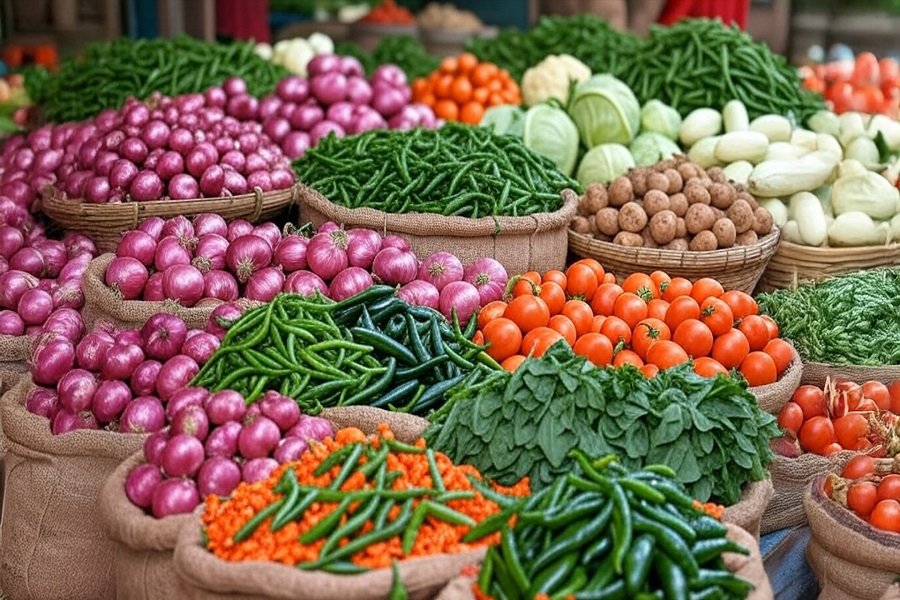
Tomato prices surged to Rs 37.26 per kg, representing a steep 46.23 per cent increase compared with a year ago. On a month-on-month basis alone, tomato prices rose more than 9 per cent, making it the most inflationary commodity in the current retail basket. The increase reflects seasonal supply disruptions and the inherently volatile nature of perishables, which remain highly sensitive to weather fluctuations and logistical bottlenecks.
In contrast, onions and potatoes continue to provide relief to consumers.
Onion prices declined 1.61 per cent year-on-year to Rs 25.67 per kg despite a monthly increase of 2.56 per cent. Potato prices witnessed an even sharper annual decline of 13.48 per cent, falling to Rs 21.25 per kg, although they recorded a 3.41 per cent increase over the previous month.
The contrasting movement among key vegetables highlights a familiar trend in India’s food economy: while cereals and pulses increasingly benefit from policy support, procurement systems and storage infrastructure, perishables remain vulnerable to seasonal disruptions that can trigger abrupt price swings.
From a broader inflation perspective, the latest retail price data suggests that food inflation risks remain largely contained heading into the early stages of the kharif season. The absence of significant price spikes across cereals and pulses offers policymakers some comfort. However, the sharp increase in edible oil prices and the resurgence of tomato inflation indicate that supply-side risks remain present, particularly as weather conditions and monsoon progress will play a critical role in shaping food prices over the coming months.