Thursday, 4 June 2026

Report warns that climate resilience must become a national agricultural priority amid rising climate risks, extreme weather and El Niño concerns.
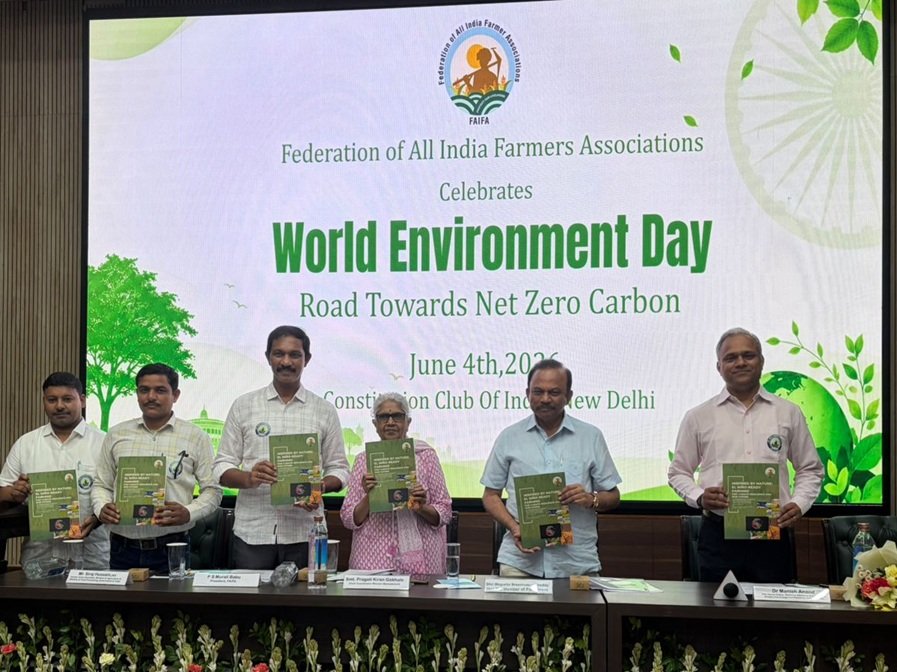
Marking World Environment Day 2026, and as India prepares for an increasingly uncertain agricultural future marked by climate variability, extreme weather events and the growing influence of El Niño conditions, the Federation of All India Farmer Associations (FAIFA) today released a landmark report calling for an urgent transition towards climate-resilient farming systems capable of safeguarding food security, farmer livelihoods and long-term agricultural sustainability.
The report, “Inspired by Nature: El Niño-Ready Farming for Climate Resilience and Our Future,” was released by Magunta Sreenivasulu Reddy, Member of Parliament, Ongole, Andhra Pradesh. The report presents a comprehensive roadmap for addressing some of the most pressing challenges confronting Indian agriculture today. It examines the growing impact of extreme heat, erratic rainfall, soil degradation, groundwater stress and resource-intensive farming practices, while outlining practical pathways for building a more resilient agricultural ecosystem.
Speaking at the event, Reddy said, “The Government of India has taken several significant steps in recent years to promote sustainable agriculture, climate resilience and environmental conservation through initiatives focused on digitisation in agriculture, natural farming, clean energy and farmer empowerment. These efforts have created a strong foundation for building a more resilient agricultural sector. As we mark World Environment Day, it is encouraging to see organisations like FAIFA complementing these efforts through constructive dialogue, knowledge sharing and practical recommendations that can help prepare Indian agriculture for future climate challenges.”
El Niño and its implications for Indian agriculture
A central theme of the report is the growing strategic importance of El Niño and its implications for Indian agriculture. The report notes that El Niño events have historically been associated with weaker monsoons, moisture deficits and increased vulnerability during the kharif season. Against this backdrop, FAIFA argues that agricultural planning must increasingly focus on preparedness, adaptation and risk management rather than reactive responses to climate-related disruptions.
The report advocates a dual transition—ecological and technological—to strengthen resilience across agricultural systems. It calls for restoring soil health, reducing excessive dependence on chemical inputs, improving water-use efficiency, promoting crop diversification and encouraging nature-inspired farming practices that enhance long-term sustainability.
The report’s release comes at a critical time for Indian agriculture. While climate-related disruptions are becoming more frequent and severe, the report highlights that the Government of India has already laid important foundations for building resilience through a range of policy interventions and institutional initiatives. These include the Digital Agriculture Mission, AgriStack, Bharat-VISTAAR, the National Mission on Natural Farming (NMNF), PM-KUSUM, PMFBY, NICRA’s Climate Resilient Villages programme, and women-led rural transformation initiatives such as Krishi Sakhis, Drone Didis, Self-Help Groups, SHE Marts and the expanded Lakhpati Didi programme. Together, these initiatives reflect a strong policy commitment towards sustainable agriculture, digital innovation, resource efficiency and climate adaptation.
India’s transition towards climate-resilient agriculture
Building on these efforts, the report presents a set of recommendations aimed at accelerating India’s transition towards climate-resilient agriculture. Among its key recommendations are the rapid expansion of Bharat-VISTAAR and AgriStack, scaling up women-led natural farming networks through Krishi Sakhis, strengthening technology-enabled crop insurance systems, promoting protective irrigation, expanding climate-resilient villages, accelerating the growth of women-led rural enterprises through initiatives such as Lakhpati Didi, and developing region-specific climate adaptation strategies for high-value agriculture.
At the same time, the report warns that climate risks continue to intensify. According to the report, India experienced extreme weather events on 331 out of 334 days between January and November 2025, affecting more than 17 million hectares of cropped area. The report further highlights alarming trends in soil degradation, citing evidence that 97 per cent of tested soil samples were deficient in nitrogen, while 85 per cent lacked adequate organic carbon—underscoring the urgent need for restorative and sustainable agricultural practices.
Speaking at the seminar PS Murali Babu, President FAIFA said, “Indian agriculture stands at a defining moment. Climate change is no longer a future challenge but a present reality affecting farmers across the country. The findings of this report clearly demonstrate that resilience must become the organising principle of future agricultural development. By combining traditional ecological wisdom, scientific innovation, digital technologies and farmer-centric policies, India has the opportunity to build an agricultural system that is productive, sustainable and prepared for future climate shocks.”
At the same time, the report highlights the transformative potential of emerging technologies in agriculture. It identifies digital public infrastructure, AgriStack, Bharat-VISTAAR, artificial intelligence, satellite monitoring, precision irrigation, remote sensing and weather-based advisory systems as critical tools for improving farm-level decision-making and reducing climate-related risks. According to the report, the future of resilient agriculture will depend on the effective integration of technology with local knowledge and farmer-centric extension systems.
The report also draws attention to India’s rich agricultural heritage, arguing that many traditional farming practices offer valuable lessons for climate adaptation. Crop diversification, mixed farming, intercropping, indigenous water management and community-based resource stewardship are highlighted as approaches that have historically helped farming communities navigate environmental uncertainty and continue to hold relevance in contemporary agricultural systems.
The report concludes that India possesses a unique opportunity to build one of the world’s most resilient agricultural systems by leveraging its traditional agricultural knowledge, scientific institutions, digital infrastructure and policy ecosystem. It calls for coordinated action among governments, research institutions, industry stakeholders and farming communities to accelerate the transition towards a climate-resilient agricultural future.
The event also recognised climate-resilient farmers, young agricultural innovators and sustainable Farmer Producer Organisations that are demonstrating leadership in environmentally responsible farming and resource-efficient agricultural practices. Their contributions were highlighted as examples of how innovation and community action can support India’s broader sustainability objectives.