Thursday, 18 June 2026

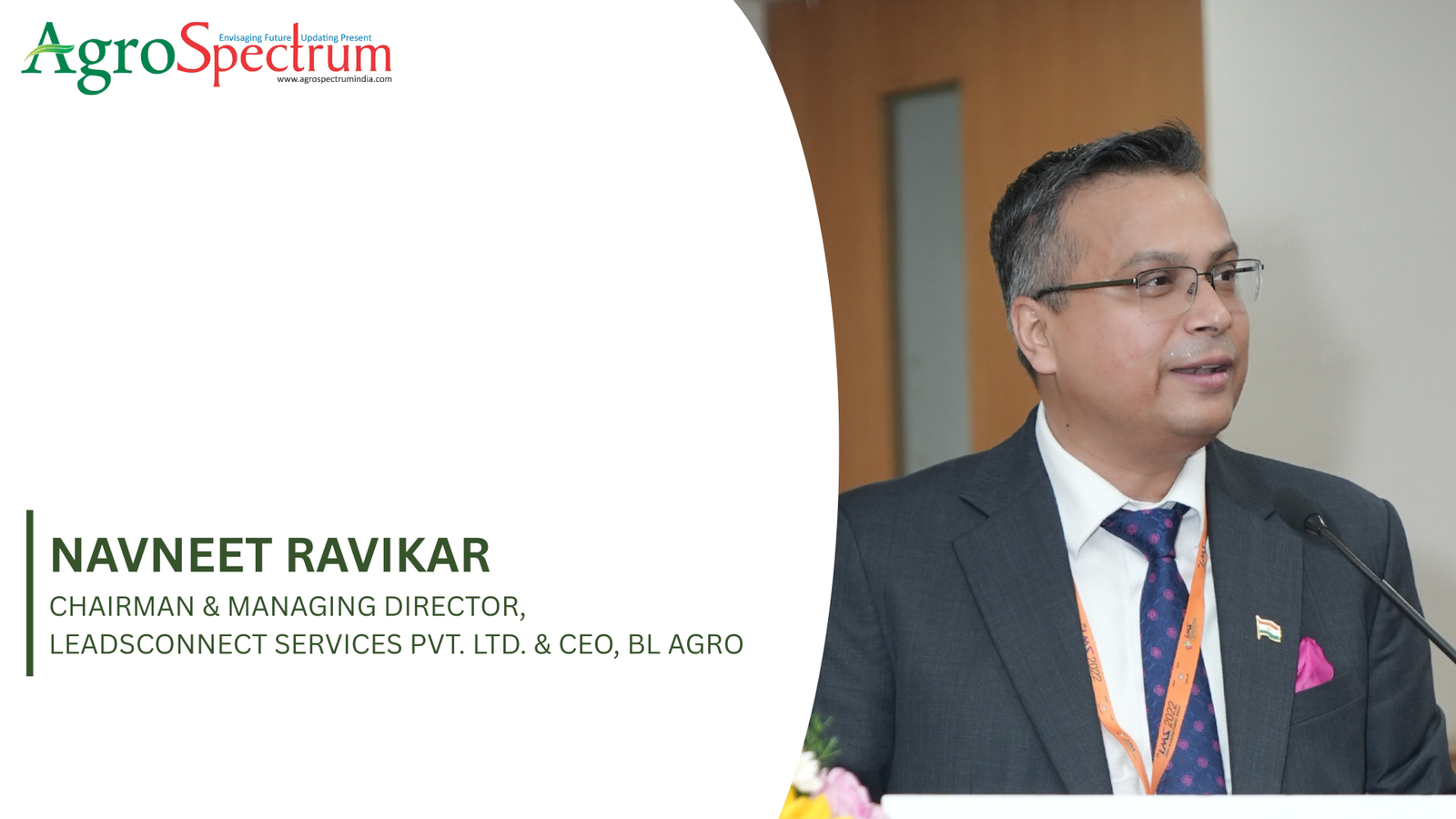
Navneet Ravikar, CMD, LeadsConnect Services Pvt. Ltd. and CEO, BL Agro, positions ICCRI and KEDAR–PARVATI
In an exclusive interview with AgroSpectrum, Navneet Ravikar, Chairman & Managing Director of LeadsConnect Services Pvt. Ltd. and CEO of BL Agro, positions ICCRI and KEDAR–PARVATI as operational intelligence infrastructure rather than traditional dashboards, integrating satellite, financial, and AI-driven analytics for real-time, parcel-level risk insights. He highlights their role as scalable, geography-agnostic systems capable of transforming agricultural risk pricing, governance, and climate resilience across sectors.
Ravikar underscores the Indo–Brazil agri corridor as a strategic South–South collaboration to co-develop AI tailored to tropical agriculture, offering an alternative to Western-centric models. He adds that platforms like ICCRI are poised to evolve into hybrid public digital infrastructure, supporting national agricultural systems while maintaining strong data sovereignty and farmer-centric governance.
You’ve positioned ICCRI and KEDAR–PARVATI as “applied AI at planet scale.” What differentiates your model from traditional agri-tech dashboards — and how does it function as critical infrastructure rather than just analytics software?
Our Integrated Command Centre for Risk Intelligence (ICCRI)- a live, in-house command centre and the recently launched KEDAR–PARVATI platform represent far more than visual dashboards — they are operational intelligence architectures designed for actionable insights, live demonstrations of proprietary intelligence frameworks.
Traditional agri-tech dashboards primarily aggregate and display historical indicators. In contrast, ICCRI, KEDAR–PARVATI and many more products like these, integrate satellite intelligence, hyperlocal analytics, climate and hazard modelling, crop phenomics, actuarial analytics, financial risk engines, and AI-driven modelling frameworks into a unified architecture capable of generating parcel-level insights at massive scale.
Importantly, the platform is already harbouring Operational geoportals including dedicated AgriFinTech products such as AGRANI and Maatri, which enable credit scoring, underwriting analytics, hotspot detection, portfolio monitoring, and financial risk intelligence for banks and financial institutions, and other products including PixStack, DEVI–Saptashati, and Kedar–Parvati. These are not pilot concepts — they are deployed frameworks aligned with ongoing central and state government engagements and institutional partnerships.
What truly differentiates KEDAR–PARVATI KEDAR (Knowledge Engineering & Deviation Analytics for Risk Intelligence) and PARVATI (Phenomics Analytics & Risk Value Assessment for Transferring Intelligence) together form is that it is geography-agnostic and domain-agnostic by design. The architecture is built to seamlessly transition across domains — from agriculture to disaster risk, from crop analytics to actuarial modelling — without dependence on massive retraining datasets. It is capable of generating over a billion land-parcel level insights in a single continuous rendering cycle, supported by dynamic calibration frameworks.
This makes ICCRI closer to national digital infrastructure than an analytics tool. Governments can use it for risk governance and climate resilience planning; financial institutions for capital allocation and exposure mapping; insurers for parametric design; and agribusinesses for value chain optimisation.
In essence, we are shifting agriculture from retrospective reporting to predictive, hyperlocal, intelligence-driven risk mitigation at scale — positioning ICCRI and KEDAR–PARVATI as foundational infrastructure for resilient agricultural economies.
The launch coincided with Brazil’s high-level state visit. How strategic is the Indo-Brazil agri corridor in your global vision, and can South–South AI collaboration become a counterweight to Western-dominated agri platforms?
The timing of ICCRI and KEDAR–PARVATI’s launch during Brazil’s state visit reflects the deep strategic alignment between India and Brazil in shaping technology-led agrarian transformation.
Both countries share remarkably similar agricultural landscapes — vast tropical agro-ecologies, climate variability, and a large base of small and medium farmers who require precision yet affordable solutions. The structural similarities in land systems and farmer demographics make the Indo–Brazil agri corridor not just symbolic, but operationally logical.
This is a strong example of South–South collaboration, where institutions co-develop AI systems tailored to tropical agriculture and inclusive growth — rather than importing models designed primarily for large-scale industrial farming in temperate geographies. As rightly highlighted by
Hon’ble Minister of Agrarian Development and Family Farming, Brazil, Mr. Paulo Teixeira, during his visit to our office for the launch, Brazil requires scalable risk intelligence and value-chain solutions of this nature — and we are committed to building and deploying them jointly.
By co-creating these platforms, we are not merely strengthening bilateral ties; we are contributing to an alternative global model of AI-enabled agricultural resilience rooted in shared realities of the Global South.
Risk intelligence is fast becoming the backbone of agricultural finance. How does real time climate, crop and financial modelling change how banks, insurers, and governments price agricultural risk?
Real-time risk intelligence transforms risk from a reactive cost to a quantifiable variable that can be actively managed. By integrating climate forecasts, yield projections, market volatility signals, and credit scoring, underwriting analytics, hotspot detection, portfolio monitoring, and financial risk intelligence indicators, banks and insurers can price risk with a much higher degree of precision, underwritten by data rather than broad heuristics. This enables institutions to extend credit and insurance with better confidence, reduce default rates, and design products that are equitable for smallholders. Governments can leverage the same analytics for disaster response, targeted subsidies, and climate adaptation planning.
You integrate satellite intelligence, field analytics, financial modeling, and LLM/SLM modules into one architecture. What governance and validation frameworks ensure that AI-driven recommendations remain accurate, unbiased, and farmer-centric?
Our governance approach is built on transparent model validation, human-in-the-loop oversight, and continuous field calibration. We have multilayered feedback mechanisms where field level outcomes feed back into model refinement; AI outputs are benchmarked against independent ground truth data with strong accuracy; and agricultural experts continuously review recommendation sets to ensure they are actionable and context relevant. Importantly, we adhere to strict data governance standards so that actionable insights improve outcomes without replacing domain expertise or farmer judgment.
Agriculture contributes significantly to GDP but remains vulnerable to climate volatility. Can AI meaningfully de-risk farming at scale—or does it simply make uncertainty more measurable?
AI’s strength is that it reduces uncertainty by quantifying it. By converging climatic data with crop, soil, and economic variables, AI does not eliminate risk — but it significantly sharpens visibility into risk patterns at scale. This enables stakeholders to take preventative and adaptive actions rather than reactive ones. In practice, this leads to earlier drought warnings, optimized input application, better credit decisions, and more robust supply chain planning — all of which cumulatively reduce systemic vulnerabilities.
Data sovereignty is emerging as a geopolitical issue. As you expand into Brazil and potentially other regions, who owns the agricultural data generated on your platforms — the farmer, the state, or the enterprise?
Data sovereignty is central to our architecture. Farmers and sovereign institutions retain ownership rights of their data — the enterprise acts as a custodian tasked with secure processing and analytics.
This means:
Data collected from farms remains under farmer control.
Aggregated and anonymized insights can be used by governments for public planning in various project we partner with.
Enterprises can operationalize analytics, but access and sharing are governed by consent, compliance, and privacy safeguards.
This framework aligns ethical stewardship with utility.
The corridor begins with the cashew value chain in collaboration with EMBRAPA. Why start with cashew, and how does value-chain digitization—from plantation science to structured markets —create a replicable global model?
Cashew Pulp (Cashew Apple) offers a compelling entry point because it has high latent value and complex systemic inefficiencies, especially in fiber utilization — a challenge that technology can directly address. Both India and Brazil are among the world’s largest cashew producers, yet nearly 80–85% of the cashew apple pulp produced alongside the nut in India goes to waste. This represents a massive untapped bio-economic opportunity.
We identified this as a critical gap — particularly in India — where there is currently no large scale technological implementation focused on upcycling cashew apple fibre into high value food products. Through our collaboration with EMBRAPA and Amazonika Mundi, we aim to bring proven Brazilian food-processing technology and plantation science expertise to India, effectively converting waste into structured value.
Our 360° model integrates plantation science, AI-enabled farm advisory, value-chain analytics, financial services, sustainable processing through patented fibre technology, and structured market integration. By digitizing and linking every node — from farm to processing to markets — we are building a full-stack, intelligence-driven value chain.
What makes this globally relevant is its replicability. Once a traditionally inefficient commodity ecosystem is digitized and structurally optimized, the same architecture can be extended to other crops and geographies. Cashew is not just the starting point — it is the proof of concept for a scalable, waste-to-wealth, AI-enabled agro-industrial model.
Looking toward 2047 and beyond, do you see AI-enabled command centers like ICCRI becoming public digital infrastructure embedded within national agricultural systems — or remaining enterprise-led innovation engines driving private-sector transformation?
We envision a hybrid future where AI-enabled command centres like ICCRI are ready to become part of the national agricultural digital backbone, interoperable with public data ecosystems and accessible to multiple stakeholders — while enterprise innovation continues to drive speed, scale, and domain depth.
ICCRI is architected to seamlessly align with Government of India initiatives such as Agri Stack and VISTAAR, which aim to create structured digital public infrastructure for agriculture. Our platform complements further to these frameworks by adding hyperlocal risk intelligence, financial analytics, climate modelling, and parcel-level insights that can strengthen public policy planning, targeted subsidy design, crop insurance frameworks, and credit delivery systems.
The objective is not to position enterprise systems outside public infrastructure, but to ensure interoperability, data sovereignty, and transparent governance, where private innovation enhances national capability. By 2047 and beyond, we see such command centres functioning as trusted digital infrastructure — enabling resilient, intelligence-driven agricultural economies at scale.
— Suchetana Choudhury (suchetana.choudhuri@agrospectrumindia.com)