Tuesday, 30 June 2026

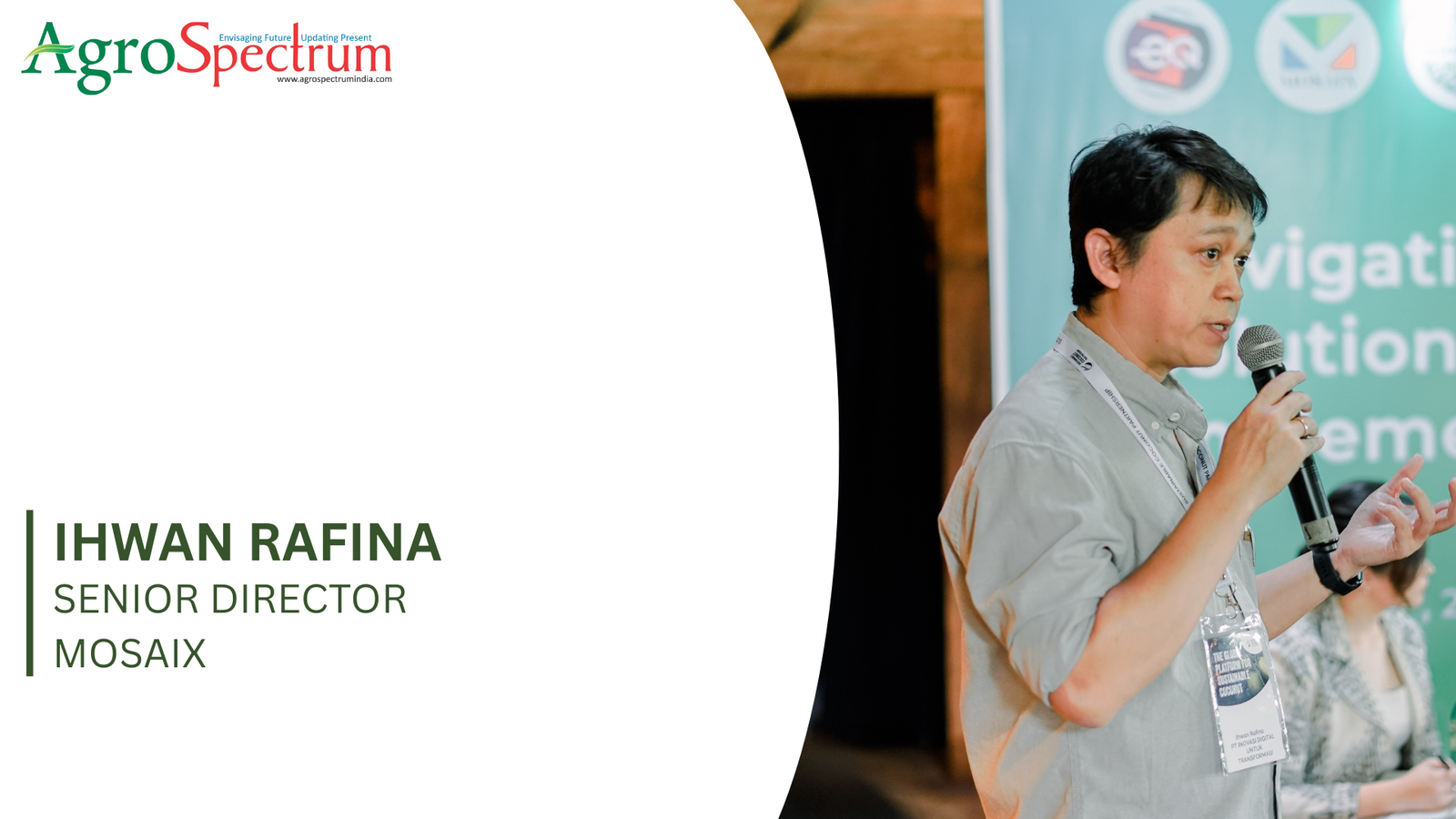
MosaiX Senior Director says fragmented supply chains and weak data governance pose deeper challenges than technology alone
In an exclusive interaction with AgroSpectrum, Ihwan Rafina discusses how the European Union Deforestation Regulation (EUDR) is reshaping global cocoa supply chains and exposing the structural complexities of compliance in producer countries like Ecuador. The interview examines the critical gaps in land tenure, traceability, and data governance that continue to challenge smallholder-driven cocoa economies despite rapid advances in digital compliance systems.
Rafina also highlights the importance of moving beyond simplistic deforestation narratives toward plot-level, evidence-based due diligence models that can balance environmental accountability with on-ground socio-economic realities. Addressing the risks of supplier exclusion, he argues for remediation-focused sustainability frameworks that enable non-compliant producers to transition toward acceptable standards rather than being permanently shut out of global markets. The conversation further explores how EUDR may create a more segmented global cocoa trade, positioning Ecuador as a potentially strong but execution-sensitive origin in the emerging hierarchy of compliant suppliers.
Structural Risk vs Regulatory Threshold
The European Union Deforestation Regulation sets a binary compliance bar—deforestation-free or not. Yet Ecuador’s cocoa economy operates in shades of informality. How do you reconcile this mismatch between regulatory rigidity and on-ground complexity?
EUDR is binary at the border, but cocoa systems are not. The practical reconciliation is to treat compliance as a risk-segmentation exercise, not a moral yes/no judgment: plots and suppliers that are already traceable and legally documented move first, while higher-risk segments need phased remediation, targeted support, and temporary market separation. That is especially relevant in Ecuador, where cocoa is highly smallholder-based and the sector is still building national traceability and due-diligence capacity.
Land Tenure Informality as a Systemic Bottleneck
With nearly 92 per cent of cocoa land unregistered, is land tenure the single largest constraint to EUDR compliance, or are we underestimating other risks like fragmented supply chains and data integrity?
Land tenure is a major bottleneck, but probably not the only or even always the single largest one. The “92 per cent unregistered” figure is based on the desktop analysis from a public database, so it’s a precautionary approach. In practice, tenure interacts with two other constraints that are just as decisive under EUDR: fragmented supply chains and weak data governance. Ecuador’s readiness work has focused not only on legality, but also on traceability design, governance mechanisms, and due-diligence tools, which suggests the constraint is systemic rather than purely cadastral.
Traceability: technology vs. reality
EUDR assumes plot-level geolocation and traceability at scale. In a smallholder-dominated ecosystem, how feasible is full-stack traceability, and where do current digital solutions fall short—data capture, verification, or interoperability?
Full-stack traceability is feasible for organised suppliers, cooperatives, and better-structured exporters, but much harder across atomised intermediated trade. EUDR requires geolocation, including GPS points for plots under 4 hectares and polygons above 4 hectares, plus legality checks and forest/protected-area overlays. Ecuador has pilots moving in that direction, but current gaps are usually not the technology itself, they are field data capture quality, verification cost, and interoperability between trader, exporter, and public systems. It’s a people issue as much as a technology one. To achieve full traceability, you need people on the ground to verify it, and that’s a huge undertaking that will take time and resource.
Deforestation attribution complexity
Your findings suggest cocoa is not the primary driver of large-scale deforestation, yet it remains exposed to compliance risks. How should companies approach deforestation attribution, especially in landscapes with overlapping land-use histories?
Companies should avoid simplistic commodity blame and instead use plot-based, time-bound attribution. Cocoa in Ecuador is often linked to agroforestry systems and is not always the main driver of large-scale forest conversion, but EUDR exposure still exists where farm boundaries intersect post-2020 forest loss or unclear land-use histories. So the right question is not “is cocoa the main driver nationally?” but “can this specific plot be evidenced as deforestation-free and legal since the cutoff date?”. The approach needs to be focused on gathering and verifying this evidence.
Protected area overlaps and legal ambiguity
The overlap of cocoa plots with protected reserves raises difficult questions. In cases where livelihoods and legality collide, how should stakeholders navigate grey zones between conservation policy and socio-economic reality?
Where cocoa overlaps with protected or restricted areas, companies should separate legal compliance from livelihood response. EUDR does not create an exception for socio-economic hardship, so non-compliant supply cannot simply be waved through. But the answer should not be exclusion only, it should combine legal screening, case-by-case remediation pathways, support for transition, and engagement with local authorities where boundaries, rights, or historic occupation are contested. For multinationals operating beyond Europe, excluding non-compliant suppliers isn’t the only option – and from a sustainability perspective, exclusion can be counterproductive. The non-compliant cocoa doesn’t disappear, it simply ends up in less regulated markets.
While the EUDR does not have a path to redemption, having a mechanism for remediation built into NDPE policies that allows for suppliers to be brought back into the fold once they have met the required standards is one of the best ways to drive impact. These suppliers can then be included in non-EU supply chains.
Due diligence as capability, not compliance
Most companies treat due diligence as a reporting exercise. Your framework suggests a shift toward operational capability. What does it take to move from static compliance checklists to dynamic, continuously auditable systems?
The shift is from static documentation to an operating system: continuous supplier onboarding, geodata validation, risk scoring, protected-area and deforestation overlays, document management, incident handling, and audit trails. Ecuador’s recent EUDR readiness work is useful precisely because it tested national risk assessment, due-diligence guidance, and pilot tools in real conditions. That is the right direction, compliance as an ongoing capability, not a one-off file.
Market access and competitive realignment
Do you see EUDR creating a two-tier global cocoa market—where compliant origins gain preferential access and others are structurally excluded? Where does Ecuador sit in that emerging hierarchy?
Yes, EUDR is likely to create a more segmented cocoa market. Origins and supply sheds with stronger organisation, cleaner traceability, and better legality evidence will gain faster access to EU buyers, while others risk discounting or diversion to less regulated markets. Ecuador is relatively well positioned compared with many origins because it has a strong export sector, active EUDR readiness programmes, and a large agroforestry cocoa base, but that advantage is conditional on execution at farmer and intermediary level.
From Ecuador to global replicability
To what extent are the risks identified in Ecuador representative of other cocoa-producing regions like West Africa or Southeast Asia? What lessons can be generalized versus those that remain highly context-specific?
Ecuador’s risks are partly generalisable and partly unique. The general lessons, smallholder fragmentation, traceability cost, legality gaps, and the need for interoperable systems, are highly relevant to West Africa and Southeast Asia. The context-specific part is Ecuador’s stronger agroforestry profile and different deforestation dynamics compared with frontier expansion landscapes elsewhere. So Ecuador is a useful model for systems design, but not a one-to-one template for all cocoa origins.
— Suchetana Choudhury (suchetana.choudhuri@agropsectrumindia.com)