Saturday, 11 July 2026

Volatility across states intensifies as sharp monthly spikes and steep corrections coexist; annual trend remains moderately positive
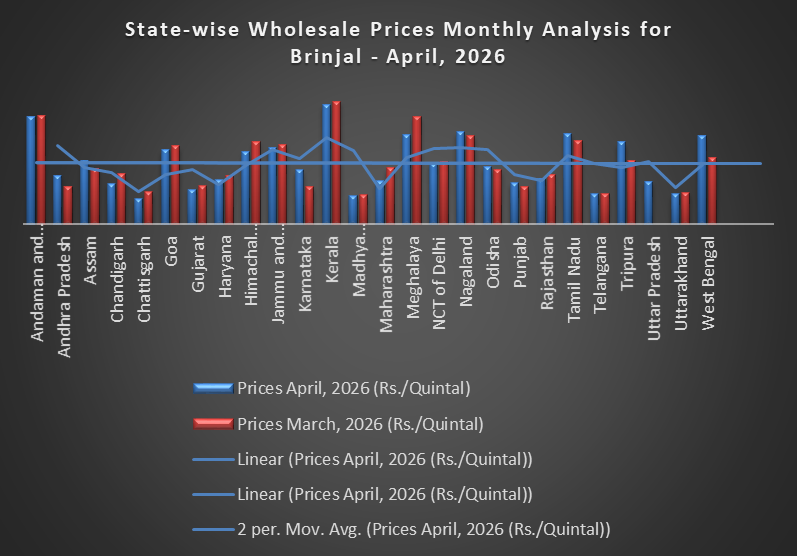
Wholesale brinjal prices across India displayed heightened volatility in April 2026, with the national average remaining largely stable at Rs 2,119.76 per quintal, marginally down from Rs 2,135.34 in March 2026, but higher than Rs 1,970.73 in April 2025. The data highlights a fragmented market marked by sharp regional divergences, strong monthly fluctuations, and mixed year-on-year trends.
Extreme Monthly Volatility Across States
Price movements in April were sharply polarized. Karnataka recorded the steepest increase of 43.2 per cent, with prices rising to Rs 1,877.96 from Rs 1,311.06 in March. West Bengal followed with a 32.5 per cent surge, while Tripura (30.6 per cent) and Andhra Pradesh (29.4 per cent) also saw strong gains.
Moderate increases were observed in Assam (14.5 per cent), Punjab (9.6 per cent), Tamil Nadu (8.8 per cent), and Odisha (5.9 per cent), indicating localized demand strength or supply constraints.
However, several states witnessed steep corrections. Maharashtra reported a sharp 23.0 per cent decline, while Chhattisgarh (-21.1 per cent) and Chandigarh (-20.9 per cent) also saw significant drops. Meghalaya (-16.8 per cent) and Himachal Pradesh (-12.5 per cent) further underscored the uneven market conditions.
Wide Price Dispersion Highlights Regional Imbalances
Significant inter-state price variation persisted in April. Kerala recorded the highest price at Rs 4,152.90 per quintal, followed by Andaman and Nicobar Islands (Rs 3,737.70), Nagaland (Rs 3,200.00), and Tamil Nadu (Rs 3,160.41).
At the lower end, Chhattisgarh reported the lowest price at Rs 890.68, followed by Madhya Pradesh (Rs 980.60) and Telangana (Rs 1,046.93), reflecting relatively better supply conditions in central markets.
Year-on-Year Trends Show Mixed Momentum
On an annual basis, the market showed moderate growth overall, but with sharp contrasts across states. Madhya Pradesh recorded the highest increase of 95.7 per cent, indicating a near doubling of prices from April 2025 levels.
Other significant annual gains were seen in Goa (76.7 per cent), Punjab (58.5 per cent), Haryana (47.1 per cent), NCT of Delhi (45.2 per cent), and Jammu and Kashmir (43.2 per cent).
At the same time, several states reported declines. Meghalaya saw the steepest drop of 30.0 per cent, followed by Maharashtra (-25.5 per cent), Gujarat (-19.1 per cent), Odisha (-18.4 per cent), and Nagaland (-16.0 per cent). West Bengal remained largely stable with a marginal 1.7 per cent decline.
Market Dynamics: Supply Swings Drive Volatility
The sharp divergence in both monthly and annual trends suggests that brinjal markets are being driven by localized supply-demand imbalances, seasonal arrivals, and regional consumption patterns.
While some states experienced supply tightening—triggering price spikes—others saw improved arrivals leading to corrections. The absence of uniform price movement underscores the highly perishable nature of the crop and its sensitivity to short-term disruptions.
Outlook: Continued Volatility Likely
With the national average remaining stable but underlying volatility intensifying, the brinjal market is expected to remain highly dynamic in the near term. Regional disparities, weather conditions, and supply chain efficiencies will continue to play a decisive role in price movements.