Monday, 25 May 2026

Led by Mahindra & Mahindra, the market saw strong share gains from Tractors and Farm Equipment Limited and CNH Industrial, while smaller players lost ground amid intensifying competition and sector consolidation.
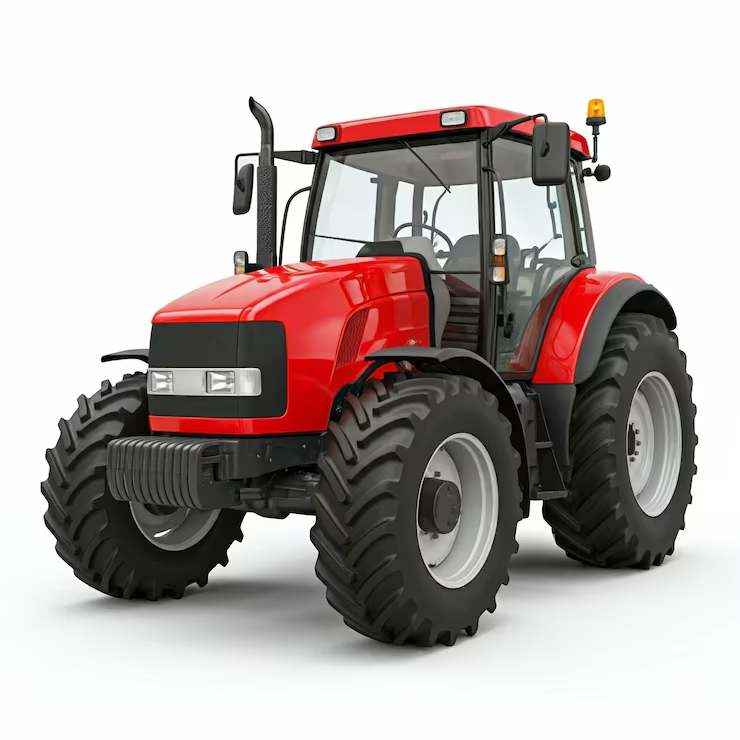
India’s tractor retail market sustained its growth momentum in March 2026, with total sales rising to 82,080 units from 74,032 units a year ago, marking a 10.87 per cent increase, according to Federation of Automobile Dealers Associations (FADA). The expansion reflects resilient rural demand, supported by seasonal agricultural activity and steady on-ground conversions.
Mahindra & Mahindra retained market leadership, with its tractor division clocking 19,652 units (up 11.71 per cent) and a marginal market share gain of 0.18 per cent to 23.94 per cent. Its Swaraj division followed closely, growing 11.51 per cent to 16,007 units, with share inching up 0.11 per cent to 19.50 per cent, reinforcing the group’s dominant position.
Among key gainers, Tractors and Farm Equipment Limited (TAFE) emerged as a standout, posting 20.13 per cent growth—one of the highest among major players—while expanding market share significantly by 0.79 per cent to 10.34 per cent. Escorts Kubota Limited also strengthened its position, with 16.11 per cent growth and a 0.49 per cent rise in share to 10.87 per cent.
International Tractors Limited (Sonalika) reported solid volume growth of 10.01 per cent to 10,194 units, though it experienced a slight market share erosion of 0.10 per cent, signaling rising competitive pressure. John Deere India similarly saw share dip by 0.11 per cent to 7.87 per cent, despite a 9.31 per cent increase in volumes.
At the lower end, Eicher Tractors recorded modest growth of 2.42 per cent, but its market share declined sharply by 0.47 per cent to 5.68 per cent. In contrast, CNH Industrial (New Holland) delivered the strongest growth in the market at 29.95 per cent, with share expanding by 0.70 per cent to 4.79 per cent, highlighting aggressive gains in a competitive segment.
The “Others” category saw the steepest correction, with sales declining 17.85 per cent and market share dropping significantly by 1.60 per cent to 4.58 per cent, indicating ongoing consolidation within the industry.
The data underscores a market increasingly driven by share shifts rather than just volume expansion, with leading players strengthening their positions through distribution, financing, and product strategies. As rural demand remains stable, the sector appears poised for continued, competitive growth in the coming quarters.