Friday, 17 July 2026


Rise in pulses, coarse cereals and oilseeds offsets decline in rice acreage; overall sowing inches up 0.48 lakh hectares
India’s summer crop sowing has registered a modest increase in the current season, with total acreage rising to 58.29 lakh hectares as of April 3, 2026, compared with 57.80 lakh hectares during the corresponding period last year, reflecting a net increase of 0.48 lakh hectares.
The incremental expansion, though marginal, underscores a shifting crop pattern, with farmers increasingly tilting towards pulses, coarse cereals, and oilseeds, even as rice acreage witnessed a noticeable decline.
Rice, the largest summer crop by area, saw sowing fall to 30.12 lakh hectares from 32.59 lakh hectares a year ago, marking a decline of 2.47 lakh hectares. The contraction in rice acreage suggests a possible recalibration by farmers, driven by water constraints, input costs, and evolving price signals.
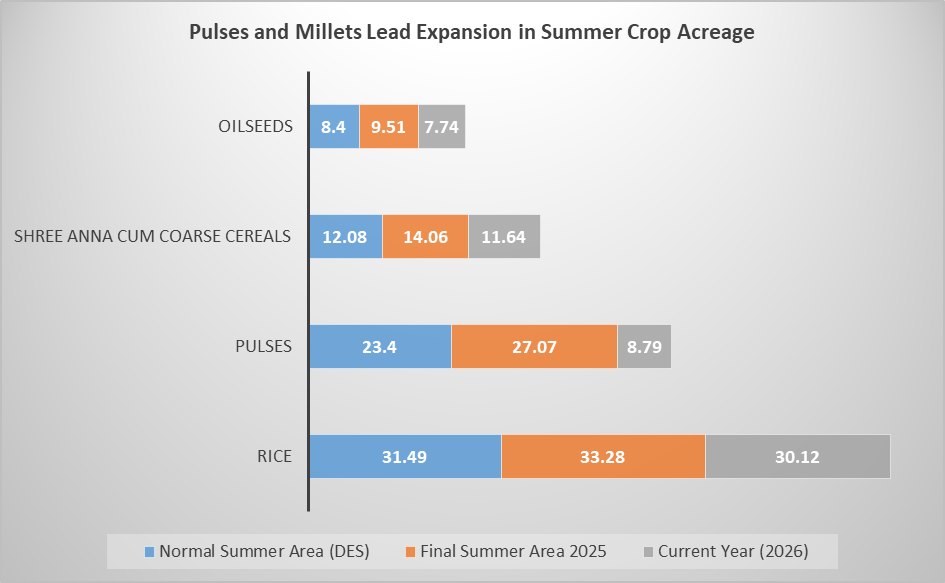
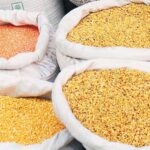
In contrast, pulses emerged as a key driver of growth, with total acreage rising by 1.77 lakh hectares year-on-year to 8.79 lakh hectares. Within the segment, greengram accounted for a significant share of the increase, expanding by 1.18 lakh hectares to 6.09 lakh hectares, while blackgram acreage rose by 0.49 lakh hectares to 2.42 lakh hectares. The expansion in pulses reflects both policy support and sustained demand, particularly amid efforts to enhance domestic protein availability and reduce import dependence.
Coarse cereals, classified as Shree Anna, also recorded a healthy increase of 0.87 lakh hectares, with total sowing reaching 11.64 lakh hectares. Bajra led the growth within this category, expanding by 0.76 lakh hectares, while maize continued to maintain steady traction with a rise of 0.17 lakh hectares. The broader momentum in millets aligns with the government’s push to promote climate-resilient crops and diversify India’s food basket.
Oilseeds too registered a moderate increase of 0.31 lakh hectares, with total area sown at 7.74 lakh hectares. Groundnut remained the dominant contributor, with acreage rising by 0.39 lakh hectares to 4.59 lakh hectares, indicating strong farmer preference. Sunflower also posted a marginal increase, while sesamum saw a slight decline, reflecting crop-specific adjustments based on market conditions and regional factors.
The overall sowing pattern points to a gradual but discernible shift in agricultural priorities, with farmers responding to a combination of climatic realities, government incentives, and market dynamics. The expansion in pulses, millets, and oilseeds suggests a move towards crops that are relatively less water-intensive and offer better resilience under changing weather conditions.
At the same time, the decline in rice acreage highlights ongoing structural challenges, including water availability and cost pressures, which continue to influence cropping decisions. Given rice’s central role in India’s food system, any sustained reduction in area will need to be closely monitored for its implications on output and supply.
Compared with last year’s final summer acreage of 83.92 lakh hectares, the current sowing levels indicate that significant planting activity is still underway, and the coming weeks will be critical in determining the overall seasonal outcome.
In a broader context, the data reflects the evolving nature of India’s agricultural landscape, where traditional cropping patterns are gradually giving way to more diversified and sustainability-oriented choices. While the increase in total area remains modest at this stage, the composition of growth offers important signals about the direction in which Indian agriculture is headed.
— Suchetana Choudhury (suchetana.choudhuri@agrospectrumindia.com)