Tuesday, 7 July 2026

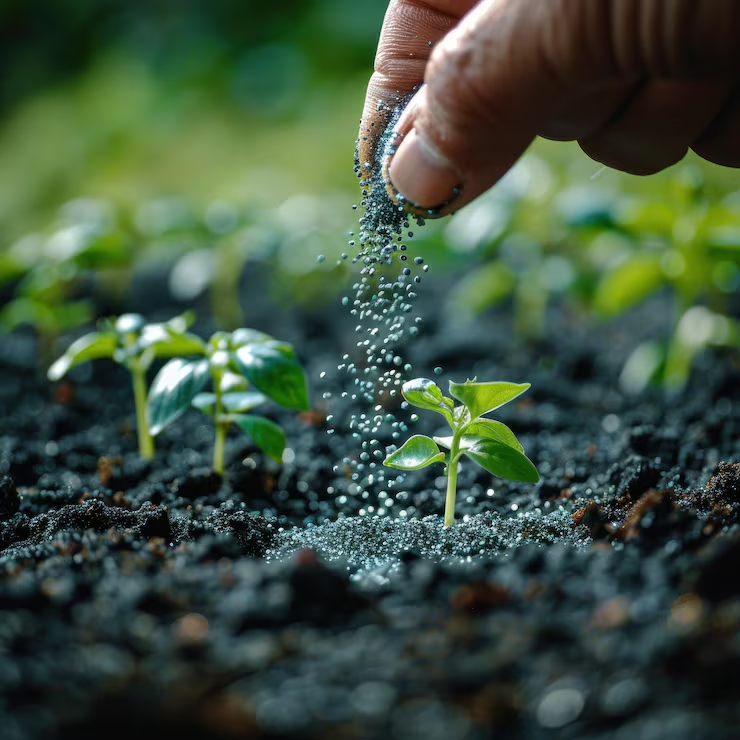
Current stocks stand at 53.08 LMT of Urea, 21.80 LMT of DAP, 7.98 LMT of MOP, and 48.38 LMT of NPKS
The Government of India has reaffirmed its commitment to safeguarding agricultural productivity, confirming that fertiliser availability remains more than adequate to meet demand during the ongoing Rabi 2025–26 season and beyond. As of 23 March 2026, national reserves stood at 53.08 lakh metric tonnes (LMT) of urea, 21.80 LMT of diammonium phosphate (DAP), 7.98 LMT of muriate of potash (MOP), and 48.38 LMT of complex fertilisers (NPKS), underscoring a well-buffered supply position across all major nutrient categories.
This surplus position is further reinforced by supply-demand dynamics during the season. Against a pro-rata requirement of 192.20 LMT of urea between October 2025 and March 2026, availability reached 250.26 LMT, with sales at 197.21 LMT—leaving a comfortable closing stock. Similarly, DAP availability stood at 74.74 LMT against a requirement of 52.80 LMT, while MOP and NPKS also recorded substantial supply buffers, with availability exceeding requirements by 3.84 LMT and 34.39 LMT respectively. These figures highlight not only adequate provisioning but a deliberate policy of maintaining strategic reserves.
Import Strategy and Global Partnerships Strengthen Supply Chain Resilience
India’s continued reliance on imports for urea and phosphatic fertilisers has been strategically managed through long-term international partnerships. A notable development is the agreement between Indian entities—including KRIBHCO, IPL, and CIL—and Saudi Arabia’s Maaden for the annual supply of 31 LMT of DAP and NPK over a five-year period from 2025–26 to 2029–30.
Country-wise import data reveals a diversified sourcing strategy. For urea, key suppliers include Oman (15.50 LMT in 2025–26 till February), Russia (13.99 LMT), and Saudi Arabia (5.27 LMT), while China remains a significant contributor across DAP (5.11 LMT) and NPK (9.61 LMT). Russia also dominates in potash (12.97 LMT MOP imports), alongside notable contributions from Canada (4.82 LMT). Morocco and Saudi Arabia remain central to DAP imports, supplying 17.56 LMT and 24.36 LMT respectively during the current fiscal period to date.
The breadth of sourcing—from regions including West Asia, North Africa, Eastern Europe, and Southeast Asia—illustrates a deliberate hedging strategy against geopolitical and supply chain disruptions.
Domestic Capacity Expansion Drives Self-Reliance in Urea Production
India’s fertiliser policy over the past decade has significantly enhanced domestic production capacity, particularly in urea. Under the New Investment Policy (NIP) 2012 and its subsequent amendment, six new urea plants have been commissioned, collectively adding 76.2 LMT per annum to capacity. Each plant operates at 12.7 LMT annually and incorporates advanced, energy-efficient technologies.
These include joint venture units at Ramagundam, Gorakhpur, Sindri, and Barauni, alongside private sector facilities at Panagarh and Gadepan. As a result, total indigenous urea production capacity has increased from 207.54 LMT in 2014–15 to 283.74 LMT in 2023–24.
Further expansion is underway. The Talcher fertiliser project, based on coal gasification, and a newly approved brownfield ammonia-urea complex in Assam—also with a capacity of 12.7 LMT per annum—are expected to deepen domestic manufacturing strength.
Policy Reforms Deliver Record Output and Efficiency Gains
Complementing capacity expansion, the New Urea Policy (NUP) 2015 has driven operational efficiencies across 25 gas-based plants, resulting in an additional annual output of 20–25 LMT. This has contributed to a record urea production of 314.07 LMT in 2023–24, compared to 225 LMT in 2014–15. Production remained robust at 306.67 LMT in 2024–25, indicating sustained high output levels.
Nutrient-Based Subsidy Framework Enhances Market Flexibility
For phosphatic and potassic fertilisers, the Nutrient Based Subsidy (NBS) scheme continues to underpin pricing and availability. By placing these fertilisers under the Open General Licence regime, the policy allows companies flexibility in import and production decisions based on market conditions.
Recent policy refinements have expanded the number of fertiliser grades under NBS from 22 in 2021 to 28, while guidelines issued in January 2024 aim to ensure reasonable maximum retail prices and incentivise domestic production. Additionally, freight subsidies for single super phosphate (SSP), introduced from Kharif 2022, have boosted indigenous alternatives.
Subsidy Shield Maintains Farmer Affordability Amid Global Volatility
Despite fluctuations in global fertiliser prices, Indian farmers remain insulated through targeted subsidy mechanisms. Urea continues to be sold at the statutorily fixed price of Rs 242 per 45 kg bag. For DAP and other P&K fertilisers, additional financial support—amounting to Rs 3,500 per metric tonne—has been extended during Kharif 2025 and Rabi 2025–26 to offset logistics costs, GST, and ensure reasonable returns for suppliers.
Outlook: Strategic Balance Between Imports and Domestic Growth
The convergence of high stock levels, expanded domestic capacity, diversified import channels, and sustained policy support positions India’s fertiliser sector on a stable footing. While import dependence persists in certain segments, particularly phosphatic and potassic nutrients, ongoing investments and policy reforms are steadily narrowing the gap.
With agricultural demand expected to remain strong, the government’s multi-pronged approach—balancing global sourcing with domestic production and farmer-centric subsidies—signals a resilient and forward-looking fertiliser ecosystem.