Friday, 12 June 2026

Five-year partnership to align research, vocational training and farmer extension with national skill and climate priorities
In a significant public-private collaboration aimed at transforming rural livelihoods, the Indian Council of Agricultural Research (ICAR) has signed a landmark Memorandum of Understanding (MoU) with Dr. Reddy’s Foundation (DRF) to strengthen agricultural vocational training, farmer extension systems and climate-smart capacity building across rural India.
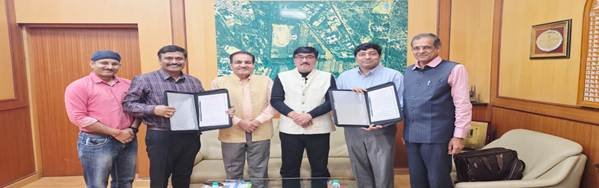
The MoU was formalized at the ICAR-National Academy of Agricultural Research Management (ICAR-NAARM) in Hyderabad, marking what officials described as a strategic step toward institutional convergence between scientific research and grassroots implementation. The initiative is being undertaken under the guidance of Dr. M.L. Jat, Secretary, Department of Agricultural Research and Education (DARE) and Director General, ICAR, with coordination facilitated by Dr. Anil Kumar, Assistant Director General (Coordination), ICAR.
Senior representatives from both organizations were present at the signing ceremony in Rajendra Nagar, Hyderabad, where the MoU documents were formally exchanged by Mr. Suman S., Director (Rural Livelihoods), DRF, and Dr. Rajbir Singh, Deputy Director General (Agricultural Extension), ICAR.
A Strategic Framework for Skills and Sustainability
Under the agreement, ICAR and DRF will collaborate to design and deliver vocational training programs in agriculture and allied sectors, strengthen extension systems and scale climate-smart farming models. A key focus will be capacity building of small and marginal farmers through DRF’s Lead Farmers Platform (LFP) model, integrating ICAR’s technical expertise with community-based extension.
The partnership will also support skill development programs aligned with the National Skill Qualification Framework (NSQF), enhancing youth employability in agriculture and life sciences. Joint research initiatives on sustainable farming practices and climate resilience will be scaled through ICAR’s scientific network and DRF’s grassroots outreach.
Leveraging Institutional Strengths
ICAR brings nearly a century of expertise in agricultural research, education, extension and policy support. With a nationwide network of 113 institutes and 74 universities, it operates one of the world’s largest national agricultural research systems.
DRF, the family trust established by Dr. Reddy’s in 1996, has impacted over two million lives through programs spanning rural livelihoods, vocational training, education and healthcare. Its flagship MITRA program has enabled more than 80,000 farmers across multiple states to adopt improved agricultural practices, demonstrating the effectiveness of its farmer-to-farmer extension model. In December 2025, DRF was recognized by the National Council for Vocational Education and Training (NCVET) as an Awarding Body, enabling it to assess and certify learners in approved qualifications.
Focus Areas: From Soil Health to Market Linkages
The collaboration will prioritize several intervention areas:
Vocational Skill Development: Industry-aligned agri-skill programs leveraging DRF’s NCVET recognition.
Soil Health to One Health Transition: Promotion of biochar-based and soil biologics-led solutions, sustainable crop residue management and carbon incentivization within climate-resilient agri-food systems.
Disaster Risk Reduction: Technology-enabled extension to promote regenerative agriculture and locally tailored climate-risk mitigation strategies.
Extension and Market Access: Scaling the Lead Farmers Platform to bridge last-mile gaps while enhancing market linkages, digital literacy and price realization for smallholders.
Alignment with National Priorities
The partnership aligns with flagship national initiatives including Skill India Mission, Pradhan Mantri Kaushal Vikas Yojana (PMKVY), the National Agricultural Education Policy and climate-smart agriculture commitments. Integration with the National Credit Framework (NCrF) will enable learners to accumulate and transfer credits, supporting both professional advancement and academic mobility.
Programs under the MoU will initially be rolled out in Andhra Pradesh, Telangana, Bihar, Madhya Pradesh, Himachal Pradesh and Uttar Pradesh, leveraging ICAR research stations, Krishi Vigyan Kendras (KVKs) and DRF’s field centers.
Governance and Timeline
The agreement, effective February 16, 2026, will remain valid for five years, with provisions for renewal based on performance evaluation. A joint monitoring committee will oversee implementation, track milestones and ensure quality standards.
Officials described the partnership as a blueprint for mainstreaming quality skill development in agriculture by integrating research rigor with scalable community engagement. By combining ICAR’s scientific backbone with DRF’s grassroots delivery model, the collaboration aims to create measurable, long-term impact on farmer incomes, youth employability and climate resilience—at a time when India’s rural economy is seeking both productivity gains and sustainable pathways to growth.